Epoetin Beta
Indications
Registered South African indications:
- Anaemia
- Increase yield in autologous blood donations
Cautions
Contraindications
- Hypersensitivity to the active ingredient or any of its excipients
- Poorly controlled hypertension
- For the indication of increasing yield in autologous blood donations: myocardial infarction or stroke in the month preceding treatment; unstable angina pectoris; risk factors for deep venous thrombosis
Cautions
- Pregnancy
- Breastfeeding
- Renal impairment
- Hepatic impairment
- Elderly
- Refractory anaemia with excess blasts in transformation
- Epilepsy
- Anaemia associated with cancer
- Anaemia associated with hepatitis C
- Thrombocytosis
- Folic acid deficiency
- Vitamin B12 deficiency
- Chronic inflammation
- Existing hypertension
- Nephrosclerotic patients not yet undergoing dialysis
- Risk of shunt thrombosis
- Severe aluminium toxicity
- Suspected or confirmed to have neutralising antibodies to erythropoietin (Pure red cell aplasia secondary to any erythropoietin product)
- Pre-existing malignancy
- Preterm infants
- Misuse
- Increase in platelets >150 x 109/l or if platelets rise above the normal range
- Phenylketonuria
Adult dosage
Anaemia associated with chronic kidney disease (CKD)
Correction phase
- SC: 20 IU/kg, 3 times a week OR 60 IU/kg/week; Titrate by 3 x 20 IU/kg/week at intervals of 4 weeks; Max: 720 IU/kg/week
The weekly dose can also be divided into daily doses
Titration should only be considered if the increase of packed cell volume is <0.25g/dl/week
- IV: 40 IU/kg, 3 times a week; To achieve a packed cell vol. of between 30-35 % the dosage may be titrated after 1 month to 80 IU/kg, 3 times a week; Titrate further by 20 IU/kg/dose, 3 times a week, at intervals of 4 weeks, if needed; Max: 720 IU/kg/week
IV solution should be injected over 2min
Maintenance phase: to maintain the HB value of approx. 10-12g/dl
- IV: Halve the correction phase dosage that was reached; Titrate at intervals of 2-4 weeks (See additional prescribing points)
- SC: Halve the correction phase dosage that was reached; Titrate at intervals of 2-4 weeks; Weekly dosage can be given once a week or in 3-7 divided doses
A haematocrit level of 35 % should not be exceeded
Patients who are stable on a once weekly
dosage regimen may be switched to once every two weeks administration
Treatment with epoetin beta is normally a long-term therapy. It can, however, be interrupted, if necessary, at any time
Symptomatic anaemia in cancer patients
Correction phase
- SC: Initial: 30 000 IU (thirty thousand IU)/week (approx. 450IU/kg/week), given as once a week dosing or divided into 3-7 divided doses or; Treatment duration: 4 weeks after the end of chemotherapy; Max: 60 000 IU (sixty thousand IU)/week
Epoetin beta is recommended when Hb <11g/dl (6.83mmol/l). Hb levels should not exceed 12 g/dl (8,07 mmol/l)
If after 4 weeks of therapy, the Hb value has increased by ≥1g/dl (0,62 mmol/l), the current dose should be continued
Titration: Double weekly dose after 4 weeks if the Hb value has not increased by ≥1g/dl (0,62 mmol/l)
If after 8 weeks of therapy, the Hb value has not increased by ≥1g/dl (0,62 mmol/l), response is unlikely and treatment should be discontinued
Once the therapeutic objective for an individual patient has been achieved, the dose should be reduced by 25–50 % in order to maintain Hb at that level. Further dose reduction may be instituted to ensure that the Hb level does not exceed 12 g/dl (7,44 mmol/l)
If rise in Hb is >2g/dl/month down titrate dosage by 25-50%
Increasing the yield of donated autologous blood
- SC: Calculated dosage according to graph below, twice a week; Treatment duration: 4 weeks; Max: 1200 IU (one thousand two hundred IU)/week
- IV: Calculated dosage according to graph below, twice a week; Treatment duration: 4 weeks; Max: 1600 IU (one thousand two hundred IU)/week
Dosage must be determined by the surgical team, individually for each patient, as a function of the required amount of pre-donated blood and the endogenous red cell reserve:
- The required amount of pre-donated blood depends on the anticipated blood loss, use of blood conserving procedures and the physical condition of the patient.
- This amount should be that quantity which is expected to be sufficient to avoid homologous blood transfusions. Assuming a PCV of 40 %, 200 ml red blood cell volume is equivalent to 500 ml whole blood or 300 ml erythrocyte concentrate.
- The required amount of pre-donated blood is expressed in units whereby one unit in the nomogram is equivalent to 180 ml red cells. - The ability to donate blood depends predominantly on the patient’s blood volume and baseline PCV.
- Both variables determine the endogenous red cell reserve, which can be calculated according to the following formula:
Endogenous blood cell reserve = blood volume [ml] x (PCV – 33) ÷ 100
Men: blood volume [ml] = 44 [ml/kg] x body weight [kg] + 1 600 [ml]
Women: blood volume [ml] = 41 [ml/kg] x body weight [kg] + 1 200 [ml]
(body weight ≥ 45 kg)
The single dose should be determined from the required amount of pre-donated blood and the endogenous red cell reserve according to the following graphs:
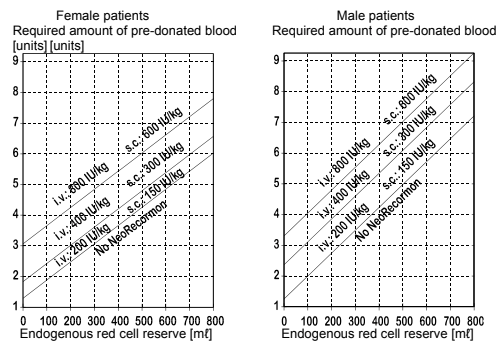
On those occasions where the patient's packed cell volume (PCV) allows blood donation, i.e. PCV ≥ 33%, dosage is administered at the end of blood donation
During the entire treatment period, a PCV of 48% should not be exceeded
IV solution should be injected over 2 minutes
Paediatric dosage
Paed. forms avail. in SA and covered in this monograph: inj
Prophylaxis of anaemia of prematurity
- SC: 250 IU/kg, 3 times a week; Treatment duration: 6 weeks
Epoetin beta treatment should start as early as possible, preferably at day 3 of life
Premature infants who have already been transfused by the start of treatment are not likely to benefit as much as untransfused infants
Special populations
Pregnancy
- Caution
- For epoetin beta no clinical data on exposed pregnancies are available. Caution should be exercised when prescribing to pregnant women
Breastfeeding
- Caution
- It is unknown whether epoetin beta is excreted in human milk. A decision on whether to continue/discontinue breastfeeding or to continue/discontinue therapy with epoetin beta should be made taking into account the benefit of breastfeeding to the child and the benefit of epoetin beta therapy to the woman
Fertility
- Animal studies do not indicate direct or indirect harmful effects with respect to fertility, pregnancy, embryonal/foetal development, parturition or postnatal development
Renal impairment
Hepatic impairment
Elderly
Porphyria Information
Drugs in Sport
-
Prohibited - At all times
Adverse reactions
Central Nervous System Disorders
- Headache
- Confused state
- Seizures
- Malaise
Cardiovascular Disorders
- Hypertension
- Hypertensive crisis
- Shunt thrombosis
- Thromboembolic event
Endocrine and Metabolic Disorders
- Fever
Musculoskeletal Disorders
- Bone pain
- Pain in limbs
Skin and Subcutaneous Tissue Disorders
- Rash
- Pruritis
- Urtcaria
- Injection site reactions
- Stevens-Johnson syndrome
- Toxic epidermal necrolysis
Immune, Blood and Lymphatic System Disorders
- Thrombocytosis
- Pure red cell aplasia
- Decreased ferritin values (premature infants)
- Decreased serum iron (Patients with cancer)
- Anaphylactoid reactions
- Increased serum potassium
- Increased serum phosphate
- Flu-like symptoms
Sensory Disorders
- Sensorimotor disorders
- Speech disturbance
Interactions
No information available
Monitoring
- Haemoglobin levels
- Blood pressure
- Serum electrolytes
Specific cases may require
- Platelet count
Prescribing points
Intravenous Administration
- In case of intravenous administration, the solution should be injected over approximately 2 minutes, e.g. in haemodialysis patients via the arteriovenous fistula, at the end of dialysis
- For non-haemodialysed patients, subcutaneous administration should always be preferred in order to avoid puncture of peripheral veins
Treatment of anaemic patients with chronic renal failure
- In chronic kidney disease patients, the aim of treatment is to reach a target Hb level of 10–12 g/dl
- In the presence of hypertension or existing cardiovascular, cerebrovascular or peripheral vascular diseases, the weekly increase in the Hb and the target Hb should be determined individually, taking into account the clinical picture
- Patients should be monitored closely to ensure that the lowest dose of epoetin beta is used to provide adequate control of the symptoms of anaemia
Special dosage instructions
- Results of clinical studies in children have shown that children need significantly higher dosages than adults and that, on average, the younger the patients, the higher the epoetin beta doses required. Nevertheless, the recommended dosing schedule should be followed as the individual response cannot be predicted
Instructions for use/handling
- Remove one syringe from the pack and check that the solution is clear, colourless and practically free from visible particles. Remove the cap from the syringe
- Remove one needle from the same compartment of the pack, fix it on the syringe and remove the protective cap from the needle
- Expel air from the syringe and needle by holding the syringe vertically and gently pressing the plunger upwards. Keep pressing the plunger until the amount of epoetin beta solution in the syringe is as prescribed
- Clean the skin at the site of injection using an alcohol wipe. Form a skin fold by pinching the skin between the thumb and forefinger. Hold the syringe barrel near to the needle, and insert the needle into the skin fold with a quick, firm action. Inject the epoetin beta solution. Withdraw the needle quickly and apply pressure over the injection site with a dry, sterile pad
Other
- In order to ensure effective erythropoiesis, iron status should be evaluated for all patients prior to and during treatment and supplementary iron therapy may be necessary and conducted in accordance with therapeutic guidelines
- Lack of effect: The most common reasons for incomplete response to erythropoietin stimulating agents (ESAs) such as epoetin beta are iron deficiency and chronic inflammation (e.g. due to uraemia or advanced metastatic cancer). The following conditions may also compromise the effectiveness of ESAs therapy: chronic blood loss, bone marrow fibrosis, severe aluminium overload due to treatment of renal failure, folic acid or vitamin B12 deficiencies, and haemolysis. If all the conditions mentioned are excluded and the patient has a sudden drop of haemoglobin associated with reticulocytopenia and anti-erythropoietin antibodies,examination of the bone marrow for the diagnosis of Pure Red Cell Aplasia (PRCA) should be considered. If PRCA is diagnosed, therapy with epoetin beta must be discontinued and patients should not be switched to another ESA
- Therapy with Epoetin Beta should be initiated by physicians experienced in the pathologies for which the drug is approved and indicated
- As anaphylactoid reactions were observed in isolated cases, it is recommended that the first dose be administered under medical supervision
Mechanism of action
Epoetin beta is identical in its amino acid and carbohydrate composition to erythropoietin that has been isolated from the urine of anaemic patients. Erythropoietin is a glycoprotein that stimulates the formation of erythrocytes from its committed progenitors. It acts as a mitosis stimulating factor and differentiation hormone. Epoetin beta administration results in increases in the number of erythrocytes, Hb values and reticulocyte counts as well as the 59Fe-incorporation rate.
Dosage forms
- Injection
- Pre-filled syringe
Formulation
Injection (per 0.3ml) 2000iu
- Recormon pre-filled (Roche) originator
Injection (per 0.3ml) 4000iu
- Recormon pre-filled (Roche) originator
Injection (per 0.3ml) 6000iu
- Recormon pre-filled (Roche) originator
Injection (per 0.6ml) 10000iu
- Recormon pre-filled (Roche) originator
Injection (per 0.6ml) 30000iu
- Recormon pre-filled (Roche) originator
References
1. Recormon PI: https://drive.google.com/drive/u/0/folders/0B0xnChtF7vduWmxYNS1jQ3h3Vm8 Date of Registration: 25 Nov 2011 2. SmPC: Neorecormon Solution for Injection in Pre-Filled Syringe, Roche Products Limited: Last updated on eMC: 29 Mar 2018; Downloaded online 10 July 2019 [https://www.medicines.org.uk/emc/product/1538/smpc] 3. NAPOS The Drug Database for Acute Porphyria: [http://www.drugs-porphyria.org/languages/UnitedKingdom/s1.php?l=gbr] Accessed online: 10 July 2019 4. South African Institute for Drug-Free Sport; Recormon Injection; Accessed online 10 July 2019 [http://www.drugfreesport.org.za/online-medication-check/] 5. SmPC: NeoRecormon 10,000 IU solution for injection in pre-filled syringe (Roche Products Limited) , Last updated on emc: 03 Feb 2020 ; Downloaded on 10/3/2020 [https://www.medicines.org.uk/emc/product/10496/smpc] 6. Clinical Pharmacologist - Dr. M Irhuma [https://trello.com/c/rMS5bjHg/321-list-of-hot-monographs]
Brands & products
9 products · stale NAPPI snapshot · refreshed 5/28/2026 · 159 days oldinjectionGeneric· 9 products
from R950.62/unit| Product | Strength | Pack | Sched | SEP | Unit | Disp fee | NAPPI |
|---|---|---|---|---|---|---|---|
| Mircera 30 Μg/ 0.3Ml | 30 μg | 0 | S4 | R950.62 | R950.62 | R224.31 | 717044001 |
| Mircera prefilled syringe 0.3ml | 50 mcg/0.3ml | 0 | S4 | R1747.19 | R1747.19 | R310.71 | 712562001 |
| Mircera prefilled syringe 0.3ml | 75 mcg/0.3ml | 0 | S4 | R2506.71 | R2506.71 | R352.01 | 712563001 |
| Mircera prefilled syringe 0.3ml | 100 mcg/0.3ml | 0 | S4 | R2530.81 | R2530.81 | R353.32 | 712564001 |
| Mircera prefilled syringe 0.3ml | 120 μg | 0 | S4 | R3873.87 | R3873.87 | R426.35 | 717045001 |
| Mircera prefilled syringe 0.3ml | 150 mcg/0.3ml | 0 | S4 | R4785.34 | R4785.34 | R475.91 | 712565001 |
| Mircera prefilled syringe 0.3ml | 250 mcg/0.3ml | 0 | S4 | R4833.52 | R4833.52 | R478.53 | 712568001 |
| Mircera prefilled syringe 0.3ml | 200 mcg/0.3ml | 0 | S4 | R4833.52 | R4833.52 | R478.53 | 712567001 |
| Mircera prefilled syringe 0.6ml | 360 μg | 0 | S4 | R7190.49 | R7190.49 | R606.68 | 717046001 |
- Recormon
Medical aid coverage
data not yet integrated- Comprehensive Series—
- Executive Plan—
- KeyCare Series—
- Priority Series—
- Saver Series—
Formulary scraper pending — coverage tier, co-pay and authorisation requirements will appear here once data is ingested.
- BonClassic—
- BonComprehensive—
- BonEssential—
- BonFit Select—
- BonSave—
- BonStart—
Formulary scraper pending — coverage tier, co-pay and authorisation requirements will appear here once data is ingested.
- Beryl—
- Emerald—
- Onyx—
- Ruby—
- Sapphire—
- Tanzanite One—
Formulary scraper pending — coverage tier, co-pay and authorisation requirements will appear here once data is ingested.
- Aquarium Option—
- Efficiency Option—
- Marine Option—
Formulary scraper pending — coverage tier, co-pay and authorisation requirements will appear here once data is ingested.