Abnormalities of the First Stage of Labour
The guidelines recommend management of common obstetric conditions at primary and referral level, based on local experience and evidence-based practice. They are not intended as strict protocols nor as standard operating procedures, but rather as a guide to safe effective management of common obstetric problems. The guidelines should be most useful to interns, medical officers and registrars.
Poor progress in the active phase
Meconium staining of the liquor
Oxytocin for augmentation of labour
PROLONGED IN THE LATENT PHASE
The latent phase is prolonged when it exceeds 8 hours.
Management of suspected prolonged latent phase
- Exclude other causes of abdominal pain, e.g. abruptio placentae, urinary tract infection, chorio-amnionitis
- Exclude false labour – characterised by no cervical changes and no increase in strength, regularity or frequency of labour pains. Women in false labour may be discharged home if there are no other obstetric problems
- If the woman is in the latent phase of labour, & after excluding fetal distress & obvious cephalopelvic disproportion, perform ‘stretch & sweep’, rupture the membranes and/or start an oxytocin infusion as for the active phase of labour.
POOR PROGRESS IN THE ACTIVE PHASE
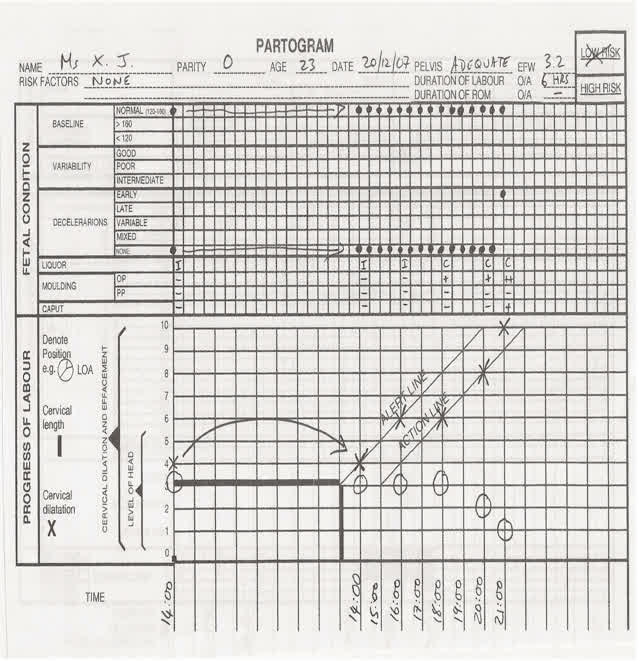
Labour is prolonged if the cervix dilates at <1 cm/hour (crosses the alert line). Partograms illustrating poor labour progress are shown below.
- Use the rule of 4 Ps in the assessment – Patient (bladder, hydration, psychological state, pain), Powers, Passage, Passenger
- Exclude conditions requiring immediate caesarean section:
- Cephalopelvic disproportion (big baby, short woman, increasing grade of lambdoid & sagittal suture moulding with no descent)
- Malpresentation: breech presentation, face presentation, transverse lie
- Fetal distress, run a CTG tracing
- Ensure adequate hydration: start an intravenous infusion of Ringer-Lactate to run at 125 mL/hour (non-cardiac, non-hypertensive women)
- Ensure that the bladder is empty; catheterize if necessary
- Give analgesia, epidural or pethidine/morphine
- Rupture the membranes if still intact
- In nulliparas, consider oxytocin infusion; use oxytocin in multiparas only if certain that there is no cephalopelvic disproportion.
MECONIUM STAINING OF THE LIQUOR
Thin meconium staining (no solid particles) requires no specific management. Thick meconium staining is associated with an increased risk of fetal distress:
- Monitor the fetus with a CTG if available
- When the head extends at delivery, do not attempt suction of the nasopharynx. Continue delivery as normal
- Have a paediatric doctor in attendance for immediate resuscitation if needed
Partogram – poor progress due to cephalopelvic disproportion
This woman presented in active phase of labour. Her labour is prolonged as a result of cephalopelvic disproportion. Note failure to progress (arrest at 5 cm cervical dilatation) on oxytocin augmentation, with an increase in moulding score and failure of descent of the fetal head (head remains at 4/5 palpable above the brim).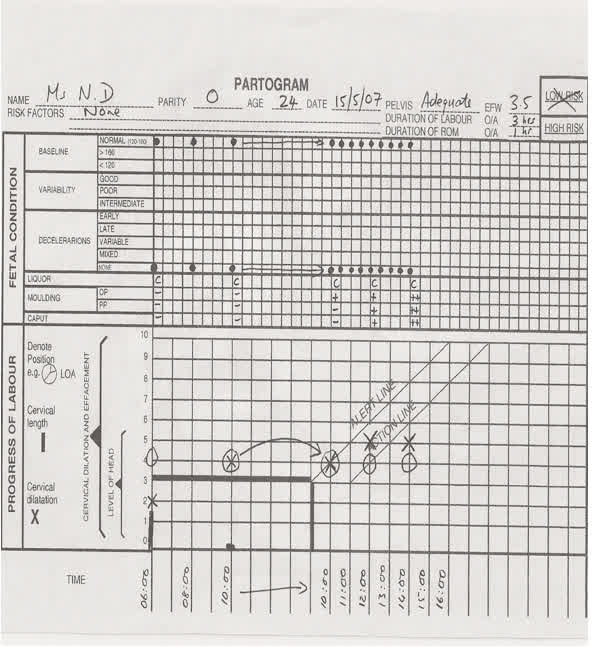
Partogram – poor progress due to inadequate contractions
This woman presented in active phase of labour. Her labour is prolonged as a result of inefficient uterine action. Oxytocin augmentation is followed by rapid progress from 6 to 10 cm cervical dilatation, & descent of the fetal head from 3/5 to 1/5. Continuous CTG monitoring was used during oxytocin augmentation.
OXYTOCIN FOR AUGMENTATION OF LABOUR
- Add 2 units oxytocin to 200 mL of Normal saline (OR 10 units oxytocin to 1000 mL of N/Saline)
- Start infusion at a rate of 12 mL/hour – equivalent to 2 mU/minute
- Increase by 12 mL/hour every 30 minutes until a minimum of 3 strong contractions (>40 seconds) in 10 minutes is achieved
- Most women will experience 3-4 strong contractions in 10 minutes at a rate of 12 mU/minute (72 mL/hour)
- When the desired contraction frequency is reached, do not increase the infusion rate further
- The maximum infusion rate should not exceed 120 mL/hour (20 mU/minute)
- Consider caesarean section if labour does not progress adequately after 4 hours of oxytocin in the active phase of labour
Precautions
- There must be no evidence of cephalopelvic disproportion
- There must be no evidence of fetal distress
- Use continuous CTG monitoring
- Use with caution in multiparas. Do not use oxytocin with parity ≥5 or previous caesarean section
Recommended Oxytocin Infusion
| Time | Volume | Oxytocin Dose | 2IU in 200 mL | 10IU in 1000 mL |
| 0 min | 12 mL/hour | 2mU/min | 12mL/hour | 12mL/hour |
| 30 | 24 | 4 | 24 | 24 |
| 60 | 36 | 6 | 36 | 36 |
| 90 | 48 | 8 | 48 | 48 |
| 120 | 60 | 10 | 60 | 60 |
| 150 | 72 | 12 | 72 | 72 |
| 180 | 84 | 14 | 84 | 84 |
| 210 | 96 | 16 | 96 | 96 |
| 240 | 108 | 18 | 108 | 108 |
| 270 min | 120 mL/hour | 20 mU/min | 120 mL/hour | 120 mL/hour |