Acquired Penile Pathology
Introduction Background Important details on history Important details on examination Make the diagnosis Pathology specific management and referral guidance The Children’s Act 38 of 2005, under Chapter 2, in Section 12 reads SETTING Primary and Secondary Healthcare Institutions in the Western Cape which refer to Red Cross War Memorial Children’s Hospital (RCWMCH) FOR STAFF Primary and Secondary D
Important details on examination
Pathology specific management and referral guidance
The Children’s Act 38 of 2005, under Chapter 2, in Section 12 reads
SETTING
Primary and Secondary Healthcare Institutions in the Western Cape which refer to Red Cross War Memorial Children’s Hospital (RCWMCH)
FOR STAFF
Primary and Secondary Doctors and Nurses who refer patients to RCWMCH
PATIENTS
Patients under the age of 13 years old with penile pathology
Introduction
Presentations of patients with penile concerns and anomalies can cause significant anxiety for parents. Most conditions are self-limiting and need no surgical input, but a few do require paediatric surgery or urological assessment and intervention.
It is the duty of the referring clinician to make a full assessment of the patient to come to an accurate assessment of the penile condition and then manage the patient appropriately prior to referring the patients when indicated. Careful counselling may be needed as part of this process.
This guideline specifically addresses acquired problems of the penis. There is a separate guideline that addresses congenital conditions of the penis. It is intended that this guideline will assist clinicians to make an accurate diagnosis and then guide appropriate management and referral of acquired penile conditions.
Background
In South Africa the child health act restricts circumcision to those patients with a medical indication - these indications are not common. Cultural childhood circumcision is permitted only if this is an established norm in the child’s community, and it is the duty of the practitioner undertaking the procedure to establish evidence that the family is part of a religion or culture which practises childhood circumcision prior to undertaking the procedure.
Circumcision for cultural reasons is not offered at RCWMCH. In the case of a patient who has comorbidities that make anaesthesia unsafe, or who is undergoing an anaesthetic for another indication, the paediatric surgical team may agree to undertake the circumcision if it is safe to do so. In this circumstance, the parents will need to provide written documentation that they are active members of a culture or religion which requires childhood circumcision. This documentation typically comes from a religious leader and will be filed with the patient’s operative note.
Important details on history
- If the patient is circumcised: when was this done and for what reason?
- Is the patient able to pass urine?
- Is the urine stream strong or is there any history of spraying?
- Is there any dysuria or urgency?
- Is there a history of trauma?
- Is the penis or foreskin painful?
Important details on examination
Expose the penis:
- Is there a foreskin and what does it look like?
- It may be swollen, and oedematous
- It may be scarred and narrow
- Is there any equipment (eg: plastibell) attached to the penis?
- Are you able to see the glans and the urethral meatus?
- Are there features of infection or cellulitis?
- Are there areas that appear to be poorly perfused?
- If there is trauma, what parts of the penis are involved? Especially assess the urethral meatus.
Make the diagnosis
| Pathology | Clinical features |
| Paraphimosis | Retraction of a narrow foreskin behind the glanular sulcus, resulting in a constrictive ring that leads to oedema of the glans and foreskin, and impaired blood circulation. |
| Balanoposthitis | Inflammation of the glans of the penis & the foreskin. This can cause significant oedema of the foreskin. |
| Primary phimosis | Inability to retract the foreskin behind the glanular sulcus. This is physiological up until the age of puberty. |
| Balanitis Xerotica Obliterans | Chronic inflammatory condition of the male genitalia, also known as Lichen Sclerosis. It causes white discolouration of the foreskin and the underlying glans. Scarring of the foreskin can cause secondary phimosis. |
| Smegma pearls | Whitish chalk-like substance that can accumulate around the foreskin & form little pearls as the foreskin is coming away from the glans. |
| Trauma | Trauma to the foreskin and penis is relatively common. Meatal involvement should always be carefully assessed. |
| Complications of circumcision: Short term | Bleeding, infection or glans injury related to circumcision. See details of complications related to single use apparatus too. |
| Complications of circumcision: Long term | Skin bridges, meatal stenosis, stenosis of the scar and excessive shaft skin loss. |
Pathology specific management and referral guidance
Paraphimosis
Paraphimosis is the retraction of a narrow foreskin behind the glanular sulcus, resulting in a constrictive ring that leads to oedema of the glans and foreskin, and impaired blood circulation.
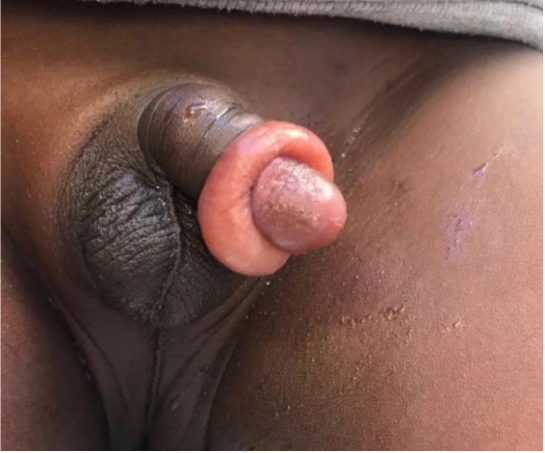
Click on the image to enlarge.
Note the enlarged, oedematous foreskin which is retracted behind the glandular sulcus.
This is a surgical emergency as the glands is at risk of necrosis because of a tight ring inhibiting adequate blood flow to the tip of the penis. Reduction should be undertaken at the point of presentation.
Management and referral guidance
Reduction should be undertaken at point of presentation:
- Arrange analgesia and sedation if available
- Various techniques to reduce oedema of the glans and foreskin have been described. A pragmatic option is to apply gauze soaked in 50% dextrose directly to the glans while awaiting analgesia and sedation to become effective.
- Apply steady circumferential pressure to the oedematous tissue in a sustained fashion (Be patient – this can take up to 10 min of steady pressure)
- Once the oedema has reduced the foreskin can be slipped back over the glans - In situations where the paraphimosis cannot be reduced, urgent referral to the urologist on call is required
- A dorsal slit can be considered in some cases, but this is not advised if the clinician has no experience with this procedure.
| Referral Guidance for Paraphimosis | |
| Failed reduction | Urgent referral to paediatric urologist on call |
| Successful reduction (first episode) | The patient may be discharged home. No routine follow up is required. It is important to emphasise the importance of always reducing the foreskin following activities involving foreskin retraction with the patient. |
| Successful reduction (second episode) | Arrange non-urgent urology outpatient review |
Parental counselling
- Paraphimosis is reasonably common in young boys
- It is not caused by naughtiness or inappropriate behaviour, and is not evidence of sexual assault
- It is most likely to be a single episode, but a small percentage may recur
- Circumcision is the definitive surgical management in recurrent cases, but a single episode of simple paraphimosis is not an indication for circumcision
Balanoposthitis
Balanoposthitis refers to inflammation of the glans of the penis & the foreskin. This presents as a painful foreskin which can be red, swollen and may have an associated discharge. Provided the patient can pass urine freely, there is no need for admission or referral.
Management guidance
Management is primarily with perineal hygiene but be clear that this does not require retraction of the foreskin to clean the glans, as this may cause small tears & lead to further chronic inflammation.
Topical chloramphenicol (usually available as “eye ointment”) is adequate for mild cases.
Oral antibiotic therapy is indicated in more severe cases and is aimed at treating urogenital organisms (amoxicillin with clavulanic acid is an appropriate choice).
All patients require a mandatory Urinary Tract Infection work-up
- Urine Dipsticks to check for nitrites & leucocytes
- Urine microscopy, culture & sensitivity
- Ultrasound of kidneys, urethra & bladder
- Micturating cysto-urethrogram if indicated (consult with paediatric nephrologist or urologist before requesting this)
Referral guidance
Most patients can be managed at primary level and do not need to be seen by the urology or surgical team.
Indications for urgent referral to the urologist on call are:
- Acute urinary retention
- Infections requiring debridement
- Infections not responding to antibiotic therapy
- Any suspicion of non-accidental Injury
Indication for non-urgent referral for urology OPD review:
- Abnormal findings on imaging of the upper tracts on ultrasound
- Genital ulcers
Phimosis
Phimosis is the inability to retract the foreskin behind the glanular sulcus. Primary phimosis is usually physiological and there will be no evidence of scarring or inflammation. Secondary phimosis occurs because of a pathological process such as balanitis xerotica obliterans which causes scarring and narrowing of the foreskin.
Management and referral guidance
Patients with primary phimosis should be reassured and not referred for further assessment
Indication for non-urgent referral for urology OPD review:
- Patients with secondary phimosis caused by Balanitis Xerotica Obliterans (see below)
- Recurrent, documented urinary tract infections with microbiological evidence in patients with urological abnormalities
- Recurrent balanoposthitis Urinary retention due to phimosis is very rare, should this be the presentation then urological review is indicated.
Parental Counselling
- Most cases of phimosis are physiological and will resolve when the patient reaches puberty.
- Avoid vigorous retraction of the foreskin to wash & clean the glans, as this will cause small tears & lead to chronic inflammation.
- If the patient is referred for urology OPD review then possible therapeutic options will include topical corticosteroid cream (0.1% hydrocortisone applied 8-12 hourly) or a circumcision.
Balanitis Xerotica Obliterans
Balanitis Xerotica Obliterans (BXO) is a chronic inflammatory condition of the male genitalia, also known as Lichen Sclerosis. It causes white discolouration of the foreskin and the underlying glans. BXO causes significant narrowing of the foreskin though scaring and is the main cause of secondary phimosis. This phimosis results in a narrow urine stream, which can cause dysuria and ballooning of the prepuce and may progress to urine retention.
This is very different from physiological phimosis, where the foreskin is soft and not scared.
Referral guidance
Non urgent referral for urology outpatient review.
Parental Counselling
- If there is scarring causing the phimosis then circumcision is usually indicated on an elective basis.
- The glans will be visualised at the time of circumcision to see if the scaring is only present on the foreskin or if the glans is also involved.
- Complications of glans involvement include meatal and urethral strictures and, if there is a concern about this, further follow up and possible dilatations will be arranged.
Smegma & smegma balls
Smegma is the medical term for the whitish chalk-like substance that can accumulate around the foreskin. In boys with physiological phimosis this can form little pearls between the foreskin and the glans.
It consists of desquamated epithelial cells & body fluids & acts as a natural lubricant. It is not pathological & is not an indication of infection.
Pearls will open up as the foreskin releases and the discharge from this is sometimes mistaken for pus.
Management and referral guidance
Reassure parents that this is completely normal and will resolve as the foreskin releases from the glans.
There is no need for surgical review.
Penile Trauma
In general, penile injuries except those that are very superficial should be referred to the paediatric urological service for further evaluation. Simple lacerations can be cleaned and sutures with absorbable sutures but complex degloving injuries or injuries involving the meatus or corpora cavernosum should be referred for experienced paediatric urology assessment.
Blood seen at the urethral meatus is a warning sign for urethral injury, and retrograde urethrography may be needed to exclude urethral injury.
Zipper entrapment
The tip of the foreskin or scrotal skin may become entrapped in the teeth of a rip when closing a fly in a hurry. This is extremely painful.
Patients should be given analgesia and sedation or anaesthesia as required to fully assess the situation.
If the zipper is already above the entrapped skin, cut the zip across the top and remove the slider. This will allow the zip to separate and release the skin. If this isn’t possible, then cut through the material either side of the zip and then cut across the zipper below the level of the entrapped skin. The zipper can then be separated from below.
If the entrapped skin is within the slider, the slider will need to be eased back down to release the skin.
Always inspect the meatus carefully following a zipper injury.
Patients with no significant tissue loss or meatal injury can be discharged home after passing urine.
Hair torniquet bands
Infants may present with redness and swelling of the distal penis with a demarcation line. Look carefully for a hair, or cloth fibre, which may have become wound around the penis to form a torniquet.
Release this and provided the patient can pass urine and has no ongoing ischaemia they can be discharged home. Any concerns of necrosis, warrant an urgent urological review.
Complications of Circumcision
Circumcision is the removal of the foreskin. When this is done in the paediatric population it is usually done under general anaesthetic, although doing it under local in neonates and compliant older children is possible.
Short term complications of circumcision include bleeding, haematoma formation, wound sepsis and urinary retention. Any of these features warrant a discussion with the surgeon on call and likely referral for surgical review.
Long-term complications include meatal stenosis, skin bridges between the shaft skin and the glans and a tight scar along the suture line. There complications can be referred for non -urgent urology outpatient review.
There are a number of commercial circumcision devices available (Eg: Plastibell and circumplast) which are commonly used by non-surgeon practitioners who choose to undertake circumcision. Although these devices are not used by paediatric surgeons at RCWMCH, it is not uncommon for patients to be instructed to present to states services (rather than returning to the responsible practitioner) when there are complications. It is therefore important to know what the complication of these devices are and how to manage them. Complications related to these devices include:
- Premature detachment: this may lead to bleeding or malalignment of the circumcision.
- Failure to detach: This should occur within 10 days, on average. Provided there is no sepsis or urinary retention close observation is appropriate until 14 days. If there are concerns about sepsis, urinary retention or excessive glans tissue swelling, then arrange urgent referral for urological review.
- Bleeding: this is commonly due to a loose circumferential suture, if the plastibell is in place, but the suture is loose, placing a second circumferential suture is the first line management to control bleeding. If this is not possible or if bleeding continues then arrange transfer for urological review.
- Excessive swelling: swelling related to these devices is common. Provided the patient is passing urine, the glans is well perfused and there is no sepsis, observation is the appropriate management. If there are features of these concerns then refer for surgical review.
- Wound sepsis: secondary infection of the wound is possible and should this be suspected, surgical review is indicated.
- Glanular necrosis due to incorrect sizing of the device is a devastating complication. If the glans appears to be ischaemic or necrotic urgent urological review should be arranged.
The Children’s Act 38 of 2005, under Chapter 2, in Section 12 reads
(8) Circumcision of male children under the age of 16 is prohibited, except when
(a) circumcision is performed for religious purposes in accordance with the practices of the religion concerned and in the manner prescribed; or
(b) circumcision is performed for medical reasons on the recommendation of a medical practitioner.
(9) Circumcision of male children older than 16 may only be performed
(a) if the child has given consent to the circumcision in the prescribed manner;
(b) after proper counselling of the child; and
(c) in the manner prescribed.
(10) Taking into consideration the child’s age, maturity and stage of development, every male child has the right to refuse circumcision.
As such, elective circumcision, unless performed for religious purposes, is illegal.
Children's Surgery Network, Western Cape Government, Red Cross War Memorial Children’s Hospital (RCWMCH), Clinical Guideline_Version 1_2025
Acquired Penile Pathology