Acute Cholecystitis
Surgical Emergencies - Acute Cholecystitis
Diagnosis
Severity assessment of Cholecystitis
Management
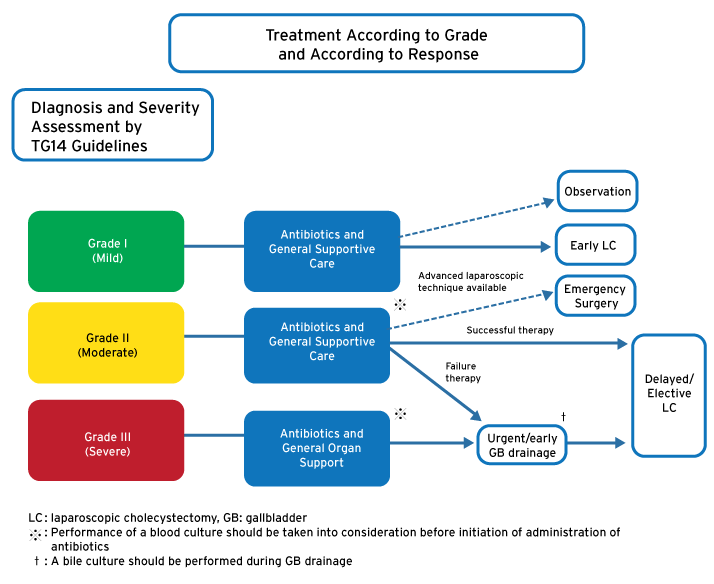
Algorithm
Acute cholecystitis is the most frequent cause of severe right upper quadrant pain, and is a common condition requiring admission to a surgical ward. The differential diagnosis includes pyelonephritis, acute hepatitis, cholangitis, acute pancreatitis and other acute abdominal diseases.
Diagnosis
Apply Tokyo Guidelines diagnostic criteria for acute cholecystitis (TG13):
- Local signs of inflammation:
- (1) Murphy’s sign, (2) RUQ mass/pain/tenderness
- Systemic signs of inflammation:
- (1) Fever, (2) elevated CRP, (3) abnormal WBC count
- Imaging findings: imaging findings characteristic of acute cholecystitis
Imaging findings characteristic of acute cholecystitis= thickened gall bladder wall, pericholecystic fluid, gall stones/ sludge, radiological Murphys’ sign
Definite diagnosis
- One item in A + one item in B are positive
- C confirms the diagnosis when acute cholecystitis is suspected clinically
Severity assessment of Cholecystitis
‘‘Grade I’’ (mild) acute cholecystitis:
- does not meet the criteria of ‘‘Grade III’’ or ‘‘Grade II’’ acute cholecystitis.
- acute cholecystitis in a healthy patient with no organ dysfunction and mild inflammatory changes in the gallbladder
'‘Grade II’’ (moderate) acute cholecystitis is associated with any one of the following conditions
- Elevated WBC count ([18,000/mm3)
- Palpable tender mass in the right upper abdominal quadrant
- Duration of complaints > 72 h
- Marked local inflammation (gangrenous cholecystitis, pericholecystic abscess, hepatic abscess, biliary peritonitis, emphysematous cholecystitis)
‘‘Grade III’’ (severe) acute cholecystitis: associated with dysfunction of any one of the following organs/systems
- Cardiovascular dysfunction/ Hypotension requiring treatment with inotropes
- Neurological dysfunction / Decreased level of consciousness
- Respiratory dysfunction
- Renal dysfunction/ Oliguria
- Hepatic dysfunction –INR >1.5
- Hematological dysfunction Platelet count <100,000/mm3
Management
- If acute cholecystitis is suspected, diagnostic assessment with TG13 diagnostic criteria every 12h
- urgent abdominal US, followed by CT scan if needed to make the diagnosis
- LFT’s, FBC, U&E, INR
- Assess severity criteria; at diagnosis, within 24 h after diagnosis, and during 24–48 h
- Correct fluids and electrolytes, analgesics and full dose antimicrobial agents
- Analgesics are a combination of paracetamol, NSAIDS (indomethacin suppository), and or opiates (morphine)
- Blood culture and/or bile culture is performed for Grade II (moderate) and III (severe) patients
Grade I (mild)
- cholecystectomy at an early stage within 72 h of onset of symptoms is recommended
- If conservative treatment patients with Grade I (mild) is selected and no response to the initial treatment is observed within 24 h, reconsider early cholecystectomy if still within 72 h of onset of symptoms or biliary tract drainage
Grade II (moderate)
- Conservative treatment
- consider early biliary drainage or cholecystectomy (in experienced centres) if no early improvement
- Grade II (moderate) and III (severe) at high surgical risk= immediate biliary drainage
Indications for emergency cholecystectomy (open or laparoscopic depending on expertise)
Grade II (moderate) cholecystitis + serious local complications
- including biliary peritonitis
- pericholecystic abscess
- liver abscess
- gallbladder torsion
- emphysematous cholecystitis
- gangrenous cholecystitis
- purulent cholecystitis,
If surgery cannot be performed due to the lack of facilities or skilled personnel, transfer of the patient is considered
Grade III (severe) with jaundice and those in poor general conditions
- emergency gallbladder drainage + antibiotics and general support measures
- if found to have gallbladder stones during biliary drainage, cholecystectomy is performed at after 3 month interval after the patient’s general conditions are improved
Algorithm