GuidelinesOther guideline
Acute Diarrhoea
This guideline aims to assist healthcare workers with antibiotic prescribing for common clinical syndromes in adult patients in South Africa, utilizing Local and International guidelines, key publications, and expert opinion.
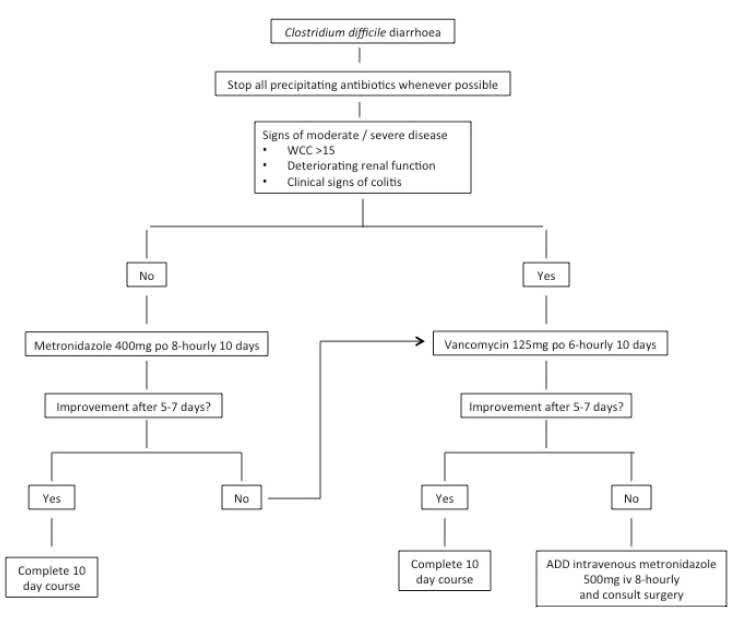
Management of C. difficile diarrhoea
Definition
Diarrhoea for < 2 weeks duration
Likely pathogens
- Viruses (norovirus, rotavirus, adenoviruses, astrovirus)
- Bacteria (Salmonella, Campylobacter, Shigella, Enterotoxigenic E. coli, C. difficile) and bacterial toxins
- Protozoa (Cryptosporidium, Giardia, Cyclospora, Entamoeba)
Clinical features
- Stool taking the shape of its container > 3 times per day
- Blood in stool
- Fever
History
- Food exposure
- Illness among close contacts
- Recent travel
- HIV status
- Recent antibiotics
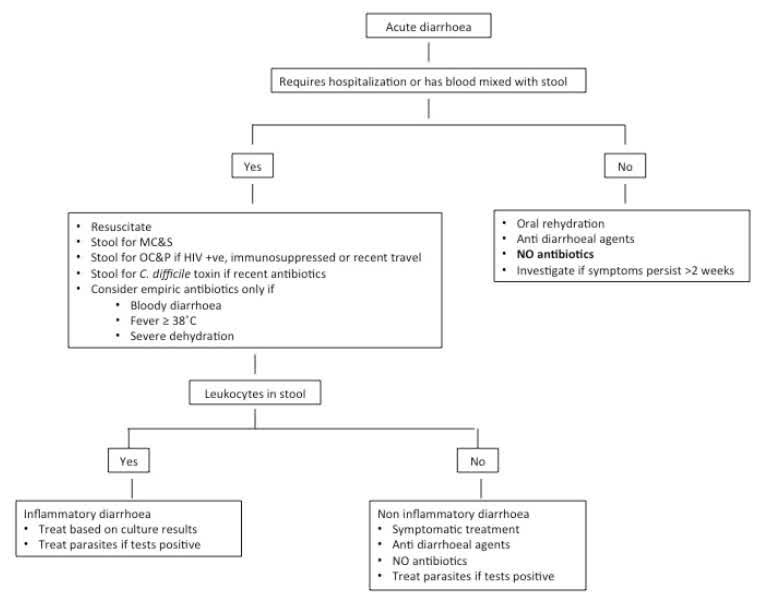
Tests(see algorithm below)
The vast majority of episodes of diarrhoea DO NOT require antibiotics. Mild cases are usually self‐limiting and require symptomatic treatment only. Moderate to severe cases require investigation +/- hospitalisation.
Diagnosis and management
Treatments
- Empiric:
- Ciprofloxacin 500 mg po 12‐hourly for 3 days pending results of culture and sensitivity
- If bloody diarrhoea add empiric metronidazole 500 mg IV 8-hourly (or 400 mg po 8-hourly) for 5 days
- Definitive:
- Based on culture results
- Clostridium difficile toxin or molecular test positive:
- See algorithm
- Resolution of symptoms generally occurs within 5-7 days, but it is not unusual for symptoms to persist for the first 3-5 days
- 25% of patients with C. difficile will relapse
Management of C. difficilediarrhoea