Acute Gastroenteritis in Children
Acute Gastroenteritis in Children
Indications for Investigations
Mild dehydration not requiring admission
Feeding children with gastroenteritis
Sodium Bicarbonate in gastroenteritis
Introduction
Acute gastroenteritis is one of the commonest reasons for acute presentation in primary care and hospitals. It is also a leading cause of death, usually from dehydration. Acute gastroenteritis is usually self-limiting with water loss rapidly diminishing after 48 hours. Careful assessment, fluid therapy and regular re-assessment are the keys to ensuring good outcomes. Most importantly, fluid therapy must be initiated early – the longer one waits, the worse the outcome is likely to be. So, essential history must be obtained while simultaneously assessing vital signs and hydration.
This section is based on the provincial “Protocol for Hospital Ward Level Management of Gastroenteritis among Children”. The full protocol should be available in every EC and paediatric ward and can be downloaded from our website at www.paarlpaeds.org. This management protocol covers emergency and urgent care for acute gastroenteritis in children, and provides guidelines for ongoing assessment and care of children for the first 48-72 hours of admission.
Essentials in treatment of Acute Gastro-enteritis:
- Rapid clinical assessment of circulation, hydration and co-morbidities such as severe malnutrition, pneumonia, sepsis and HIV disease
- Immediate treatment of shock (intravascular dehydration) with pushes of parenteral (intravenous or intra-osseous) isotonic fluids (normal saline) until the shock is treated or escalation of care is required
- Treatment of extravascular dehydration with Rapid rehydration over four hours by nasogastric infusion of oral rehydration fluid where possible unless contraindicated
- IV fluid use confined to shocked, severely dehydrated, or complicated cases
- Regular re-assessment of hydration
- Continuing breast-feeding, and early re-introduction of other normal feeds
- Mineral and electrolyte supplementation
History:
Essential history must be obtained while simultaneously assessing vital signs and hydration.
- Is the child vomiting; how much?
- When was the last oral intake?
- Stools: blood, mucus, amount, consistency, frequency;
- Diet: malnutrition risk;
- Other systems: especially heart/lung disease
- Use of oral rehydration solution;
- Length of history (if > 10 days of loose stools, manage for ‘persistent’ or ‘chronic’ diarrhoea).
Examination:
- Assess airway and breathing
- Always assess for shock next (intravascular dehydration) as it is a leading cause of death from gastroenteritis: If the child is shocked, urgent fluids are required. Institute therapy immediately. If the child is not shocked, check for (extravascular) dehydration. See table below.
- Assess nutritional status as this will alter fluid volumes to be administered.
- Calculate the fluid management according to the guidelines below. Initiate the fluids and complete the rest of the clinical examination looking especially for signs that may suggest electrolyte abnormality (e.g. floppiness, seizures) and signs of severe acute malnutrition, neurological or cardio-respiratory disease that may alter your fluid prescription.
ASSESSMENT OF DEHYDRATION
| Some dehydration | Severe Dehydration | Shocked |
| 5% weight loss | 10% weight loss | ≥ 10% weight loss |
| Reduced skin turgor < 2sec Restless or IrritableSunken eyes Dry mucous membrane Decreased urine output Thirsty or drinks eagerly Crying without tears | Reduced skin turgor > 2secRestless or lethargicVery Sunken eyes & fontanelSevere dry mucous membraneDecreased urine outputCapillary refill time <s Tachycardia | Depressed LOC or lethargicPeripherally cold and shut downPulses absent, weak or threadyCapillary refill time > 3sSevere tachycardiaAcidotic breathingSigns of dehydration could be absent |
Indications for Investigations:
These are NOT routine.
- If the child was shocked, severely dehydrated, has signs of electrolyte imbalances (e.g. floppiness, seizures), seems to be sicker than the degree of dehydration would suggest, do the following tests: HGT, U&E, Blood gas, HIV (Rapid) if not documented
- Blood culture indicated: Under 3 months of age, Shock, Septic, High fever, severe malnutrition or seems sicker than the degree of dehydration would suggest.
- Urine Dipstix in all Children with gastro. No urine dipstix, no going home post call!
- Stool culture only if there is dysentery or suspected diarrhoea outbreak.
- Infants under 3 months of age with gastroenteritis usually warrant a ‘septic work-up’: FBC,CRP,Blood culture, urine MC&S.
- Chest X-ray: Under 3mo, if co-morbid disease is suspected (Like cardiac lesion, myocarditis, pneumonia)
- AXR: Abdominal distention/bilious vomiting
Indications for Antibiotics:
- Neonate: Cefotaxime and Ampicillin (until sepsis and meningitis excluded)
- Suspected sepsis: Ampicillin + Gentamicin
- Suspected meningitis, seizure with fever: Ceftriaxone unless CSF is normal
- UTI: See protocol
- Dysentery: Ceftriaxone if septic, change to Ciprofloxacin once stable.
Fluid management
Fluid therapy is the mainstay of the management of acute gastroenteritis. Decide on the appropriate:
- A) FLUID VOLUME: Take into account: Degree of dehydration, Age, Co-morbidities (i.e. cardiac, SAM)
- B) WHAT fluids to give: e.g. 0,9%NaCl for shock, oral rehydration solution or . DD
- C) HOW to give fluids: route (e.g. nasogastric) and speed (e.g. Rapid Rehydration).
RESUSCITATION / SHOCK:
- Give nasal oxygen, Check HGT, Set up IV line. If unsuccessful after two tries, insert intra-osseous (IO) needle. If < 6 months old or unsuccessful IO – call senior doctor.
- Give 0,9% normal saline 20ml/kg as bolus IV or IO with 20ml syringe and 3-way tap over 10min (NB: Give 10ml/kg if severely malnourished or cardiogenic shock).
- If still shocked, give 10ml/kg until shocked reversed to a maximum of 40ml/kg. After each bolus reassess for shock, or evidence of circulatory overload. (NB: if signs of cardiogenic shock develop - enlarging liver, crackles in chest, gallop rhythm - start inotropes and request help).
- If still shocked after 40ml/kg:
- Give another 10ml/kg bolus (unless there are signs of cardiogenic shock)
- Take blood culture, acid-base, U&E, stat dose of IVI Ceftriaxone 100mg/kg
- Start inotropes and call senior doctor
- Do not leave the child
- Possible reasons for failure of resuscitation: cardiac disease, hypoglycaemia, sepsis, ARDS, severe malnutrition, metabolic disease, fluid was not given, drip is out.
- When no longer shocked, assess hydration and clinical condition and commence appropriate continuing hydration regimen.
REHYDRATION:
A. MANAGEMENT FIRST 4 HOURS OF REHYDRATION:
Rapid Rehydration Over 4 Hours: Indicated In Every Case, Except In These Situations:
Contra-indication to Rapid rehydration (rehydrate over 24 hours)
- Shock
- Severe malnutrition
- Cardio-respiratory co-morbidity
- Neurological co-morbidity
- Suspected hypernatremia
- Infant under 3 months of age
- Child over 5 years of age
Severe dehydration 10%: | Some dehydration 5%: |
Rapid Rehydration over 4hours:
| Rapid Rehydration over 4hours:
|
If contraindication to Rapid Rehydration, rehydrate over 24 hours:
| If contraindication Rapid Rehydration, rehydrate over 24 hours:
|
B. MANAGEMENT AFTER THE FIRST 4 HOURS OF REHYDRATION:
If the child is still dehydrated, fluid losses are likely to have been greater than previously assessed, so consider repeating the Rapid Rehydration regimen. Alternative:
Re-assess hydration status and rehydrate over 24 hours:
- Rehydration (RH):
- 50ml/kg (5% dehydration),
- SOROL or 1/2 DD solution
- 100ml/kg (10% dehydration)
- Maintenance (M):
- Neonate (150ml/kg/d), <10kg (100ml/kg/d),
- 10 – 20kg (1000ml + 50ml/kg), > 20kg (1500ml + 20ml/kg)
- Give as milk or Breastfeeding
- Ongoing losses (OL):
- 10-20ml/kg ORS after each loose stool
- Add 50-100ml/kg/24hrs in severe dehydration or frequent loose stools
- Use 1/2 DD solution IV if orals contraindicated
Example: 2 year old shocked child – weight 12kg
- Give 240ml 0,9%NaCl fluid bolus, up to 2 times until shock resolved. If still shocked give 120ml bolus, start inotropes and call for consultant.
- Once shocked resolved start with rapid rehydration . DD IVI 240ml/hr over first 4 hours (Use Rapid Oral Rehydration with ORS 240ml/hr via NGT if oral fluids tolerated and no contra-indicated). Reassess after 2 hours and again at 4hrs.
- If still 10% dehydrated repeat rapid rehydration over 4 hours or give . DD at 95ml/hr (RH 1200ml + M 1100ml) over next 24 hrs. Can give RH ORS via NGT if tolerated. Milk can be given for maintenance fluids.
- Add 120ml ORS after each loose stool.
Mild Dehydration Not Requiring Admission
- Can be treated as outpatient
- Show the caregiver how to give ORS with a cup and spoon using frequent small sips.
- Encourage caregiver to give 10 mL/kg after each diarrhoeal stool until diarrhoea stops.
- Instruct the caregiver how to make ORS at home and to continue treatment.
- Encourage the caregiver to continue feeding the child, especially breast-feeding.
- Instruct the caregiver to give the child extra feeds after the diarrhoea has stopped to make up for the period of inadequate intake. Educate caregivers about hygiene, oral rehydration solution and danger signs of diarrhoea
Child should return immediately if:
- No improvement
- Blood in stool
- Condition deteriorates
- Fever develops
- Poor drinking or feeding
- Sunken eyes
FEEDING CHILDREN WITH GASTROENTERITIS
- Never stop breast feeding (unless there is another contraindication).
- After the first 4 hours, start with feeds (Feeding reduces the duration of diarrhoea in most cases).
- Any child with diarrhoea asking for food or taking oral fluids can be fed.
- Small amounts are usually well tolerated.
SUPPLEMENTATION
- Zinc elemental oral: < 1 year of age: 10mg/day/orally. > 1 year of age: 20mg/day/orally
- Give for a total of 10 days (zinc reduces stool output and the chances of a repeat bout in the following three months)
- Vitamin A oral: All children who are admitted for gastroenteritis require a dose of Vitamin A:
- < 1 year of age: 100000 IU orally stat
- > 1 year of age: 200000 IU orally stat
- NB: Note this extra dose in the RTHB.
- Potassium Chloride (KCl) oral
- < 6 months of age: 125mg 8hrly orally for 2 days
- > 6 months of age: 250mg 8hrly orally for 2 days
NB: Do not give potassium chloride to children who have been shocked until the renal function test results have been reviewed and it is considered appropriate to supplement potassium intake.
ASSESSMENT FOR DISCHARGE
If the following criteria are fulfilled, the child will usually be ready for discharge:
- Discharge weight > admission weight
- Bright eyed and alert
- Drinking well
- No vomiting in recent hours
- Plans for other problems do not require inpatient care
FOLLOW-UP:
- Stools resolved: Hygiene advice (prevent another episode). Check SSS knowledge. No follow up required. Zinc elemental oral (10mg/day <1 years of age, 20mg/day >1 year of age) for 10 days.
- Stools still not fully formed: refer for weight and hydration check at local clinic. Advice re an extra meal a day for a week (WHO standard). Stamp RTHB or RHTC with ‘Diarrhoea stamp’ (Appendix 2) and fill in any necessary details, or write a short note including discharge weight and complications. Check SSS knowledge. Zinc elemental oral (10mg/day <1 years of age, 20mg/day >1 year of age) for 10 days.
- Other problems present: follow up in Primary Care service (e.g. nutrition clinic, local authority clinic) unless specific hospital-level service is required (remember the cost of transport to the family).
- Advise an extra meal a day for a week for every child after an episode of gastroenteritis to assist with regaining list weight.
NB. Always ensure that the parent/caregiver:
- knows how to make home-made oral rehydration solution safely
- understands danger signs and where to access care
- is reminded/taught the essentials of hand hygiene and safe food preparation.
GENERAL POINTS IN MANAGEMENT OF DIARRHOEA:
- Always give fluids orally or via a NG tube if tolerated.
- Do NOT withhold feeds in simple gastro. If the child does not have a contra-indication to oral fluids, early feeding should be instituted as it shortens duration of gastro and prevents malnutrition. Don’t withhold breast feeding in simple acute diarrhoea.
- If the child is vomiting try continuous NGT. If still vomiting then change to IV rehydration . DD.
- Give IV fluids and keep NPO if obstruction, ileus or decreased LOC.
- ASSESS hydration frequently (general condition, capillary filling time, level of consciousness, skin turgor, sunken eyes, respiratory rate, abdomen, if passing urine), stool output (consistency, frequency),vomiting (amount, frequency, content), oral intake. Also assess for complications and co-morbidities.
Sodium bicarbonate used in acute gastro-enteritis in with severe metabolic acidosis
This is not for rapid correction of a metabolic acidosis, but for persistent metabolic acidosis with high chloride blood level and high bicarbonate loss (eg. severe ongoing diarrhoea). NB: Fluid resuscitation and rehydration still forms the bases of management. The use of sodabic in gastro-enteritis is controversial, always consult specialist first. For specific cases with marked metabolic acidosis and high chloride levels, where fluid rehydration failed to improve acidosis, sodabic infusion can be considered. To give a mixture with the same sodium content as . DD solution, take 180ml 5% DW and add 20ml 4,2% Sodabic to get 200ml with 50mmol/l Na+ concentration. To make solution with higher sodium concentration, use . DD solution and add appropriate volume sodabic. If child has severe metabolic acidosis with hypernatremia, custom made solution can be made by adding 4,2% NaBic (0,5mmol Na+/ml) to Na+ containing fluids. Use solution containing approximately 2/3 Na+ of the patient’s formal serum Na+. See section under the management of hypernatremia: Sodium bicarbonate mixture in hypernatremia dehydration with severe metabolic acidosis. Always consult specialist first.
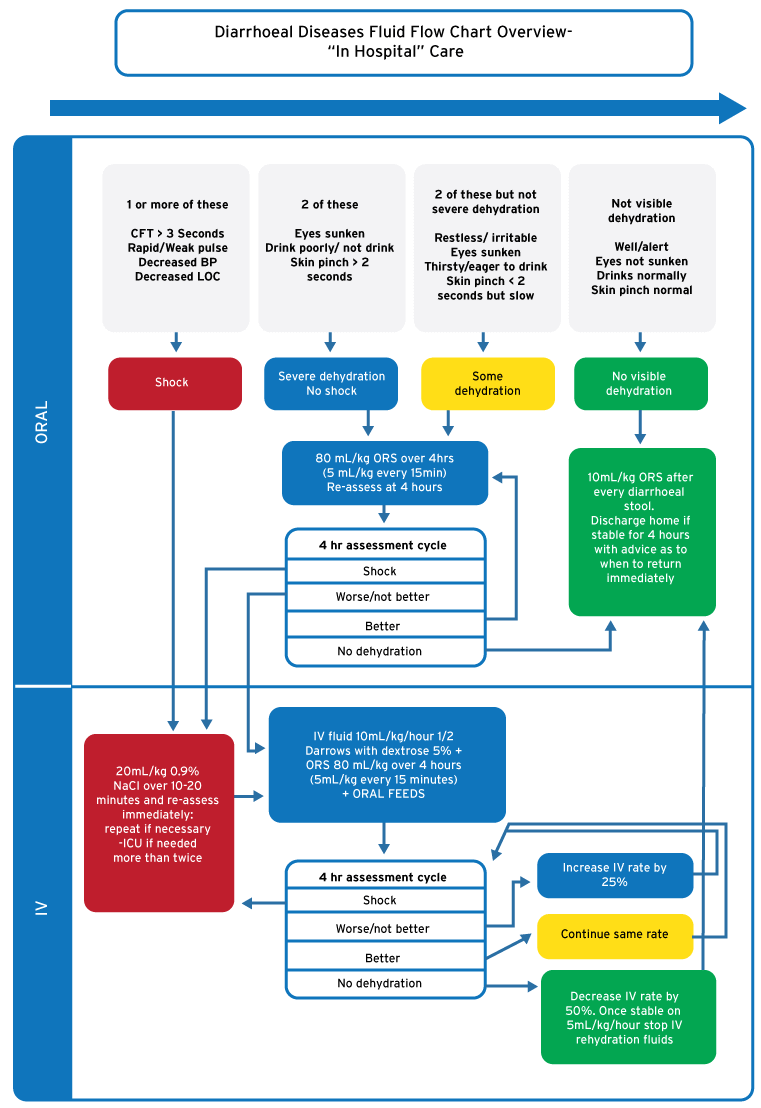
Diarrhoeal diseases fluid flow chart
Persistent Diarrhoea
By definition chronic or persistent diarrhoea is an episode of loose stools for longer than two weeks. Persistent diarrhoea results in significant morbidity and mortality associated with poor nutrition.
Diagnostic criteria
Persistent diarrhoea is most frequently due to temporary injury of the intestinal microvillous brush border (post infective diarrhea) with e.g. lactase loss, or due to luminal infection with bacterial overgrowth. Other causes include HIV infection, food allergies, cystic fibrosis and coeliac disease.
- Persistent diarrhoea without weight loss or dehydration – consider Toddler’s diarrhoea.
- Persistent diarrhoea with weight loss and dehydration – consider small bowel mucosal injury, e.g. lactose intolerance or small bowel bacterial overgrowth.
- Persistent diarrhoea with weight loss but no dehydration – consider a malabsorption syndrome, e.g. cow’s milk allergy, coeliac disease, cystic fibrosis, etc.
Investigations
Indicated diarrhoea continues with failure to thrive, dehydration recurs or the child is ill looking:
- FBC, Diff, UEC, CMP and Alb
- Urine and stool microscopy
- Stool-reducing substances
Management
- Monitor hydration, stools, nutritional status, weight gain and growth
- Nutritional support: Get dietician involved early!
- Antidiarrhoeal and anti-emetic agents are NOT recommended.
- Antibiotics only indicated when specific infections are suspected:
- Campylobacter: Erythromycin, oral, 10 mg/kg/dose 6 hourly for 7 days.
- G. lamblia: Metronidazole, oral, 7.5 mg/kg/dose 8 hourly for 5–7 days.
- Y. enterocolitica: Ceftriaxone, IV, 50 mg/kg/dose once daily or Cefotaxime, IV, 50 mg/kg/dose 6 hourly in neonates.
- Cryptosporidium: No effective treatment available
- Dysentery treat as per protocol below.
- Zinc (elemental), oral, if < 10 kg: 10 mg/day or if > 10 kg: 20 mg/day.
STEP-WISE EMPIRIC PROTOCOL FOR MANAGEMENT OF DIARRHOEA
Commence management at the most appropriate step according to previous management.
| Day 0 | Treat as per acute diarrhoea protocol Continue with breast or full-strength formula feeds Additional oral rehydration solution (ORS) to maintain hydration. |
| Day 1-2 | Continue full-strength feeds with additional ORS as required. |
| Day 3-5 | Consider change to lactose-free feeds if not breastfed. Continue additional fluids as required. If diarrhoea resolves, discharge, but continue with lactose-free feeds for 2 weeks. |
| Day 6-8 | Add Gentamicin, ORAL, 8 mg/kg/dose 4 hourly for 3 days only. Change to lactose-free feeds if not breastfed. |
| Day 9-13 | Change to Semi-elemental formula (Similac Allimentum, Pepticate or Peptamin Junior). If diarrhoea resolves, discharge on semi-elemental feeds for at least 2 weeks. If this is not possible, do a trial of lactose free feeds and if tolerated discharge on the lactose free feeds. If giardia is not excluded: Metronidazole, oral, 7.5 mg/kg/dose 8 hourly for 5 days. In HIV infected children: Co-trimoxazole, oral, 5mg/kg/dose 12 hourly for 10 days. |
| Day 14+ | If all steps above are unsuccessful, refer to tertiary center for further work-up and to consider total parenteral nutrition until diarrhoea has stopped. |
DYSENTRY
Diarrhoea with passage of blood and mucus in the stools. Shigella infection is the most common serious cause in children in South Africa. Treat as Shigella during an epidemic of Shigellosis, or if the child is febrile, “toxic”-looking, has seizures or if Shigella is cultured from the stool and the child is still ill.
Clinical diagnoses:
Normally presents with sudden onset, abdominal cramps, peritonism, urgency, fever and diarrhoea with blood and mucus in the stools.
Complications:
Dehydration, severe acidosis, electrolyte abnormalities, convulsions, shock, toxic megacolon, rectal prolapse, renal failure and haemolytic uraemic syndrome.
NB: Exclude intussusception. Evidence of intussusception includes: pain or abdominal tenderness, bile-stained vomitus, red currant jelly-like mucus in stool, rectal prolapse.
Investigations:
Stool culture to confirm diagnosis of Shigellosis. Polymorphs and blood on stool microscopy. Immediate microscopy of warm stool to diagnose amoebic dysentery if available.
Management:
Monitor fluid and electrolyte balance. Ensure adequate nutrition and hydration.
Fluid and electrolyte replacement as per acute diarrhoea protocol
Antibiotic therapy: Ciprofloxacin oral, 15 mg/kg/dose 12 hourly for 3 days. If child is septic: Ceftriaxone, IV, 50 mg/kg as a single daily dose for 5 days or Cefotaxime IV 75 mg/kg/dose 8 hrly for 5 days if neonate.
For further information on the drugs listed in the above guidelines, click on the drug name and you will be directed to the EMGuidance drug monograph.
Ampicillin
Cefotaxime
Ceftriaxone
Ciprofloxacin
Co-trimoxazole
Erythromycin
Gentamicin
Oral rehydration solution