Acute Liver Failure
Acute Liver Failure
Introduction
Identification
Severity assessment
Management based on severity
Relevant history, examination
Investigations
Referral criteria
Treatment Algorithm
Introduction/ Description
Defined as rapid development of severe acute liver injury with impaired synthetic function (INR ≥ 1.5) and encephalopathy in a person who previously had a normal liver or had well-compensated liver disease. The mainstay of treatment is supportive until the acute insult resolves.
Identification/recognition/diagnosis of problem
Patients in acute liver failure tend to attend the EC with complications of their liver failure. Complications (presentations) may include the items listed in the box
Complications of acute liver failure
- Cerebral Oedema
- Seizures
- Coagulopathy and bleeding
- Respiratory complications:
- Hypoxia
- Aspiration
- Atelectasis
- Non-Cardiogenic Pulmonary Oedema (ARDS)
- Renal Failure (poor prognosis)
- Infection (more prevalent due to impaired neutrophil function)
- Septicaemia
- Pneumonia
- Urinary Tract Sepsis
- Peritonitis
- Metabolic abnormalities
- Hypoglycaemia
- Hyponatraemia
- Hypokalaemia
- Hypophosphataemia
- Lactic Acidosis (poor prognosis)
- Cardiovascular
- Hypotension (fluid deplete)
- Hypertension (↑ICP)
Important causes of liver failure include, but are not restricted to:
- Drug Induced (paracetamol, antiretrovirals, TB drugs, traditional medicine, alcohol, illicit drugs)
- Viral Hepatitis (Hep A, Hep B, Hep E, CMV, EBV, HSV)
- Autoimmune
- Shock/ Hypoperfusion – Ischaemic hepatitis
- Other (Mushrooms poisoning, HELLP)
Severity assessment (Triage): mental state grading
From an EC perspective grading according to mental state is useful to determine which patients will require airway support. This is however not the only system that may require support.
| Grade I | Changes in behaviour with minimal change in LOC: agitation, mild Confusion |
| Grade II | Lethargy, disorientated to time, inappropriate behaviour |
| Grade III | Somnolence. Confusion. |
| Grade IV | Comatose |
Management based on severity
General measures
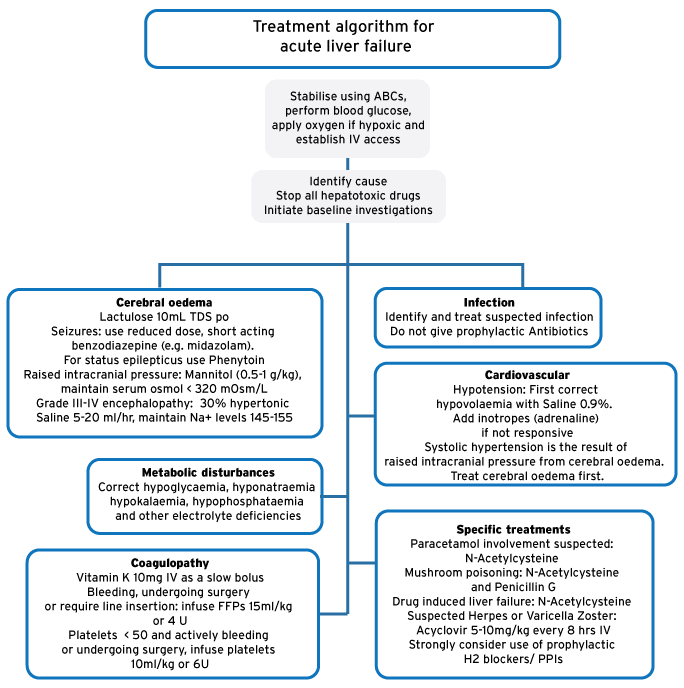
- Stabilise using ABCs, perform blood glucose, apply oxygen if hypoxic and establish IV access.
- Intubate and ventilate for airway protection as indicated (Grade III or IV encephalopathy) and nurse head-up 30 degrees
- Glucose checks 2 hourly
- Stop all hepatotoxic drugs and avoid all nephrotoxic drugs
- Maintain a peaceful environment (avoid sedatives – if needed give short acting benzodiazepine prn)
Management of cerebral oedema
- Exclude other causes of decreased consciousness: hypoglycaemia, head Injury/ Intracerebral bleed, alcohol withdrawal, etc.
- Lactulose 10mL TDS po, reduces ammonia levels thus reducing cerebral oedema
- Terminate seizures using a reduced dose, short acting benzodiazepine (e.g. midazolam). If seizure continues then proceed to load with phenytoin
- With signs of raised intracranial pressure, give Mannitol (0.5-1 g/kg), keeping serum osmol < 320 mOsm/L (measured 6 hourly). Watch for fluid overload if renal failure present.
- For grade III-IV encephalopathy and where available, consider Hypertonic saline 30% at 5-20 ml/hr to maintain Na+ levels 145-155 to prevent raised intracranial pressure.
Management of Metabolic disturbances
Correct hypoglycaemia, hyponatraemia hypokalaemia and other electrolyte deficiencies. Hypophosphataemia should be corrected in discussion with the specialist admission team if a delay in admission presents
Management of Coagulopathy
- Vitamin K 10mg IV as a slow bolus
- If the patient is bleeding, undergoing surgery or require a procedure (line insertion), infuse FFPs 15ml/kg or 4 U
- With platelets <50 and actively bleeding or undergoing surgery, infuse platelets 10ml/kg or 6U. The platelet count should be checked after 1 hour and 24 hours. Transfused platelets survive 3-5 days
Management of Infection
Identify and treat any suspected infection. Do not routinely provide prophylactic Antibiotics
Management of Cardiovascular system
- Hypotension should first be addressed by correcting hypovolaemia with Saline 0.9%. Inotropes should be added if needed (Adrenaline)
- Systolic hypertension is usually the result of raised intracranial pressure from cerebral oedema. Treating the cerebral oedema will address hypertension as well.
Specific treatments
N-Acetylcysteine is used in the majority of cases of drug/ toxin involvement. It should not be withheld even if the ingestion was 48-72 hrs prior to presentation. Administration is recommended until there is firm evidence of improved hepatic function (resolution of hepatic encephalopathy, improving coagulopathy INR < 1.5, and declining transaminases).
- Paracetamol involvement suspected: N-Acetylcysteine
- Mushroom poisoning: N-Acetylcysteine and Penicillin G
- Drug induced liver failure: N-Acetylcysteine
- Suspected Herpes or Varicella Zoster: Acyclovir 5-10mg/kg every 8 hrs IV
- Strongly consider use of prophylactic H2 receptor blockers/ PPIs
N-Acetylcysteine administration (max weight for calculation: 110 kg)
- 150mg/kg in 200 mL 5% Dextrose over 15 minutes to 1 hour
- 50mg/kg in 500 mL 5% Dextrose/ 4 hours
- 100mg/kg in 1 L 5% Dextrose/ 16 hours
Hepatic function not resolved, continue with:
- 150mg/kg in 1L 5% Dextrose/ 24 hours
Relevant history, Examination
History
Enquire specifically as top date of onset of symptoms, exposure to viral illness (Travel, sexual contacts, body piercing), drug use (prescription and illicit), alcohol use, herbal or traditional medicine use or hepatotoxin exposure (mushrooms). Target symptoms the patient may have that is consistent with the complications of acute liver failure
Examination- Jaundice (not always present)
- Asterixis (Hepatic flap)
- RUQ tenderness
- Hepatomegaly
- Splenomegaly
- Ascites
- Evidence of Bleeding
- Evidence of superimposed infection
- Mental status examination
Investigations
EC investigations
- Blood gas (arterial if respiratory system affected) for acidosis and lactate
- Glucose
- Renal function, Mg+, Ca2+, PO4-
- Liver function
- Full blood count and INR
- Group and screen – If Hb low
- Blood culture
- Paracetamol level (overdose or if cause unclear)
- Pregnancy test and Urine dipsticks
- CXR (aspiration, atelectasis, pneumonia, ARDS)
- Ultrasound abdomen
Specialist investigations (will require appropriate referral)
- Viral serology (HIV, Hep B and C, CMV, EBV, HSV)
- Plasma ammonia level
Referral criteria
- All patients with acute liver failure should be referred to a physician for management.
- If intubated the patient needs to be transferred to an intensive care unit.
- Wherever possible the Liver Unit should be consulted early for inputs in patient management
Treatment algorithm for acute liver failure
References
Lee, Stravitz, Larson. AASLD Position Paper: The Management of Acute Liver Failure: Update 2011. Hepatology September 2011
Ramrakha, Moore. Oxford Handbook of Acute Medicine. Second edition 2005. Acute Liver Failure p658-662
Sood, Katz. Acute Liver Failure Clinical Presentation. Medscape. Updated Aug 22 2012. Accessed 3 September 2012.
Rossiter D, Blockman M (eds.). South African Medicines Formulary. 11th Ed. Cape Town: Health and Medical Publishing Group; 2014
Cameron P, Jelinek G, Kelly A, et al. Textbook of Adult Emergency Medicine. 4th Ed. Elsevier; 2015