Acute Management of Abdominal Trauma in Pregnancy
These protocols are intended for the use of students, interns and registrars within Tygerberg hospital and its immediate catchment area only. Always consult with a senior colleague if you are unsure of the correct management.
Most common causes of abdominal trauma in pregnancy
Risk associated with abdominal trauma in pregnancy
Management: Initial assessment and work up
Management: Minor trauma in pregnancy
Management: Major trauma in pregnancy
Management: Role of tocolysis in abdominal trauma
Management: Role of antenatal steroids in abdominal trauma
DEFINITIONS
Major trauma:
- Trauma associated with clinical signs i.e. ecchymosis, haematoma or bruising on the abdomen.
- Unstable patient
- Associated with
- Motor vehicle accidents
- Assault with direct abdominal injury
Minor Trauma:
- No visible signs of abdominal injury, with no other associated trauma or symptoms.
MOST COMMON CAUSES OF ABDOMINAL TRAUMA IN PREGNANCY
- Motor vehicle accidents
- Assault
- Domestic Violence and abuse
- Falls
- Associated illicit drug use in up to 20% of cases
RISK ASSOCIATED WITH ABDOMINAL TRAUMA IN PREGNANCY
PREGNANCY RELATED COMPLICATIONS
- Abruptio placentae
- Preterm labour
- Fetal-Maternal Haemorrhage
- Uterine rupture
OTHER COMPLICATIONS
- Splenic and hepatic trauma/rupture (More common in third trimester)
- Bowel injury (less likely in the pregnant women)
NB! For the purpose of the protocol viability will be defined as-
Sure gestation of 27w0d and EFW of 800g.
MANAGEMENT: INITIAL ASSESSMENT AND WORK-UP INITIAL MANAGEMENT OF BLUNT ABDOMINAL TRAUMA IN PREGNANCY
Primary Survey and Stabilisation of patient:
- Evaluate and manage circulation, airway, breathing [Blood gas as necessary]
General assessment:
- Obtain history, especially if any symptoms of vaginal bleeding, abdominal pain or symptoms suggestive of rupture of membranes.
- Check antenatal card for MSU, HIV, Syphilis results and normal detail scan.
- Ensure correct gestation (Sure gestation = early ultrasound ± Dates / SF)
NB! If patient is unbooked or lost her card:
- Check for results on the computer, if not do rapid HIV, Rh and Syphilis tests.
- Request registrar on call to do basic scan, exclude gross abnormality and get EFW (Complete the basic scan report form)
!But do not delay management while waiting for the above!
- General examination
- Maternal vital signs, urinalysis, including hydration status
- Asses uterine activity and tenderness by abdominal palpation
Perform sterile speculum examination. (Only if patient is symptomatic)
- If evidence of ruptured membranes – Follow protocol for PPROM
- Look for vaginal lacerations, pelvic trauma or foreign bodies
Perform bimanual and rectal examination
- In cases of major / significant trauma
- Perform digital cervical assessment [Only with intact membranes!] To determine dilation, effacement, position, consistency
Side-room and special investigation:
- Ward Hb, Bloodgas
- Mid-stream urine specimen for culture and sensitivity
NB! In all pregnancy abdominal trauma cases:
- Ensure all Rhesus Negative women received a dose of Rh D immunoglobulin
- Do Kleinhauer-Betke acid elution test if fetal-maternal haemorrhage is suspected
- Involve the Social Worker if domestic violence or abuse is suspected
- Ensure that all documentation of the assault case was done (J88)
MANAGEMENT: MINOR TRAUMA IN PREGNANCY:
Sure gestation < 26w6d [If unsure gestation then EFW < 799g]
- Treat as non-pregnant patient.
- Asymptomatic patients with normal vitals can be treated at their local clinic/hospital.
- Patients should receive counselling on symptoms and signs to look out for.
- If complaining of decreased or no fetal movements then the presence of the fetal heart can be confirmed with a Doppler/Doptone and if present and normal then for discharge; if absent then she must be referred to a District (level 1) hospital.
Sure gestation ≥ 27w0d [If unsure gestation then EFW ≥ 800g]
- Asymptomatic patients with normal vitals and with normal fetal movements can be treated at their local clinic/hospital.
- Patients should receive counselling on symptoms and signs to look out for.
- If complaining of decreased or no fetal movements then she must referred to a District (level 1) hospital.
- The presence of the fetal heart can be confirmed with a Doppler/Doptone
- If present: Then do a 10 min CTG evaluation
- If absent then she must be referred to a Regional (level 2) hospital
If a patient is discharged she must be fully counselled on possible complications and advised to return if:
- Any signs of preterm labour
- Abdominal pain and / or vaginal bleeding
- Change in fetal movements
MANAGEMENT: MAJOR TRAUMA IN PREGNANCY
Sure gestation < 24w0d [If unsure gestation then EFW < 550g]
- Treat as non-pregnant patient
- Patient needs to be stabilized and referred to her local trauma/emergency unit, District or Regional Hospital.
- Once stabilised the obstetric registrar can be contacted to evaluate the pregnancy.
Sure gestation 24w0d – 26w6d [If unsure gestation then EFW 550 g - 799g]
- Patient needs to be stabilised and referred to her local trauma/emergency unit, District or Regional Hospital.
- Once stabilised the obstetric registrar can be contacted to evaluate the pregnancy.
Sure gestation ≥ 27w0d [If unsure gestation then EFW ≥ 800g]
- Patient need to be stabilised first and referred to level 2 hospital
- If stable enough for theatre then do continuous CTG for 4h in labour ward.
- A course of antenatal steroids should be given
- If asymptomatic and a normal CTG for 4h then do intermittent 6hly CTG for 24h in labour ward
- If symptomatic or suspicious CTG during the first 4h then do continuous CTG for 24h in labour ward
- If at any stage there is a pathological CTG tracing, the patient must be taken immediately for a caesarean section, surgeons should be notified and be present at surgery to assess the abdominal cavity for any surgical trauma.
MANAGEMENT: ROLE OF TOCOLYSIS IN ABDOMINAL TRAUMA
Value
- Tocolytic therapy has been shown to prolong pregnancy in preterm labour to provide benefit of administering antenatal corticosteroids.
- Tocolytic therapy may play a role in safe transport for women with preterm labour.
- Routine tocolysis is not indicated in abdominal trauma.
- In cases where patients present in preterm labour after abdominal trauma before tocolytics are given there should:
- Be no suggestion of an abruption
- There should be no contraindication for tocolysis
- Non-pregnancy related complications should be excluded
Indication for Tocolysis
- Women in preterm labour 24w0d-33w6d sure gestation or EFW 800g – 1850g if unsure gestation.
Contraindications for Tocolysis
- Mother does not consent to suppression
- If ≥ 34w0d sure gestation or EFW ≥ 1850g in unsure gestation
- Pathological or suspicious fetal heart rate pattern [CTG monitoring in sure gestation > 27w0d or Unsure gestation EFW > 800g]
- Lethal fetal anomaly
- Intra uterine fetal death
- Suspected chorioamnionitis (clinical signs of infection)
- Severe hypertensive conditions in pregnancy
- Abruptio Placentae
- Severe IUGR (<3rd percentile)
Relative contraindications for Tocolysis (To be assessed and discussed with your consultant)
- If less than 26w0d sure gestation or EFW < 800g if the gestation is unsure
- Ante-partum haemorrhage of unknown cause
- HIV positive patients / immunocompromised patients
Drugs & Dose
- No clear first line drug but the following drugs can be used
- Calcium channel blocker: Nifedipine (Adalat®)
- Dose: 30 mg loading dose orally (do not chew or take sublingually) and 20mg 3 hours later. If still contractions, continue with 20 mg 8 hourly per os for 48 hours.
- Contraindications: All cardiac diseases, hypotension and hypertensive diseases. (Unless discussed and decision made by consultant – make clear notes!)
- Side effects: Flushing, headache, dizziness, nausea
- Prostaglandin synthetase inhibitor – Indomethacin (Indocid®)
- Dose: 100mg rectal suppository 12hly for 3 doses Maximum 4 doses or 48hrs of treatment
- Contraindications: pre-existing gastrointestinal ulcers/lesions, known allergy to NSAIDS, significant renal or hepatic impairment, sure gestation of ≥32w0d
NOTE!
If unsure gestation and EFW ≥ 1.6kg rather use Salbutamol if indicated.
- Side effects: Nausea, heartburn, fluid retention, suppression of platelet function.
If at this stage tocolysis is not effective in stopping the contractions, the use of a beta2 stimulant as an adjunct (salbutamol) in the dose as below can be considered.
- Beta-mimetic – Salbutamol (Ventolin®)
- Dose: 250 μg (1⁄2 ampoule diluted in 20ml saline) slowly IV as soon as possible
- Can continue infusion: 2mg (4 ampoules) in 200ml saline at 1ml/minute and increase every 10 minutes by 1 ml/minute until maximum of 4ml/minute or pulse >120 bpm.
- Contraindication Cardiac arrhythmias, maternal tachycardia (pulse > 110bpm), all underlying cardiac and diabetic mothers. (Unless discussed and decision made by consultant – make clear notes!)
- Side effects Cardiac or cardiopulmonary arrhythmias, edema, myocardial ischemia, tachycardia, hypotension
- Dose: 250 μg (1⁄2 ampoule diluted in 20ml saline) slowly IV as soon as possible
NB!
- Salbutamol infusions can only be started if the maternal monitoring can be done with continuous ECG and oxygen saturation monitoring
- Keep pulse rate 110-120 bpm
MANAGEMENT: ROLE OF ANTENATAL STEROIDS IN ABDOMINAL TRAUMA
Value
- This is the most beneficial intervention for patients in true preterm labour
- All symptomatic minor abdominal trauma and all major abdominal trauma patients should be evaluated for a course of steroids.
Indications
- All pregnant women between 26w0d and 33w6d gestation who are at risk of preterm birth within 7days should receive single course of corticosteroids
Relative Contraindications
- Severe maternal infection/septicaemia
Drugs and Dose
- Betamethasone (Celestone®)
- Dose: 12 mg IM repeat the same dosage after 24 hours
- The first dose should be given as soon as possible (even at MOU)
NB!
The use of antenatal corticosteroids in pregnancies complicated by maternal diabetes mellitus is not contraindicated and the decision should be made with your consultant.
Side-effects and complications:
- May accentuate glucose intolerance/hyperglycaemia (avoid glucose screening for 48hrs and do not react on glucosuria)
- Pulmonary edema
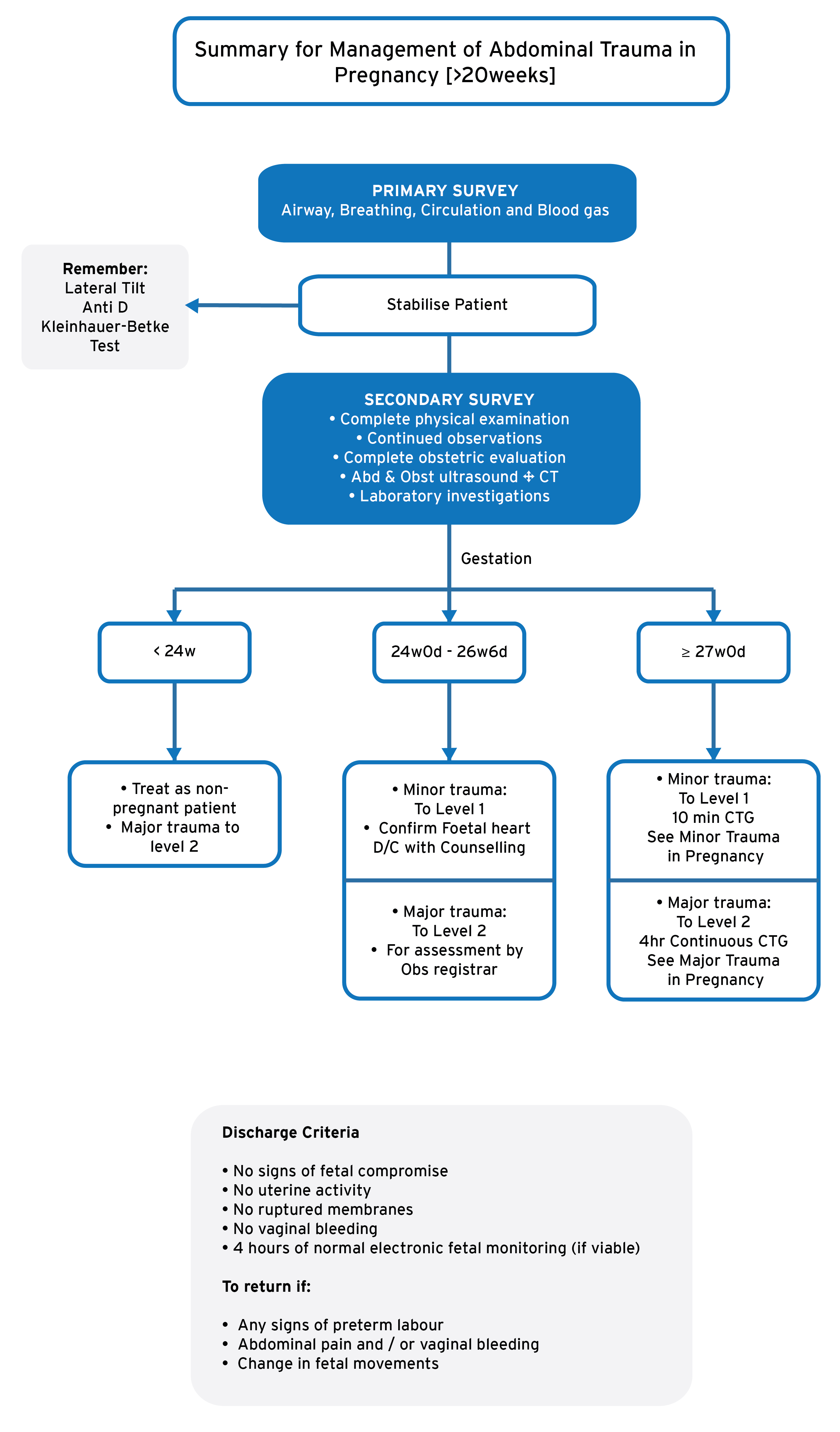
Click on the image to enlarge
Click here to open the above content in the original PDF view
Tygerberg Hospital, Department of Obstetrics and Gynaecology; Protocol for the Acute Managemnet of Abdominal Trauma in Pregnancy; Version: May 2013; Last checked for updates by EMGuidance: Oct 2023