GuidelinesOther guideline
Acute Meningitis
This guideline aims to assist healthcare workers with antibiotic prescribing for common clinical syndromes in adult patients in South Africa, utilizing Local and International guidelines, key publications, and expert opinion.
Definition
- Acute inflammation of the meninges of <7 days duration.
Likely pathogens
- Common – Various bacteria, viruses. TB meningitis can present acutely.
- Common bacterial pathogens are Streptococcus pneumoniae, Neisseria meningitidis, Haemophilus influenzae and Listeria monocytogenes (in immunocompromised, alcohol abuse, and patients over 50 years of age).
- Rare - fungi, protozoa and helminths
Clinical features
- Any 2 of the 4 cardinal features; headache, fever > 37.5˚C, neck stiffness and altered mental status
- Supporting features are photophobia, blanching or purpuric rash and vomiting
Tests
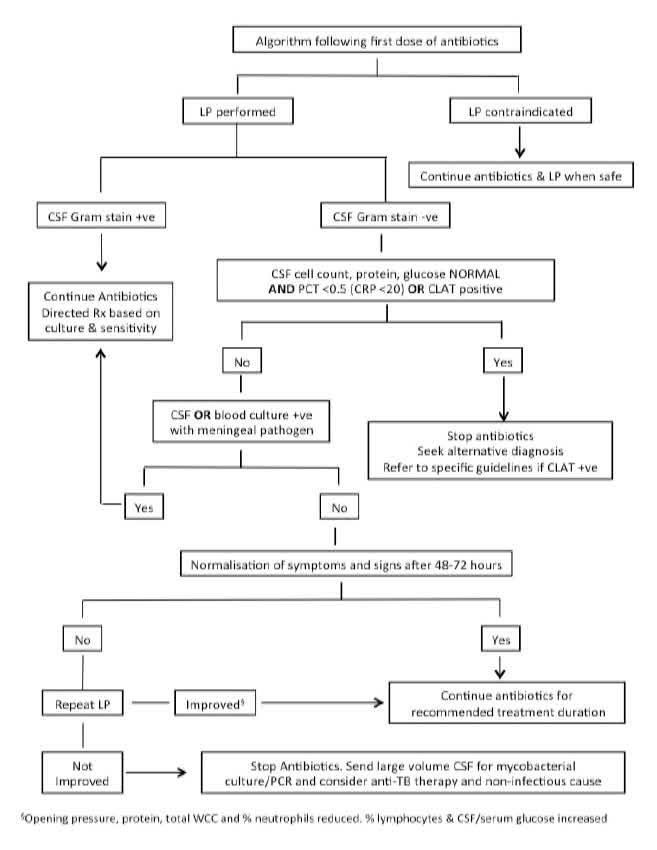
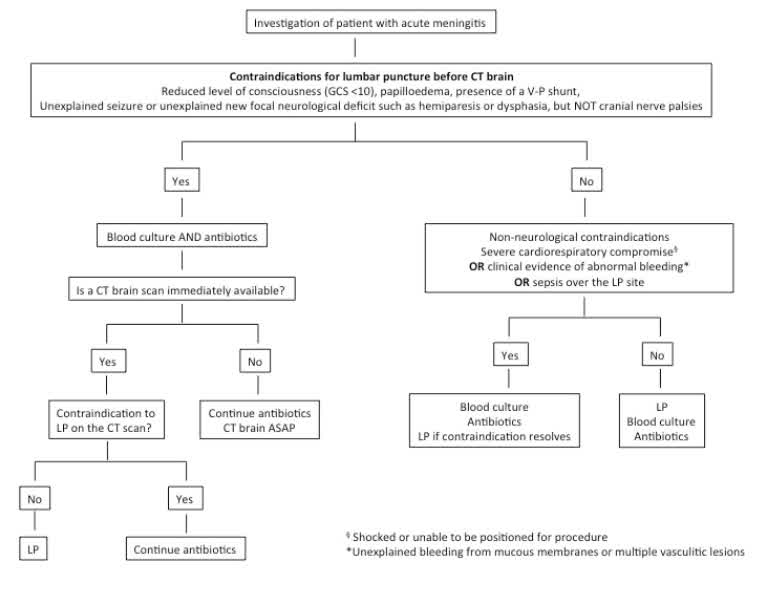
- See algorithm for lumbar puncture and CT brain
Management
General principles:
- Patients with suspected bacterial meningitis should receive ceftriaxone 2 g IV immediately. The dose for continued treatment is 2 g IV 12-hourly
- Penicillin allergy is not a contra-indication to use of ceftriaxone, unless the allergy was life threatening
- Blood culture and lumbar puncture should be performed before administration of antibiotics ONLY if this does not cause significant delay
- If bacterial meningitis is strongly suspected on the basis of clinical and CSF findings and all cultures are negative, give ceftriaxone for 10 days
- Steroids are not recommended
Specific therapy:
- S pneumoniae: duration 10 days
- If MIC unknown or > 0.1 microg/ml: ceftriaxone 2 g IV 12-hourly
- If MIC < 0.1 microg/ml: penicilin G 4 mU IV 4-hourly or ampicillin 2 g IV 4-hourly
- N meningitidis: duration 7 days
- Ceftriaxone 2 g IV 12‐hourly
- L monocytogenes: duration 21 days
- Ampicillin 2 g IV 4-hourly
- Gram-negative infection: duration 21 days
- Community-acquired: cefepime 2 g IV 8-hourly or ceftazidime 2 g IV 8-hourly
- Health care associated: meropenem 2 g IV 8-hourly