Acute Pancreatitis
Surgical Emergencies - Acute Pancreatitis
Diagnosis
Differential diagnosis
Aetiology Investigations
Initial assessment
Haemodynamic resuscitation
Risk predictors / assessment
Definition of Severity of Pancreatitis
Modified Marshall scoring system for organ dysfunction
Referral of patients with pancreatitis
Management principles
Cape metro acute pancreatitis algorithm
Diagnosis
The diagnosis of AP is established by the presence of 2 of the 3 following criteria:
- abdominal pain consistent with the disease,
- serum amylase and / or lipase greater than three times the upper limit of normal, and / or
- characteristic findings from abdominal imaging
Contrast-enhanced computed tomography (CECT) and / or magnetic resonance imaging (MRI) of the pancreas should be reserved for patients in whom the diagnosis is unclear or who fail to improve clinically within the first 48 – 72 h after hospital admission or to evaluate complications.
Differential diagnosis
Consider other causes of acute abdominal pain, such as:
- Biliary colic or acute cholecystitis.
- Perforated peptic ulcer.
- Acute liver conditions.
- Bowel obstruction.
- Acute appendicitis.
- Lung disease (for example pneumonia or pleurisy).
More severe pain suggests other possible causes, such as:
- Perforated or ischaemic bowel.
- Ruptured aortic aneurysm.
- Myocardial infarction.
Aetiology Investigations
US should be performed only if the history of alcohol intake is not convincing
In the absence of gallstones and / or history of significant history of alcohol use, a serum triglyceride should be obtained and considered the etiology if > 1,000 mg / dl.
In a patient > 40 years old, a pancreatic tumour should be considered as a possible cause of AP
ERCP investigation of an elusive etiology in patients with AP should be limited, and discussed with HPB Unit
Initial assessment
Hemodynamic status should be assessed immediately upon presentation and resuscitative measures begun as needed
Risk assessment should be performed to stratify patients into higher- and lower-risk categories to assist triage, such as admission to an intensive care setting
Patients with organ failure should be admitted to an intensive care unit or intermediary care setting whenever possible
Haemodynamic resuscitation
Aggressive hydration with Ringers lactate at 250-500 ml per hour should be provided to all patients until stable, unless renal or cardiovascular contra-indications exist. This is most beneficial during the first 12-24 hours
Fluid requirements should be reassessed at frequent intervals within 6 h of admission and for the next 24 – 48 h. The goal of aggressive hydration should be to decrease the urea levels.
Risk predictors / assessment
| Patient Factors | SIRS (>2 of the following criteria) |
Laboratory Findings | Radiology Findings |
| Age > 55 years Obesity (BMI > 30 kg/m2 Altered mental status Comorbid disease |
pulse > 90 beats / min resp rate > 20 / min or PaCO2 > 4.5 kPa temperature > 38 °or <36° C WBC count > 12,000 or < 4,000 cells / mm 3 or > 10 % immature neutrophils |
urea > 7.5 mmol/l or rising HCT > 44 % or rising Elevated creatinine |
Pleural effusions Pulmonary infiltrates Multiple or extensive extra-pancreatic collections |
Definition of Severity of Pancreatitis (Atlanta 2013)
|
Mild Acute Pancreatitis |
Moderately Severe Acute Pancreatitis |
Moderately Severe Acute Pancreatitis |
| Absence of organ failure Absence of local complications |
Local complications and / or Transient organ failure ( < 48 h) |
Persistent organ failure > 48 h (Modified Marshall Score) |
Modified Marshall scoring system for organ dysfunction
| Organ system | 0 | 1 | 2 | 3 | 4 |
| Respiratory (PaO2/FiO2) |
>400 |
301-400 |
201-300 |
101-200 |
≤101 |
| Renal* (creat,micromol/L) |
≤134 |
134-169 |
170-310 |
311-439 |
>439 |
| CVS off inotropes (systolic BP mmHg)• |
>90 |
<90, fluid responsive |
<90, not fluid responsive |
<90, pH <7.3 |
<90, pH <7.2 |
For non-ventilated patients, the FiO2 can be estimated from below:
|
Supplemental oxygen (L/min) |
FiO2 (percent) |
| Room air | 21 |
| 2 | 25 |
| 4 | 30 |
| 6-8 | 40 |
| 9-10 | 50 |
A score of 2 or more in any system defines the presence of organ failure.
* A score for patients with pre-existing chronic renal failure depends on the extent of further deterioration of baseline renal function. No formal correction exists for a baseline serum creatinine ≥134 micromol/L or ≥1.4 mg/dL.
Referral of patients with pancreatitis
|
Mild Acute Pancreatitis |
Moderately Severe Acute Pancreatitis |
Moderately Severe Acute Pancreatitis |
| Manage at district level hospital | Transfer to hospital with high care facility | Refer to ICU Manage by HPB Unit GSH |
Management principles
- Analgesia
- Intravenous fluids.
- Antibiotics for treatment of associated cholangitis or documented acute infections, such as a chest infection or urinary tract infection.
- No role for prophylactic antibiotics
- Supplemental oxygen (to maintain oxygenation of vital organs).
- Early nutritional support — enteral feeding is preferable and is possible in the vast majority of people.
- No role for deliberate “pancreatic rest”
- Parenteral feeding is reserved for patients in whom enteral nutrition is not possible.
If the person has acute pancreatitis of suspected or proven gallstone aetiology, management may include:
- early ERCP in patients with proven cholangitis
- Cholecystectomy during the same admission (unless protracted course of severe disease)
Cape metro acute pancreatitis algorithm
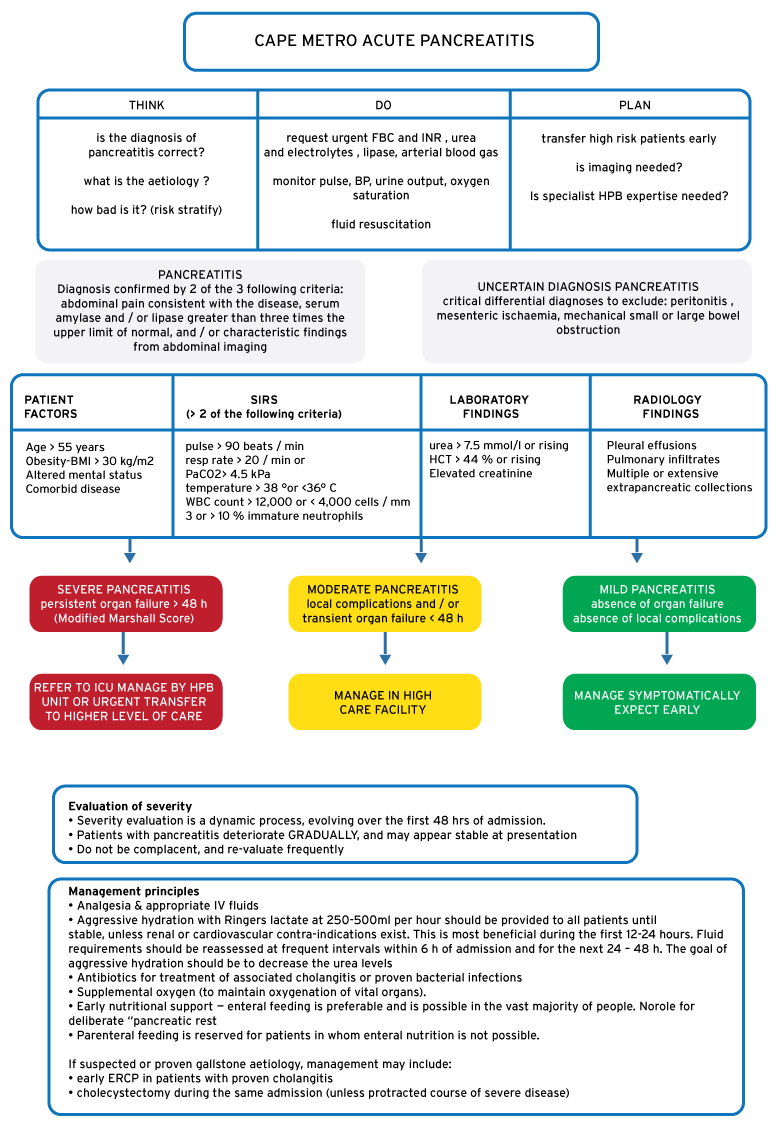
Evaluation of severity
- Severity evaluation is a dynamic process, evolving over the first 48 hrs of admission.
- Patients with pancreatitis deteriorate GRADUALLY, and may appear stable at presentation
- Do not be complacent, and re-valuate frequently
Management principles
- Analgesia and appropriate IV fluids
- Aggressive hydration with Ringers lactate at 250-500 ml per hour should be provided to all patients until stable, unless renal or cardiovascular contra-indications exist. This is most beneficial during the first 12-24 hours. Fluid requirements should be reassessed at frequent intervals within 6 h of admission and for the next 24 – 48 h. The goal of aggressive hydration should be to decrease the urea levels
- Antibiotics for treatment of associated cholangitis or proven bacterial infections
- Supplemental oxygen (to maintain oxygenation of vital organs).
- Early nutritional support — enteral feeding is preferable and is possible in the vast majority of people. No role for deliberate “pancreatic rest
- Parenteral feeding is reserved for patients in whom enteral nutrition is not possible.
If suspected or proven gallstone aetiology, management may include:
- early ERCP in patients with proven cholangitis
- cholecystectomy during the same admission (unless protracted course of severe disease)