Adolescent Chronic Disease: Transition Of Care
Description General and supportive measures Medicine treatment Referral ICD-10 code: Z00.3 DESCRIPTION Transition of care in adolescence is described as the purposeful, planned movement of a person with chronic medical conditions from a child-centred to an adult-orientated healthcare service. Specialised programmes for transition improve adherence and outcomes. Careful assessment of
General and supportive measures
ICD-10 code: Z00.3
DESCRIPTION
Transition of care in adolescence is described as the purposeful, planned movement of a person with chronic medical conditions from a child-centred to an adult-orientated healthcare service.
Specialised programmes for transition improve adherence and outcomes. Careful assessment of growth and development may determine an individualised approach to transition. Chronic disease during this period impacts on growth and development.
GENERAL AND SUPPORTIVE MEASURES
- Promote adherence to medicine and follow-up.
- Counselling and support.
- Manage and co-ordinate treatment through a multidisciplinary team, including physicians and paediatricians.
MEDICINE TREATMENT USING TANNER STAGING
The Tanner staging is used to assess pubertal development and medication doses may be adjusted according to Tanner staging rather than strictly on the basis of age.
TANNER STAGING OF PUBERTAL DEVELOPMENT
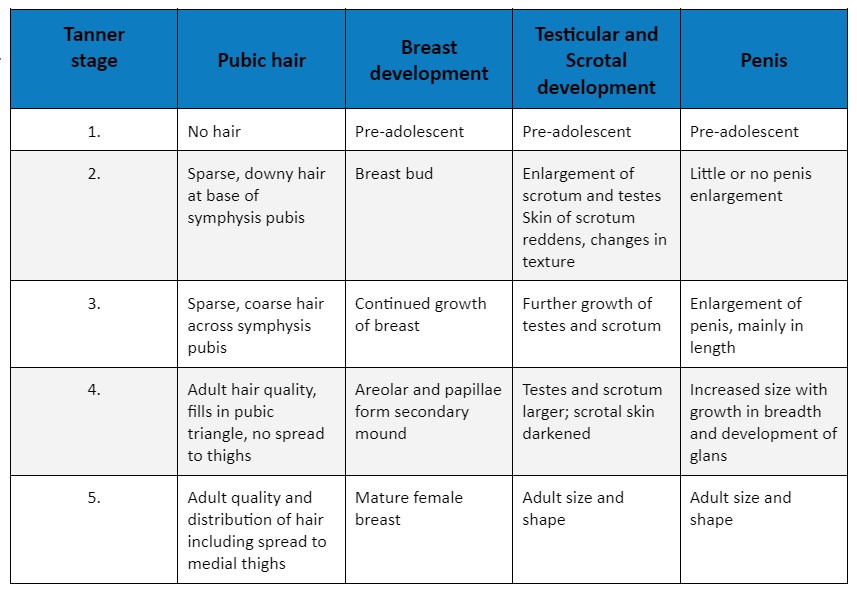
Click on table to enlarge
Note: Deviation from normal pubertal development may be primarily a disorder of the endocrine system and may reflect the impact of another disease process on the endocrine system.
In 50% of children, breast Tanner stage 2 develops at 10 years, pubic hair Tanner stage 3 at 11.5 years and menarche at 12.5 years.
Titrate doses according to Tanner staging rather than strictly on the basis of age.
- Tanner stage 1 or 2 or 3 (early to mid-puberty): use paediatric schedules.
- Tanner stage 4-5 (late puberty): use adult schedules.
- Puberty may be delayed in children with chronic disease, adding to discrepancies between Tanner stage-based dosing and age-based dosing (consult relevant package inserts for guidance of dosage).
- Optimise therapy of certain medicines by monitoring drug levels, and by adjusting doses during puberty and with weight gain.
- Consider medicine interactions, e.g. induction of oral contraceptive metabolism by rifampicin and changes of drug disposition during puberty and use convenient medicine formulations and devices that contribute to better treatment adherence.
- Minimise the adverse impact of medicines on cognition and brain development.
REFERRAL
- Refer patients with cognitive impairment and mental health problems to a psychiatrist.
- Refer adolescents with chronic disease for assessment by a psychologist and mental health specialist for recognition of anxiety, depression, attention-deficit disorder and post-traumatic stress disorder.
Standard Treatment Guidelines And Essential Medicines List For South Africa, Hospital Level, Paediatrics, 2023 Edition
Chapter 24 Adolescence, 24.1 Adolescent Chronic Disease: Transition Of Care