AKI Definition
AKI is defined as any of the following (Not Graded): Increase in SCr by ≥0.3 mg/dl (27 µmol/l) within 48 hours; or increase in SCr to ≥1.5 times baseline, which is known or presumed to have occurred within the prior 7 days; or urine volume <0.5 ml/kg/h for 6 hours. AKI is staged for severity according to the following criteria ( Table 2 ). (Not Graded) Table 2: Staging of AKI Stage Serum creat
- AKI is defined as any of the following (Not Graded):
- Increase in SCr by ≥0.3 mg/dl (27 µmol/l) within 48 hours; or increase in SCr to ≥1.5 times baseline, which is known or presumed to have occurred within the prior 7 days; or urine volume <0.5 ml/kg/h for 6 hours.
- AKI is staged for severity according to the following criteria (Table 2). (Not Graded)
Table 2: Staging of AKI
| Stage | Serum creatinine | Urine output |
| 1 | 1.5–1.9 times baseline OR ≥27 µmol/l increase |
<0.5 ml/kg/h for 6–12 hours |
| 2 | 2.0–2.9 times baseline | <0.5 ml/kg/h for ≥12 hours |
| 3 | 3.0 times baseline OR Increase in serum creatinine to 354 µmol/l OR Initiation of renal replacement therapy OR, in patients <18 years, decrease in eGFR to <35 ml/min per 1.73 m2 |
<0.3 ml/kg/h for ≥24 hours OR Anuria for ≥12 hours |
- The cause of AKI should be determined whenever possible. (Not Graded)
- We recommend that patients be stratified for risk of AKI according to their susceptibilities and exposures. (1B)
- Manage patients according to their susceptibilities and exposures to reduce the risk of AKI (see relevant guideline sections). (Not Graded)
- Test patients at increased risk for AKI with measurements of SCr and urine output to detect AKI. (Not Graded) Individualize frequency and duration of monitoring based on patient risk and clinical course. (Not Graded)
- Evaluate patients with AKI promptly to determine the cause, with special attention to reversible causes. (Not Graded)
- Monitor patients with AKI with measurements of SCr and urine output to stage the severity, according to Recommendation (Not Graded)
- Manage patients with AKI according to the stage (see Figure 4) and cause. (Not Graded)
- Evaluate patients 3 months after AKI for resolution, new onset, or worsening of pre-existing CKD. (Not Graded)
- If patients have CKD, manage these patients as detailed in the KDOQI CKD Guideline (Guidelines 7–15). (Not Graded)
- If patients do not have CKD, consider them to be at increased risk for CKD and care for them as detailed in the KDOQI CKD Guideline 3 for patients at increased risk for CKD. (Not Graded)
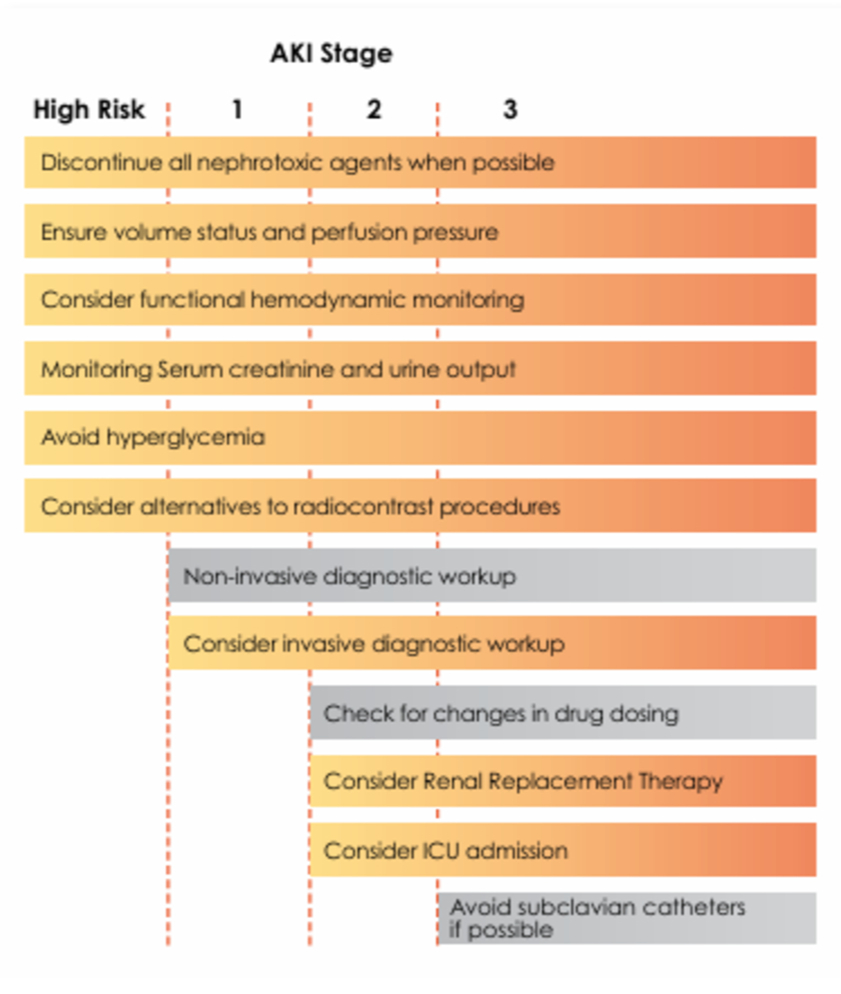
Figure 4: Stage-based management of AKI Shading of boxes indicates priority of action – solid shading indicates actions that are equally appropriate at all stages whereas graded shading indicates increasing priority as intensity increases. AKI, acute kidney injury; ICU, intensivecare unit.
Click on the image to enlarge.
Van Rensburg B, Naicker S, Paget G, et al. Guideline for the Care of Patients with Acute Kidney Injury. South African Renal Society (Adopted KDIGO Guideline); 2015.