Alcohol Withdrawal
Alcohol Withdrawal
Introduction
Identification
Severity assessment
Management based on severity
Investigations
Referral criteria
Discharge criteria
Outpatient follow up centres
Inpatient specialised substance treatment programs
Other agencies
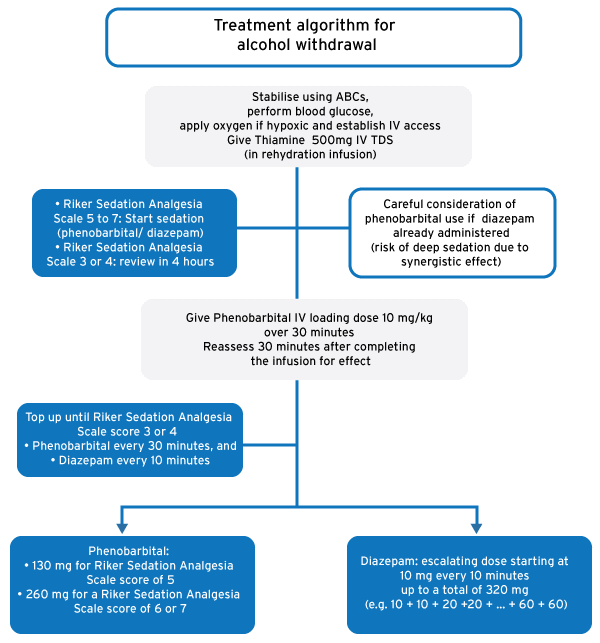
Treatment Algorithm
Introduction/description
By enhancing inhibitory tone (via Gamma Aminobutyric Acid (GABA) modulation), and inhibiting excitatory tone (via excitatory amino acid modulation), chronic alcohol consumption has a depressant effect on the Central Nervous System (CNS). Alcohol withdrawal syndrome thus results in increasing circulating Catecholamine levels, and CNS excitation.
Identification/ recognition/ diagnosis of problem
Mild alcohol withdrawal
≥ 6 hours (peaks at 24 to 36 hours) after cessation or significant decrease in alcohol intake: anorexia; nausea and vomiting; restlessness and anxiety; sleep disturbances; tremor; hyperreflexia; hypertension; tachycardia
Moderate – Severe alcohol withdrawal
≥ 24 hours (peaks at 50 hours to 5 days) after cessation or significant decrease in alcohol intake: anorexia; nausea and vomiting; restlessness and anxiety; sleep disturbances; tremor; fever; hyperreflexia; hypertension; tachycardia;decreased seizure threshold; hallucinations; delirium tremens
Withdrawal Seizures
Withdrawal Seizures are Generalised Tonic-Clonic (GTC); usually single / a brief flurry, and self-limited (recurrent / prolonged seizures, or Status Epilepticus are uncommon and require further investigation, to rule out co-morbid pathology);usually occur ≤ 12 to 24 hours; and are more common if there Is a long history of alcohol consumption before withdrawal
Alcoholic Hallucinosis
Alcoholic Hallucinosis usually occur ≤ 12 to 24 hours, and resolve ≤ 24 to 48 hours; usually visual (tactile and auditory less common); NO Confusion; NO Adrenergic Syndrome
Delirium Tremens
Delirium Tremens (DTs) is life- threatening, usually occurs >/=3 days, and includes: tremor; hallucinations; confusion (disorientation /clouded sensorium); agitation; hyperadrenergic syndrome (temp >38˚C,BP>140/90mmHg, HR>100bpm)
Differential Diagnosis
- Withdrawal from other sedative/hypnotic drugs (Withdrawal from Benzodiazepines and Barbiturates usually progresses more slowly, with withdrawal seizures occurring later, and with a greater incidence of Status Epilepticus)
- Intoxication with stimulant drugs (Sympathomimetic Toxidrome)
- Other Toxidromes (Anticholinergic, Neuroleptic Malignant Syndrome, Serotonin Syndrome)
- Infections (Intracerebral (Meningitis or Encephalitis) or Systemic (with Septic Shock))
- Metabolic conditions (e.g. Thyrotoxicosis, Hypoglycaemia, Electrolyte disorders, Renal / Hepatic failure)
- Trauma (Head injury or Polytrauma (with Haemorrhagic Shock))
- Hypoxia (Intracerebral (Cerebrovascular Accident (CVA) or Intracerebral Haemorrhage (IVH)) or due to Respiratory or Cardiovascular compromise)
- Psychiatric condition (Substance-induced Psychosis, Mood Disorder or Psychotic Disorder)
Severity assessment
Severity in our setting is assessed by using the Riker Sedation Analgesia Scale. Most algorithms make use of a scale to provide an objective assessment of the patient’s condition. More specific assessment tools, such as the Clinical Institute Withdrawal Assessment (CIWA) tool, are difficult to use within a low resource setting. The Riker Sedation Analgesia Scale uses agitation as a proxy to triage the patient’s severity. It is imperative that a diagnosis of alcohol withdrawal first be made prior to using it.
| Riker Sedation Analgesia Scale | ||
Score | Characteristic | Examples of patient’s behaviour |
| 7 | Dangerous agitation | Climbs over bed rails, strikes at staff, thrashes side to side, tries to remove catheters |
| 6 | Very agitated | Does not calm despite frequent verbal reminding of limits, requires physical restraints |
| 5 | Agitated | Is anxious and mildly agitated, calms down in response to verbal instructions |
| 4 | Calm and cooperative | Is calm, follows commands |
| 3 | Sedated | Is difficult to arouse, awakens to verbal stimuli or gentle shaking, but drifts off again, follows simple commands |
| 2 | Very sedated | Arouses to physical stimuli but does not communicate or follow commands |
| 1 | Unarousable | Has minimal or no response to noxious stimuli, does not communicate or follow commands |
Management based on severity
Immediate action
Non-drug treatment
Treat priorities as they present first,e.g. secure airway, maintain circulation, treat seizures, etc. Consider risk of aspiration. Give IV fluid to treat dehydration. Resuscitate with balanced solutions.
Drug treatment
- Thiamine: Included due to high risk of Wernicke’s Encephalopathy. Homelessness, malnutrition,decompensated chronic liver disease, or hospitalised for a co-morbid alcohol-related problem all suggest a high risk although signs could be subtle and history is not always available. Start with at least 500mg IV TDS mixed in 50 or 100 mL saline or 5%Dextrose.
Sedation: Start with phenobarbital. Careful consideration if benzodiazepines have already been given in last 6 hours (risk of deep sedation due to synergistic effect between these two drug classes). Give Phenobarbital IV loading dose 10 mg/kg over 30 minutes. Reassess 30 minutes after completing the infusion for effect. Add on benzodiazepines IV every 10 minutes and top up phenobarbital IV every 30 minutes until a Riker Sedation Analgesia Scale score of 3 or 4 has been reached. Top up use:
- Phenobarbital: 130 mg for Riker Sedation Analgesia Scale score of 5 and 260 mg for a Riker Sedation Analgesia Scale score of 6 or 7.
- An escalating dose of diazepam every ten minutes following reassessment and starting at 10 mg up to a total of 320 mg (e.g. 10 +10 + 20 +20 + … + 60 + 60). In chronic liver disease, acute alcoholic hepatitis and chronic lung disease use half dose Lorazepam hourly (short acting) or alternative agents, e.g. Oxazepam 20 – 40mg PO 4 – 6 hourly (no active metabolites)
- Seizures: Use Benzodiazepines (e.g. Diazepam) to abort seizures and Phenobarbital / Propofolin the case of Status Epilepticus. Phenytoin is ineffective in the treatment of withdrawal seizures and no convincing evidence exists for the use of Carbamazapine. Recurrent to prolonged seizures or Status Epilepticus is suspected require further investigation, to rule out co-morbid pathology. In isolated withdrawal seizures, sustained anticonvulsant therapy has no role.
- Hallucinations: Give Haloperidol 1 – 5mg PO/IM/IV, 4 – 6 hrly (PRN), for the treatment of severe hallucinations (especially in patients with pre-existing psychiatric conditions, and when refractory to sufficient treatment with Benzodiazepines). Haloperdol can lower the seizure threshold,prolong QT interval that can lead to arrhythmias, may cause hypotension and interferes with heat dissipation. Promethazine 25mg PO/IV/IM, 8 hrly (PRN), is useful for tactile hallucinations.
- Adjunctive treatments including ethanol, propofol, centrally acting α2agonists (Dexmedetomidine, Clonidine), β blockers (Propranolol) and selective GABA-B receptor agonists (Baclofen) are not currently recommended for use in alcohol withdrawal.
Investigations
- It is important to consider testing for glucose, sodium, potassium, magnesium, and phosphate as patients are predisposed to SIADH, hypoglycaemia, -kalaemia, -magnesaemia, and-phosphataemia
- Bedside: Haemoglobin, glucose, u-dipstix
- Also consider in complicated patients: Calcium,full blood count and liver functions (including clotting)
- CXR if aspiration pneumonia suspected
- CT Brain and/or Lumbar Puncture are not normally indicated unless recurrent to prolonged seizures or Status Epilepticusis suspected. Bear in mind that chronic subdural haemorrhage occurs more frequently in the alcoholic population.
Referral criteria
- Patients with a Riker Sedation Analgesia Scale score ≥ 5, Delirium Tremens, seizures, severe alcohol dependence and significant co-morbidities require hospitalisation at a district or regional health care facility after initiating treatment as described.
- Patients with a Riker Sedation Analgesia Scale score 3 – 4 and age > 60 years, pregnancy, psychiatric co-morbidity(psychosis / suicidal), poor home circumstances and limited support structures,and failed out-patient detoxification may require hospitalisation at a district or regional health care facility
Discharge criteria
Most patients do not require hospitalisation, and can be treated as follow, and followed up regularly at a community:
- Sedation: Calculate the sedation required to maintain a Riker Sedation Analgesia Scale score 3 – 4 in the last 24 hours.Prescribe this dose over the next 24 hours in divided doses (diazepam 4-6hourly and lorazepam 4 hourly). Taper the dose over the next three to five days.
- Thiamine 200mg PO, QID, for 7 days, THEN 100mg, BD, for 1 month
- Vit BCo 2 tablets PO, daily
- Vitamin C 200mg PO, daily
Outpatient follow up centres
City of Cape Town Matrix clinics:
- Delft South Matrix Clinic, tel: 021 955 1010/1021
- Tafelsig Matrix Clinic, tel: 021 397 8195/ 8906
- Tableview Matrix Clinic, tel: 021 557 1065/6
- Khayelitsha Matrix Site, tel: 021 360 4014/ 4000
CTDCC:
- Observatory, tel: (021) 447 8026
- Mitchell's Plain, tel: (021) 391 0216
SANCA:
- Regional office, tel: 021 945 4080
- Tygerberg, tel: 021-945 2099/2103
- Althone/Gugutethu, tel: 021 638 5116/5181; 021 637 2832
- Atlantis, tel: 021 572 7461
- Kayelitsha, tel: 021 364 6131
- Mitchells Plain, tel: 021 397 2196
- Paarl, tel: 021-872 9671
- George, tel: 044 8840674
Sultan Bahu:
- Mitchell's Plain branch, tel: 021 372 2945 / 372 4555
- Hanover Park, tel: 021 691 7782
- Bonteheuwel, tel: 021 694 9874
CARES
- Somerset West, tel: 021 850 0792
- Hout Bay, tel: 021 790 105
Inpatient specialised substance treatment programs:
Government/ NGO rehab facilities
- De Novo Treatment centre: (require social worker report for referral), tel: 021 988 1138
- Kensington: (require social worker report for referral) , tel: 021 511 9169
- Toevlug Treatment Centre (includes a youth program) , tel: 023 342 1162 (toevlug@mweb.co.za )
- Ramot, tel: 021 939 2033 (ramot@mweb.co.za )
- Hesketh King (Salvation Army) (males only; includes a youth program for 16-21 year olds) , tel: 021 884 4600 (hking@mweb.co.za )
- Ward 13, Stikland hospital (self-referrals; alcohol only), tel: 021 940 4496
- Western Cape Rehabilitation Centre (youth only), tel: 021-843 3200
- Durbanville Inpatients (SANCA), tel: 0219754927 (durbanville@sanca.co.za)
Private clinics
- Stepping Stones: Tel: 021 783 4230 (www.steppinstones.co.za )
- Crescent Clinic: Tel: 021 762 7666 (www.crescentclinic.co.za )
- Kenilworth Place: Tel: 021 685 2657 (kwplace@iafrica.com )
- Claro Clinic Tel: 021 595 8500
- Orient Rehabilitation Tel: 021 704 2032
- Tabankulu Addiction Recovery Centre Tel: 021 785 4664 (tkulu@mweb.co.za)
- Harmony Addictions Recovery Centre Tel: 021 785 4302; Fax: 0866022505 (reception@harmonyclinic.co.za)
- False Bay Therapeutic Centre Tel: 021 – 7826242 (falsebaytc@telkomsa.net )
- Namaqua Treatment Centre Tel: 027 217 1144; (info@namaqua-rehab.co.za)
- Minnesota House (George) Tel: 044-870 8585; (info@minesotahouse.co.za)
- Oasis Treatment Centre (Plettenbergbay) Tel: 044 5331752; (info@oasiscentre.co.za)
- Serenity Care Centre (Sedgefield) Tel: 044 343 1395 (serenity@cyberperk.co.za)
- Tehillah Spread Your Wings Treatment Centre (Elsies River) Tel: 0219330990 (tehillahcc@polka.co.za)
Other agencies:
- Alcohol Anonymous Tel: 0215925047 (aawestcape@freemail.absa.co.za)
- Alcohol Victorious (men) Tel: 0217861981
- Alcohol Victorious (women) Tel: 0217971270
- Narcotics Anonymous: Tel: 0881300327 (24 hours) (www.na.org.za)
- Nar-Anon and Nar-Ateen (family support narcotics) Tel: 0881296791
- Alateen and Al-Anon (family support alcohol) Tel: 0215923970 (alaonnct@iafrica.com )
- Tough Love (parents) Tel: 0214043056 (info@toughlove.org.za )
- ABBA network (Stellenbosch Area) Tel: 0218838030
- Christian Action for Dependants (CAD) Tel: 0219034472 (www.cad.org.za )
- CAB: Christelike Afhanklikheidsbediening Tel: 023 3486369 or 023 3421162
- Drug wise Tel: 0214348703
- Dopstop Tel: 0218875111 (www.dopstop.org.za )
- SMART Tel: 021 852 6065
- MRC Alcohol and Drug Abuse Research group Tel: 0219380419
- Gambling Help Line Tel: 0800006008
- Smoke Enders Tel: 0800 002 222
- Life Line Tel: 021 461 1111
Treatment algorithm for alcohol withdrawal
| Riker Sedation Analgesia Scale | ||
Score | Characteristic | Examples of patient’s behaviour |
| 7 | Dangerous agitation | Climbs over bed rails, strikes at staff, thrashes side to side, tries to remove catheters |
| 6 | Very agitated | Does not calm despite frequent verbal reminding of limits, requires physical restraints |
| 5 | Agitated | Is anxious and mildly agitated, calms down in response to verbal instructions |
| 4 | Calm and cooperative | Is calm, follows commands |
| 3 | Sedated | Is difficult to arouse, awakens to verbal stimuli or gentle shaking, but drifts off again, follows simple commands |
| 2 | Very sedated | Arouses to physical stimuli but does not communicate or follow commands |
| 1 | Unarousable | Has minimal or no response to noxious stimuli, does not communicate or follow commands |
References:
Kloeck WGJ. A Guide to the Management of Common Medical Emergencies, 8th ed. University ofcWitwatersrand Faculty of Health Sciences; 2008
Plymouth Hospital Alcohol Withdrawal Guidelines, November 2009
Rosen’s EmergencyMedicine, 8th Edition
Sullivan JT, Sykora K, Schneiderman J, Naranjo CA, Sellers EM. Assessment of AlcoholcWithdrawal: The Revised Clinical Institute Withdrawal Assessment for Alcohol Scale (CIWA-Ar). Br J Addict. 1989 Nov; 84(11):1353-7
Up To Date. Management of Moderate and Severe Alcohol Withdrawal Syndromes. [Online] October 2014. Available from: www.uptodate.com . [Accessed: 17November 2014]
Up To Date. Medically Supervised Alcohol Withdrawal in the Ambulatory Setting. [Online] January 2014. Available from: www.uptodate.com . [Accessed: 17 November 2014]
Western Cape Guidelines for the Management of Psychoactive Substance Intoxication and Withdrawal, 2012
Rosenson J, Clements C, Simon B, et al. Phenobarbital for acute alcohol withdrawal: a prospective randomised double-blind placebo-controlled study. J Emerg Med. 2013;44(3):592-598