AMS Structures
Supporting the Antimicrobial Resistance Strategy Framework and the Guidelines on Implementation of the Antimicrobial Strategy in South Africa: One Health Approach and Governance, 2018
The Hospital AMS Committee
The AMS team
Roles of the AMS team
Roles of AMS team at decision points in stewardship pathway
The Hospital AMS Committee
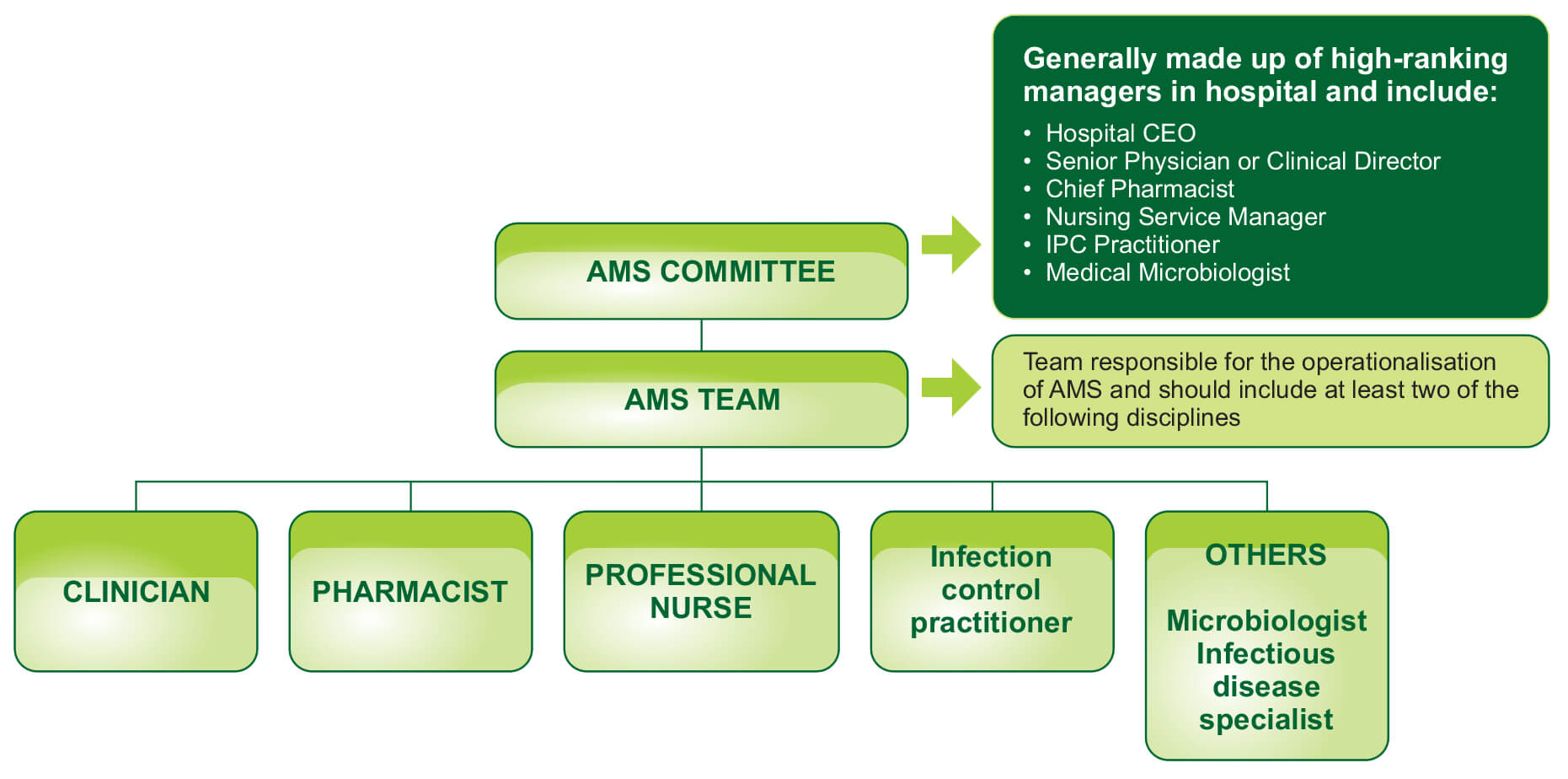
The AMR One Health Approach and Governance Guidelines24 require that all health facilities establish a HAMSC to provide oversight and coordination for AMS activities at the institution, including the activities of the hospital’s AMS team. The composition and specific responsibilities of the HAMSC are described in those guidelines (see also Annexure E) and organogram below
AMS structures in hospitals
Click on image to enlarge
The role of the HAMSC is to provide oversight and coordination for AMS activities at the institution, including the activities of the hospital’s AMS team(s), and to provide 6-monthly progress reports to the Provincial AMS Committee (PAMSC).
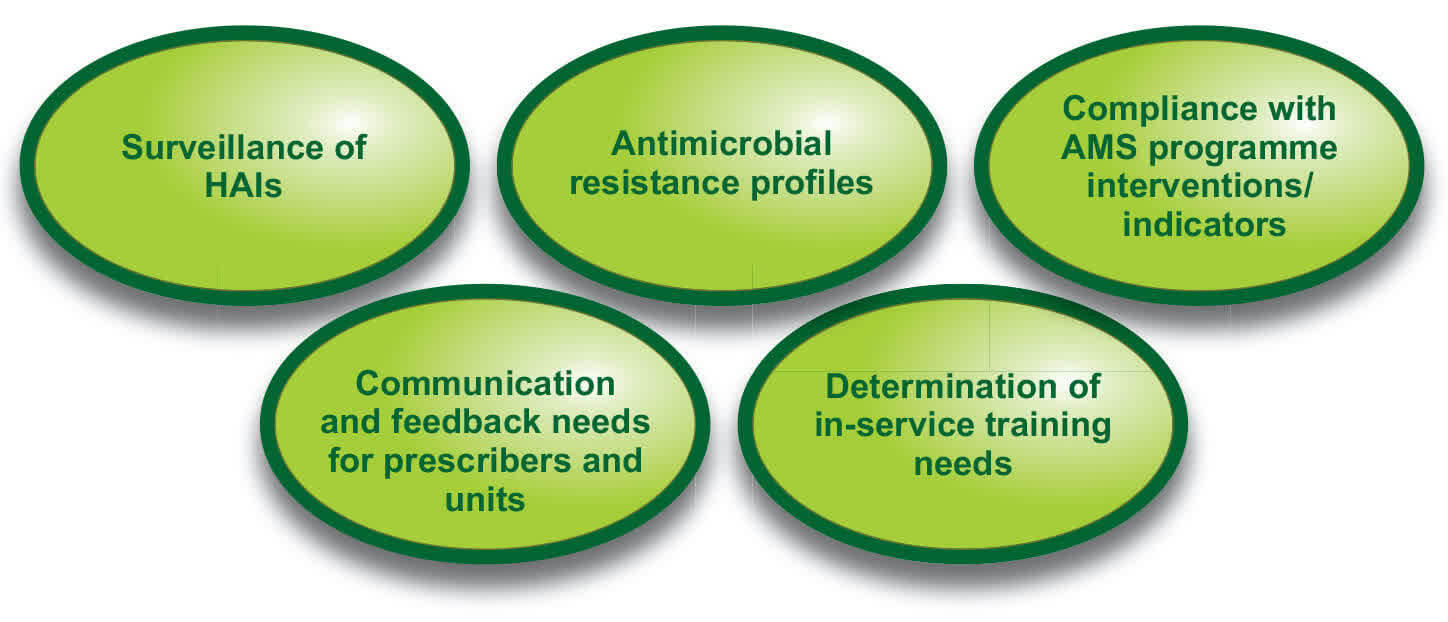
The position of the HAMSC within the hospital management structure is at the discretion of the Chief Executive Officer. The HAMSC may either form a standalone committee or be incorporated into the agenda of either the hospital’s IPC or another clinical or quality committee. If AMS is positioned within an already existing committee, AMS activities defined in the Figure below must be included in the agenda of that committee as standing items. For smaller hospitals the AMS Committee and AMS team may be one and the same structures.
Key agenda items for AMS and IPC discussions
Click on image to enlarge
There must be clearly defined lines of communication and feedback provided between the HAMSC and other relevant hospital committees, heads of nursing, pharmacy, quality improvement, other relevant heads of departments, as well as with the PAMSC.
The AMS team
The AMS team is a small, on-the-ground clinical team that should be represented on the HAMSC but is a distinct entity that performs patient-level AMS activities in the institution.
Composition of AMS team
International guidelines recommend that AMS programmes should be led by infectious diseases physicians or clinical pharmacists with advanced AMS training. These are scarce skills in South Africa and will be unavailable at almost all health care facilities. However, other trained staff members can effectively lead AMS programmes, and these should be identified by the HAMSC.
It is important to identify a respected, well known team leader in order to enhance buy-in from prescribers and other HCWs. The team leader should undergo some form of training in AMS. The rest of the AMS team should ideally be comprised of a multidisciplinary group of staff members who have also received training in AMS. The specific size and makeup of the AMS team will depend on the needs and resources of each facility. Should the hospital be very small, it may be difficult to resource an entire team, in which case the respected, well-known leader will implement the programme.25 The following staff members may be included (see AMS structures in hospitals):
- Pharmacist;
- Practitioner with IPC knowledge;
- Clinician;
- Other members may not necessarily be on-site, but may be included as necessary on an ad hoc basis;
- Quality manager;
- Microbiologist (to consult on specific cases or in facilities with access to microbiology support they should form part of the core AMS team);
- Infectious diseases specialist.
Roles of the AMS team
The role of each member of the AMS team is summarised in the tables below. Depending on the composition of the team at each facility, there may be substantial overlap in responsibilities between team members. The team has overall responsibility for providing regular patient-level AMS activities in the facility. These activities are described in detail below.
Role of AMS team members and treating clinical team
|
AMS Clinician or Infectious Disease Specialist
|
|
• Accurate antimicrobial use and allergy history
• Early and appropriate cultures taking
• Appropriate empiric antimicrobial
• Timely antimicrobial initiation
• Preliminary microbiology results and antimicrobial adjustment
• Antimicrobial dosing and de-escalation
• IV to oral antimicrobial switch
• Evaluation of clinical response
• Final culture report review and antimicrobial adjustment
• Identification of AMR
• Hand hygiene
• Infection control precautions
• Evaluate need for IV cannulas and urinary catheters• Adverse events |
| Pharmacy |
|
• Accurate antimicrobial use and allergy history
• Medication reconciliation
• Preliminary microbiology results and empiric antimicrobial adjustment
• Antimicrobial dosing and de-escalation
• Therapeutic drug monitoring if indicated
• Discontinuation of the antimicrobial therapy
• Adverse events
• Final culture report and antimicrobial adjustment
• IV to oral antimicrobial switch
• Compatibility of IV antimicrobials with infusion solutions and rate of IV administration
• Appropriate duration
• Ensuring medications are available timeously for administration• Patient education |
| Nursing |
| • Triage and appropriate isolation • Accurate antimicrobial use and allergy history • Early and appropriate cultures taking • Timely antimicrobial administration • Medication reconciliation • Monitor and report on progress • Adverse events • Monitor for changes in patient condition • IV to oral antimicrobial switch • Hand hygiene • Infection control precautions • Assess for appropriate care of IV cannulas and urinary catheters • Patient education |
| IPC practitioner |
|
• Triage and appropriate initial isolation
• Identification of AMR • Infection control precautions • Hand hygiene • Assess for appropriate care of cannulas and urinary catheters • Patient education |
| Microbiology |
| • Preliminary microbiology results and antimicrobial adjustment • Final culture report and antimicrobial adjustment • Identification of AMR • Advise infection control precautions • Advisory role on AMS progress |
*IV – intravenous
Source: SASOCP26
Click here for the Roles of AMS team at decision points in stewardship pathway
Source: SASOCP27
24 National Department of Health, Guidelines for the Implementation of the Antimicrobial Resistance Strategy in South Africa: One Health Approach and Governance. Pretoria; 2017
25 C Pulcini, F Binda et al. Developing core elements and checklist items for global hospital antimicrobial stewardship programme: A Consensus approach. ESCMID; 2018.
26 SASOCP. Position Statement on the Pharmacists Role in Antibiotics Stewardship. 2018.
27 Schellack N, Bronkhorst E, et al. SASOCP Position Statement on the Pharmacists Role in Antibiotics Stewardship; SAJID 2017;33(1):28-35.