An Approach to Haematochezia
Doctor, I am passing blood per rectum!
Introduction
Differential Diagnosis
Evaluation Priorities
Lower GI Bleeding Algorithm
Context: Emergency Unit
Introduction
Fresh bleeding per rectum most commonly means that the bleeding source is from the hindgut, originating from the colon, rectum or perianal pathology.
Perianal conditions will usually cause red blood on the toilet paper or blood dripping into the toilet bowl after defecation, and are seldom of haemodynamic consequence; whereas colonic bleeding is usually mixed with stool.
A brisk upper GI bleed can occur without haematemesis, and a high volume of blood may rush unchanged through the gut and appear “fresh” per rectum.
Bleeding from the small bowel is rare.
Differential Diagnosis
| Common | Clues |
| Haemorrhoids | Fresh squirt of blood after defecation or on toilet paper |
| Diverticular disease | Older patient large amount of altered blood acutely |
| Colon carcinoma | LOW, change of bowel habit, family Hx |
| Colitis with dysentery | Diarrhoea, with blood |
| Uncommon and weird | Clues |
| Warfarin toxicity | Take a drug history |
| Angiodysplasia | Diagnosis by exclusion/ older patient |
| Intussusception | Abdominal pain/ bowel obstruction/ younger patient |
| Meckel’s diverticulum | Younger patient |
| Mesenteric ischaemia | Vasculopath |
| Don't want to miss | Clues |
| Upper GI bleed | Haemodynamic unstable |
| Colorectal cancer | Often has no other symptoms at all |
Evaluation Priorities
How bad is this?
There is no universally accepted scoring system, and fortunately, most patients (irrespective of the cause) stop bleeding without needing intervention.
Could this be a severe upper GI bleed?
Any patient who presents with a haemodynamically unstable bleed must have an upper GI source of bleeding excluded before the cause can be assumed to arise from the hindgut.
Is this really just haemorrhoids?
Patients often attribute any perianal or defecation symptom to a self-diagnosis of “haemorrhoids”. It is essential to perform a thorough perianal examination and procto-sigmoidoscopy in all cases, and to actively exclude a colorectal carcinoma even in those patients who really do have “haemorrhoids”.
Lower GI Bleeding Score | |
| Admission risk marker | Score |
| Blood Creatinine | |
| ≥150 | 1 |
| Haemoglobin (g/L) | |
| <10.0 | 1 |
| Continued bleeding PR | |
| >12 hrs or rebleed | 1 |
| Systolic BP (mm Hg) | |
| <100 | 1 |
| Patient age | |
| >60 | 1 |
| Pulse | |
| Pulse ≥100 (per min) | 1 |
Lower GI Bleeding Algorithm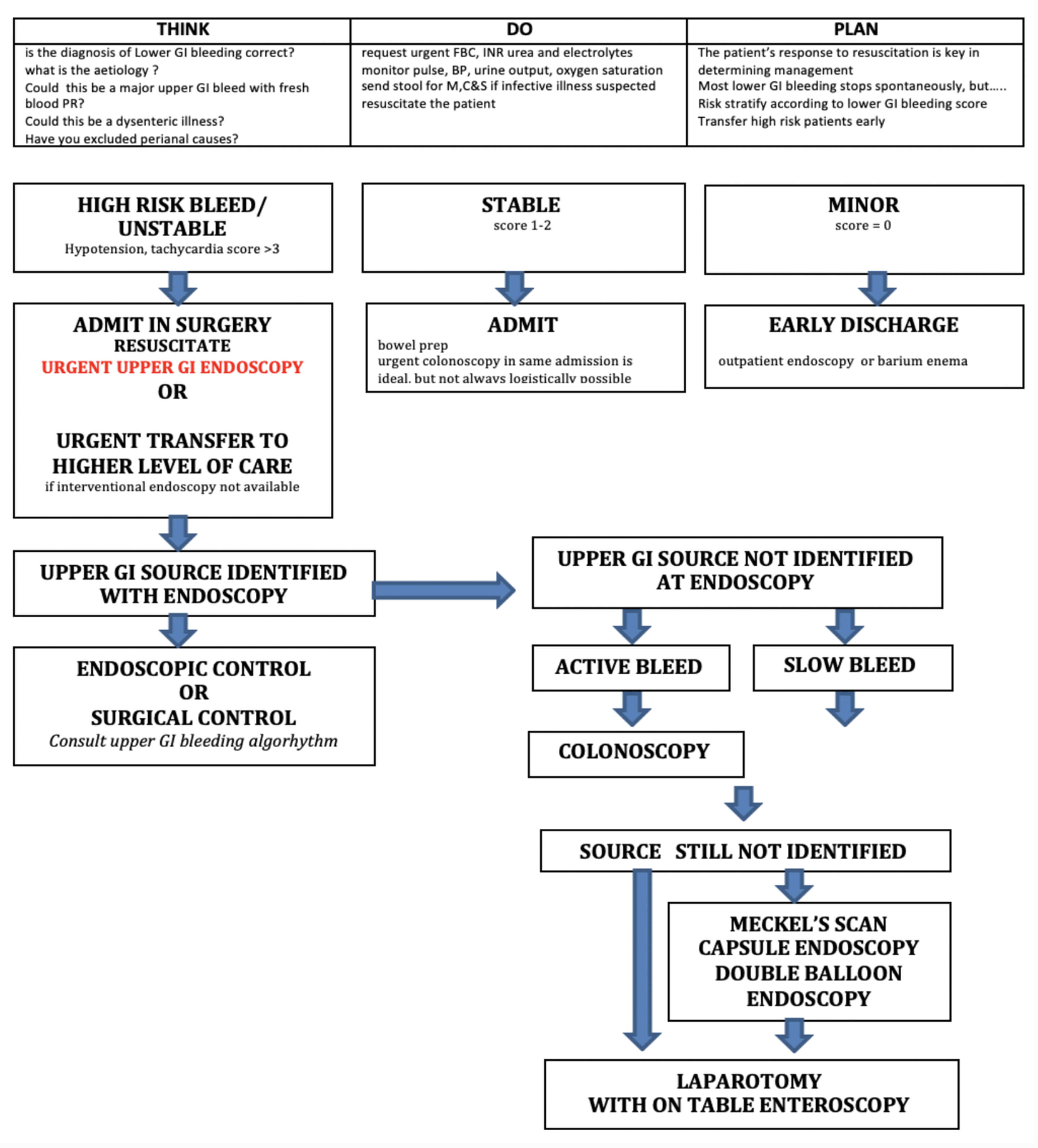 Click on above image to enlarge
Further Considerations about Management
- Major bleeds are uncommon.
- Usually the bleeding is self-limiting.
- Perform a thorough perianal examination including proctoscopy and rigid sigmoidoscopy to exclude
- perianal or rectal causes of bleeding
- Resuscitation and aggressive management is mandatory in cases at high risk (score >3)
- Patients with ongoing bleeding are complex, and should be transferred to regional, or provincial hospitals early