An Approach to Large Bowel Obstruction
Doctor, my abdomen is swelling up and I can't go to the toilet!
Introduction
Differential Diagnosis of Abdominal Distention
Causes of LBO
Evaluation Priorities
Large Bowel Obstruction Algorithm
Context: Emergency Unit
Introduction
Abdominal distention may be the presenting sign of a range of potential diagnoses, some of which are glaringly obvious (i.e. pregnancy!) whilst others may really test your diagnostic acumen. The clinical context is very important; age and gender of the patient will strongly influence your decision making and differential diagnosis.
Differential Diagnosis of Abdominal Distention
The 6 F's
Fetus | Pregnancy must always be considered in women, it’s easy not to consider it in the perimenopausal years. Take a thorough gynaecological history, and always do a pregnancy test |
Fat | Some patients develop predominant abdominal adiposity- clinical evaluation can be very challenging |
Flatus | Bowel obstruction, either SBO or LBO, can cause massive abdominal distention, clearly resonant on percussion. Almost all patients will have symptoms of gut dysfunction (nausea, vomiting, constipation, abdominal pain) |
Faeces | Faecal impaction can cause clinical features of large bowel obstruction, with colonic distention. Patients with colonic dysmotility can retain a massive volume of faeces in the bowel |
Fluid | Ascites is a common “medical” cause of abdominal distention. On occasion patients with an occult malignancy present with malignant ascites and metastatic deposits in the omentum (omental cake). Pseudomyxoma peritonei can cause gelatinous ascites. |
Filthy tumour | Ovarian neoplasms are the commonest cause of a large intra-abdominal mass retroperitoneal sarcomas, cystic tumours of the pancreas, GIST tumours of the bowel, and lymphomas are other possibilities |
The typical presentation of large bowel obstruction is with a few weeks of progressive constipation, abdominal distention, obstipation, mild discomfort, eventually followed by severe pain and nausea and vomiting.
On examination pay specific attention to signs of dehydration. Look for anaemia and adenopathy. The abdominal examination must include a meticulous search of all hernia sites. Perform a proper digital rectal examination AND a pelvic examination in women - large ovarian neoplasms are easy to miss if you don't do this. A complete LBO can cause spectacular abdominal distention, but on palpation, the patient should not have signs of peritonism unless a perforation or bowel necrosis has occurred.
The radiological features of LBO are of distended colonic loops (look for the haustra and peripheral location of the distended bowel), with little or no small bowel distention. The differentiation between SBO and LBO clinically and radiologically can be very difficult, and a discussion with a senior colleague must always be done.
Causes of LBO
Common causes (>90%) |
| Colonic carcinoma Diverticular stricture Sigmoid volvulus Faecal impaction Pseudo-obstruction |
| Unusual |
| In the lumen Foreign body obstruction Large pedunculated polyp In the wall Inflammatory bowel disease (Crohn's or UC stricture) Infective strictures (TB, ameboma, schistosomiasis) Radiation stricture Unusual neoplasm (GIST/lymphoma/Kaposi's) Extrinsic Volvulus of the transverse colon or caecum Adherence to inflammatory mass (appendix abscess) Intra-peritoneal carcinomatosis Compression by non GI neoplasm (gynae oncology/retroperitoneal sarcoma/prostate cancer) Internal hernias and adhesions Dysmotility Autonomic neuropathy in diabetics/post spinal cord injury Post-op patients (postoperative ileus |
Evaluation Priorities
How bad is this?
- rehydrate the patient, and correct the expected electrolyte derangements
- nasogastric tube drainage if the patient is vomiting
Is this really LBO?
- make sure this is not a presentation of an infective or inflammatory intraperitoneal condition (don't miss appendicitis!!!), or an SBO.
What is the cause?
| Cause | Description |
Colonic carcinoma | Gradual onset of change of bowel habits may have anaemia |
Diverticular stricture | Previous episodes of abdominal pain. Often indistinguishable from a colonic malignancy, until histology specimens are taken |
Sigmoid volvulus | Sudden onset of abdominal distention and pain. Characteristic “coffee bean” appearance of distended sigmoid on plain Xray |
Faecal impaction | Hard impacted faeces palpable on rectal examination |
Pseudo-obstruction | Soft stool present in the rectum on PR. Metabolic derangements (hypokalaemia/hypercalcaemia/hypothyroidism) or neurologically frail/ bed-bound patients |
Is the bowel obstruction complete or incomplete?
- Obstipation, gross distention, and lack of gas in the rectum imply the obstruction is complete
Could the bowel be ischaemic / compromised?
- persistent pain, pyrexia, peritonism, leukocytosis, intramural gas or intraperitoneal gas are diagnostic of perforation. The most common site of perforation is the caecum - right iliac fossa tenderness and marked distention of the caecum on X-ray are concerning findings.
Does the patient need an operation?
- Most cases of LBO allow you 24-48 hours of diagnostic workup before a therapeutic decision is taken.
- No case of LBO "gets better by itself" - you need to make a plan.
- Untreated LBO will lead to perforation and cause a catastrophic death unless it is dealt with.
- Cases suggestive of bowel ischaemia MUST have an urgent operation.
- A large bowel operation must be done by a senior surgeon, decision making is complex, and errors can have major consequences.
Cause | Treatment Options |
Colonic carcinoma | Bowel resection/ diverting stoma/ stent |
Diverticular stricture | Bowel resection/ diverting stoma/ stent |
Sigmoid volvulus | Endoscopic de-torsion, followed by elective resection |
Faecal impaction | EUA, and manual disimpaction of the fecaloma |
Pseudo-obstruction | Correct underlying metabolic derangements/ fleet enemas/ oral laxatives/ occasionally colonoscopy to decompress |
What other investigations must I consider?
- A CT scan, emergency flexible sigmoidoscopy or contrast enema are the options to evaluate cases. Local availability of these will determine which is used first.
- Don't let these investigations delay the surgical decisions by weeks!
Real problem scenarios!
I am not sure if the patient has SBO or LBO! Review your diagnosis - a CT scan is indicated, only if it can be done without undue delay. Discuss this scenario with your seniors - decision making in this context is difficult.
The patient has clear LBO, but I am not an experienced surgeon, and there is no one else in my hospital for a long weekend! Refer the patient now. Don't wait and see.
Large Bowel Obstruction Algorithm
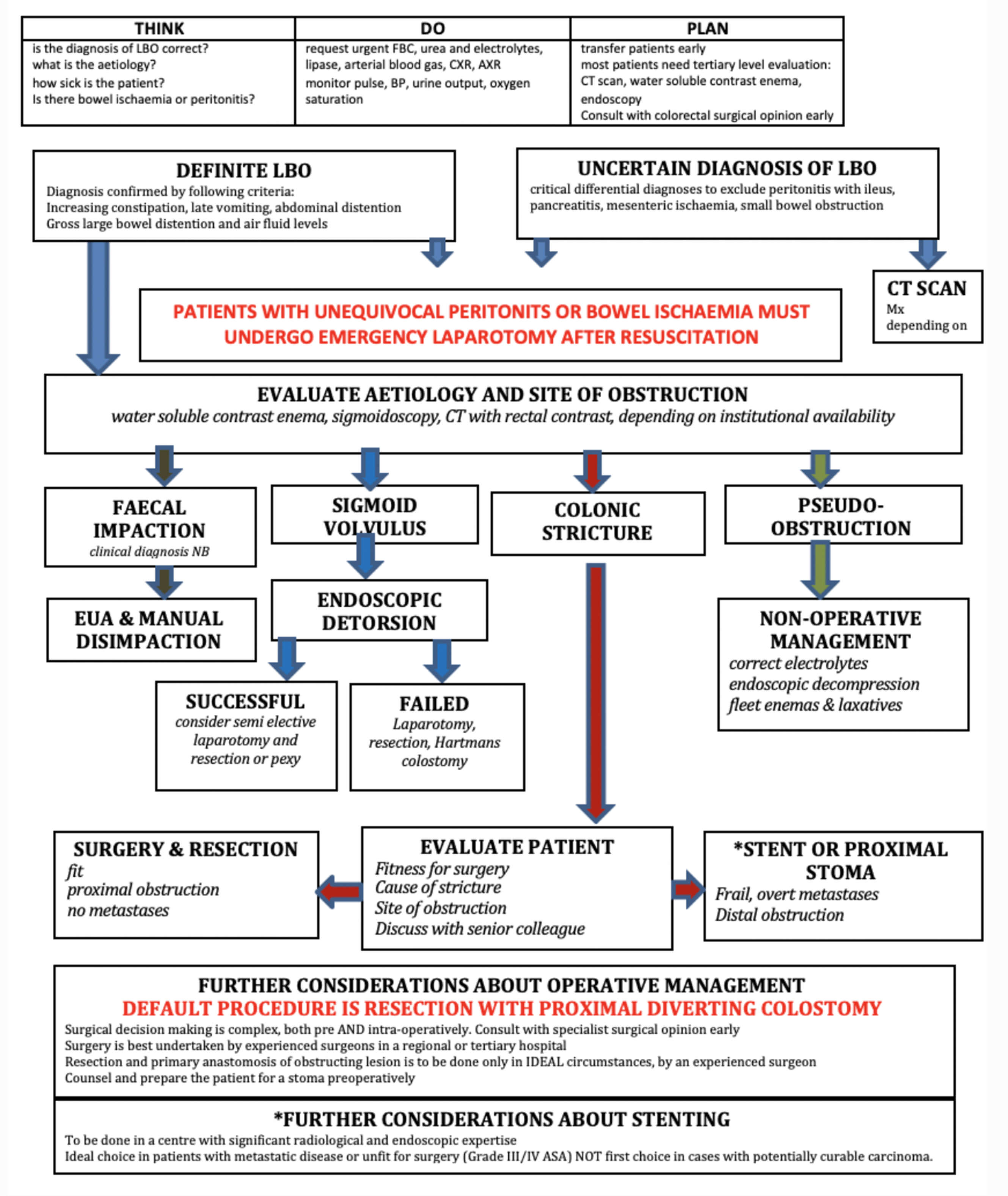
Click on above image to enlarge