Anaemia, iron deficiency
ICD-10 codes: D50.0 / D50.8 / D50.9 Description General measures Medicine treatment Referral DESCRIPTION A common cause of anaemia in young children and women of childbearing age. A full blood count showing a low MCV suggests the diagnosis of iron deficiency anaemia. A full blood count is not required for children, unless referral criteria above are present. Note: Iron deficiency anae
ICD-10 codes: D50.0/D50.8/D50.9
Description
General measures
Medicine treatment
Referral
DESCRIPTION
A common cause of anaemia in young children and women of childbearing age.
A full blood count showing a low MCV suggests the diagnosis of iron deficiency anaemia.
A full blood count is not required for children, unless referral criteria above are present.
Note: Iron deficiency anaemia in children > 5 years of age, adult males and non-menstruating women, is generally due to occult or overt blood loss. Refer all cases for investigation and treatment of the underlying cause.
GENERAL MEASURES
- Identify and treat the cause.
- Exclude other causes. See referral criteria in Anaemia.
- Dietary advice:
- Avoid drinking tea/coffee with meals.
- Increase vitamin C intake (e.g. citrus fruit, orange juice, broccoli, cauliflower, guavas, strawberries) with meals to increase iron absorption from the diet.
- Increase dietary intake of iron. Foods rich in iron include: liver, kidney, beef, dried beans and peas, green leafy vegetables, fortified wholegrain breads, cereals.
MEDICINE TREATMENT
Treatment
Treat the underlying cause.
Children < 5 years of age
- Iron, oral, 1 - 2 mg/kg/dose of elemental iron 8 hourly with meals.
- Follow up Hb after 14 days.
- Hb lower than before: refer.
- Hb the same/higher: continue treatment and repeat after another 28 days.
- Continue treatment for 3 months after Hb normalises.
Empiric treatment for worms (this will not treat tapeworm)
- Mebendazole, oral.
- Children 1 - 2 years: 100 mg 12 hourly for 3 days.
- Children > 2 - 5 years: 500 mg as a single dose.
OR
- Albendazole, oral, single dose.
- Children 1 - 2 years: 200 mg as a single dose.
- Children ≥ 2 years and adults: 400 mg as a single dose.
Adults
- Ferrous sulfate compound BPC (dried), oral, 170 mg (± 55 mg elemental iron) 12 hourly with meals.
OR
- Ferrous fumarate, oral, 200 mg (± 65 mg elemental iron) 12 hourly.
- Do not ingest with tea, antacids or calcium supplements/milk.
- Doses should be taken on an empty stomach, but if gastrointestinal side effects occur doses should be taken with meals
- Continue with treatment for 3 - 6 months once Hb has normalised to replace iron stores.
Follow the patient after one month of treatment and Hb should rise by at least 2 g/dL in 4 weeks in the adherent patient without ongoing blood loss.
If daily iron is poorly tolerated (e.g. epigastric pain, nausea, vomiting and constipation), intermittent iron supplementation may be administered:
- Ferrous sulphate compound BPC (dried), oral, 340 mg per week, (± 110 mg elemental iron), with meals.
OR
- Ferrous fumarate, oral, 400 mg per week (± 130 mg elemental iron).
Pregnant women
See: Anaemia in pregnancy.
Consider the following if there is failure to respond to iron therapy:
- non-adherence,
- continued blood loss,
- wrong diagnosis,
- malabsorption, or
- mixed deficiency; concurrent folate or vitamin B12 deficiency.
Prophylaxis
Infants from 6 weeks
ICD-10 code: Z29.2
If < 2.5 kg at birth:
- Ferrous lactate, oral, 0.6 mL daily (provides ± 15 mg elemental iron) until 6 months of age.
OR
- Ferrous gluconate syrup, oral, 2.5 mL daily (provides ± 15 mg elemental iron) until 6 months of age.
Pregnant women
See: Antenatal supplements.
Elemental iron per preparation
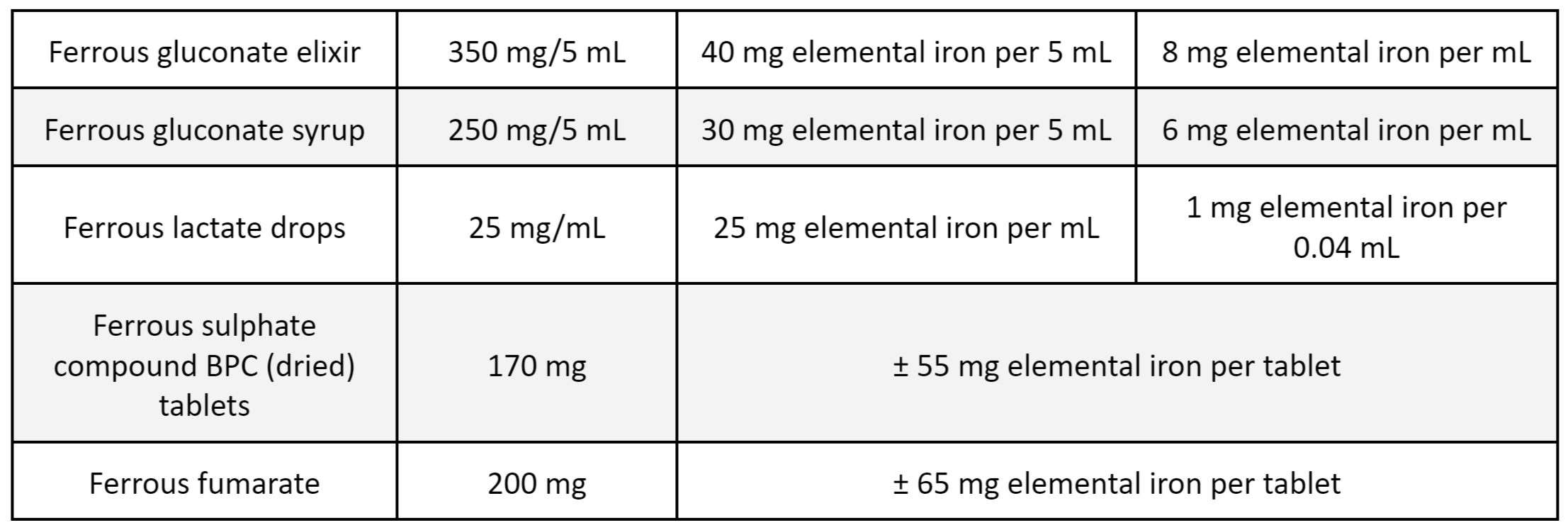
Click on table to enlarge
CAUTION
Iron is extremely toxic in overdose, particularly in children. Store all medication out of reach of children.
REFERRAL
- As in Anaemia.
- Children > 5 years of age, men and non-menstruating women.
- No or inadequate response to treatment.
Standard Treatment Guidelines and Essential Medicines List for South Africa, Primary Healthcare Level, Updated for the 2023 Edition