Ankle Injuries - Mechanism of Injury
Ankle injuries - Mechanism of injury
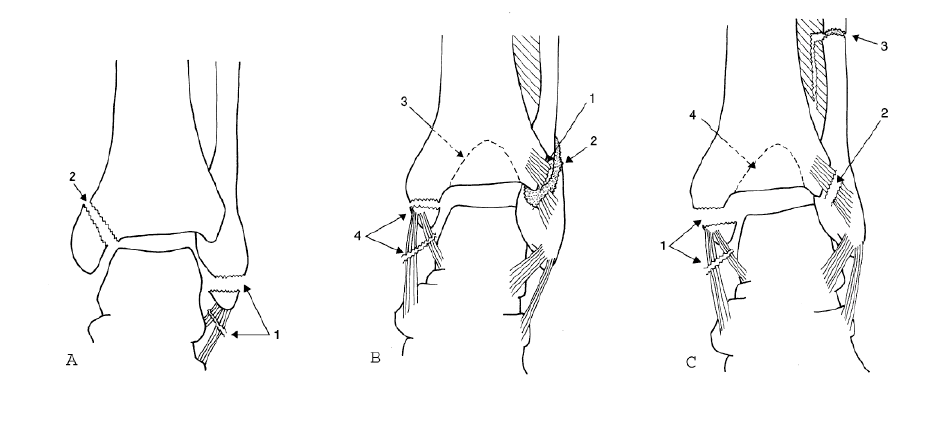
Bio-mechanics of injury:
- (A) supination-adduction or inversion - the ankle is inverted, the foot is supinated and the talus is adducted.
- 1) tear the lateral ligaments or avulse a bony fragment from the lateral malleolus
- 2) drive the talar dome medially, impacting and obliquely fracturing the medial malleolus at the level of the mortise.
- (B) supination-external rotation - the talus is externally rotated, the foot is either supinated or pronated. The rotational or torsional forces that are introduced create a clockwise or counterclockwise pattern of injury around the long axis of the leg.
Supination-external (SE) rotation forces injure anterolateral ankle structures first, beginning with:
- rupture of the anterior syndesmosis;
- spiral fracture of the fibula at the level of the mortise;
- posterior malleolar fracture and/or posterior syndesmotic tear;
- medial malleolar fracture and/or deltoid ligament sprain.
In contrast, pronation-external (PE) rotation forces injure medial ankle structures first, beginning with:
- medial malleolar fracture and/or deltoid ligament tear; and progressing to
- tear of the anterior syndesmosis;
- fibular shaft fracture above the level of the mortise; and, finally,
- posterior syndesmosis tear.
(C) pronation/ external rotation. Eversion or pronation-abduction (PA) forces injure medial structures first :
- tearing the deltoid ligament or avulsing a fragment from the medial malleolus;
- rupturing the syndesmosis; and
- driving the talar dome laterally, causing an oblique fracture of the lateral malleolus at the level of the mortise.
According to the Lauge-Hansen classification system of ankle fractures, the numbers represent the order in which specific structures are injured.
For practical purposes, ankle injuries can be divided into three groups based on the motion of the talus within the mortise:
- Inversion (adduction)
- Eversion (abduction)
- External rotation
The patterns of injury that occur during inversion and eversion have the following in common each features damage to the ipsilateral ligament (with or without a transverse avulsion fracture of the malleolus) and an oblique impaction fracture of the opposite malleolus.
PEARL
- Understanding the mechanism, structures involved and the injury pattern can help the clinician anticipate where to look closely for fractures.
- With the exception of lateral ligament tears and lateral malleolar avulsions, injuries do not often occur in isolation.
- The level of the fibular fracture with respect to the mortise determines overall joint stability and guides management. Fibular fractures that occur at or above the level of the mortise are almost always associated with rupture of the syndesmosis and create an unstable injury.