Annexure C : Laboratory Alert Organism Report
Supporting the Antimicrobial Resistance Strategy Framework and the Guidelines on Implementation of the Antimicrobial Strategy in South Africa: One Health Approach and Governance, 2018
The alert organism list contains a line listing of all specimens from which one (or more) of the “alert” organisms have been isolated. These “alert” organisms are those that either necessitate an infection control intervention as they are important from a public health perspective (outbreak prevention or control) or may serve as an indicator of inadequate infection control practices. The table below shows all the organisms included in the alert list, which specimens they may come from, and a brief explanation of why they are reported on.
List of organisms/ conditions included in Alert Organism Reports
| Organism | Specimen | Reason / Action |
| Methicillin resistant S. aureus (MRSA) | All | Antibiotic resistance – contact precautions |
| ESBL producing Enterobacteriaceae | All | Antibiotic resistance – contact precautions |
| Vancomycin resistant Enterococci (VRE) | All | Antibiotic resistance – contact precautions, notifications |
| Carbapenem resistant or multidrug or extensively drug-resistant Acinetobacter baumannii | All | Antibiotic resistance – contact precautions |
| Multi- or extensively drug-resistant P. aeruginosa1 | All | Antibiotic resistance – contact precautions |
| Carbapenem resistant Enterobacteriaceae | All | Antibiotic resistance – contact precautions, notifications |
| Candida auris | All | Antibiotic resistance – contact precautions |
| Candida species resistant to >1 antifungal class, e.g. Candida glabrata resistant to fluconazole and echinocandins or Candida krusei resistant to fluconazole and Amphotericin B | All | Antibiotic resistance – contact precautions |
| Tuberculosis (TB) smear positive or GeneXpert positive | All | Airborne precautions, notification |
| Clostridium difficile | Stool | Contact precautions, notification |
| Rotavirus | Stool | Contact and droplet precautions |
| Neisseria meningitidis | BC and CSF | Droplet precautions, prophylaxis, public health, notification2 |
| Vibrio cholerae | Stool | Contact precautions, public health, notification2 |
| Salmonella typhi | All | Contact precautions, public health, notification2 |
| BC – blood culture; CSF – cerebrospinal fluid |
| 1: Multi-resistant Pseudomonas; defined as resistant to three or more of the following: • Piperacillin tazobactam • Cefipime and/or ceftazidime • Amikacin and/or gentamicin and/or tobramycin • Imipenem and/or meropenem and/or doripenem • Ciprofloxacin 2: “Public health, notification” here means that the relevant local authority needs to be notified (including the completion of a notification form) so that they may conduct a community level investigation and manage appropriately. |
Please note: The list of alert organisms does NOT include all organisms isolated by the laboratory. It is NOT therefore a substitute for the normal laboratory reporting methods that clinicians are accustomed to using to obtain their results.
The alert organism report will include the following headings (See an example in the table below):
- Laboratory number: Unique number assigned to each specimen received by the laboratory. If you want to query a result
- with the laboratory, having this number available will facilitate the enquiry.
- Patient name and surname
- Gender
- Age
- Folder number: Unique number generated by the hospital
- Ward: Indicates the ward the patient was in at the time the sample was taken (if no ward is indicated on the request form, this will be blank).
- Collection date: Date specimen collected (if captured on request form; if not it usually defaults to the registration/ admission date).
- Specimen type.
- Test name: Indicates how the result was generated – Culture, GeneXpert, microscopy etc.
- Alert reason: as defined in the table above.
- Result: The actual name of the organism (thus for example the “alert reason” may state “presumed ESBL producing Enterobacteriaceae”, and the “Organism” column will specify Klebsiella pneumoniae, E. coli, etc.).
The diagnostic laboratory should send an “alert organism list” to the hospital infection control services, and the person receiving the report should have the appropriate IPC and/ or epidemiological skills to utilise the report appropriately.
In summary, the alert organism list:
- Includes common, important resistant bacterial and fungal pathogens (e.g. ESBL producing Enterobacteriaceae, carbapenem resistant Enterobacteriaceae, carbapenem resistant Acinetobacter, methicillin resistant S. aureus, Candida auris).
- Includes common pathogens that may be transmitted from patient to patient or patient to HCWs (e.g. C. difficile, M. tuberculosis).
- Should be sent daily, as well as collated monthly and presented to the HAMSC.
- Is NOT used to measure HAI rates, but should be used to identify patients who need transmission-based precautions (see IPC section) and can be used to identify hospital units where there is an increased occurrence of particular AMR/ other pathogens.
- Is NOT a surrogate for clinicians retrieving results for individual patients (see diagnostic stewardship). The report only includes certain pathogens (based on resistance phenotype) and does not provide a full antibiogram for each organism.
Alert organism list/ example
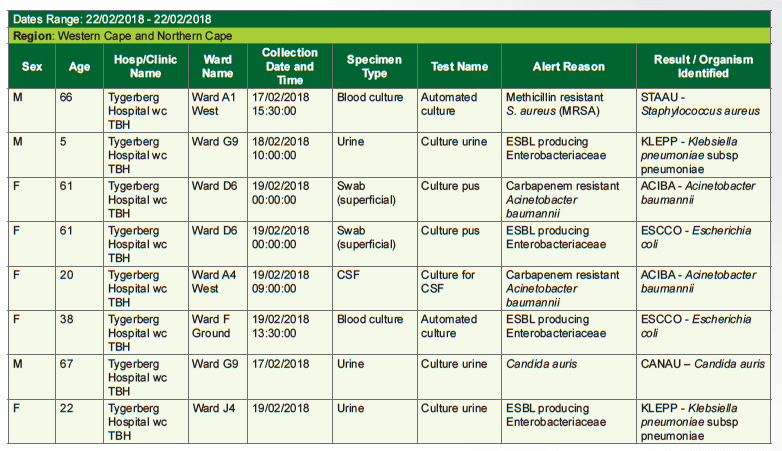
Click on image to enlarge
Limitations of the alert organism report
- The report has several limitations, which need to be carefully understood to avoid inappropriate use / interpretation of the data:
- The list does NOT represent health care associated infections, for three reasons:
- The lists of organisms in the reports are based on samples collected in the wards, based on clinical indication and as such have not been distinguished as community- or hospital-acquired.
- Many isolates may represent colonisation rather than infection.
- Some patients may have an infection without an appropriate sample being taken, or with no organism being isolated from a sample.
- Different facilities have very different types of patients, different numbers of beds etc., and the data is thus not appropriate for comparing one facility to another.
- Specimens are not collected in a standardised fashion – either with respect to which patients are sampled, or with respect to how samples are collected.
- The data should ideally not be referred to as surveillance data. It is certainly not surveillance for HAIs, and it is not truly surveillance for multi-resistant organisms.
- The reports contain no information about total number of specimens submitted, or about total number of patients sampled, or about total number of patients admitted.
- The data therefore cannot be used to calculate rates. There are no standardised denominators, and the data is based on routine samples.