Annexure F: Cumulative Antibiograms
Supporting the Antimicrobial Resistance Strategy Framework and the Guidelines on Implementation of the Antimicrobial Strategy in South Africa: One Health Approach and Governance, 2018
In order to make informed decisions about antibiotic choices, and in order to monitor antibiotic resistance trends, it is important to be able to review antibiotic resistance rates for certain organisms or organism groups periodically. The cumulative antibiogram aims to describe the format such reports will take, as well as some of the limitations of the reporting, and the parameters that are used to generate the reports. The cumulative antibiogram is aimed primarily at clinicians and hospital managers who may be receiving and reviewing these reports. It is strongly recommended that these cumulative antibiograms be analysed in conjunction with a microbiologist familiar with the laboratory where the testing had taken place.
The cumulative antibiogram contains the following key aspects:
- the micro-organisms;
- how many isolates of that organisms were cultured;
- their percentage susceptibility to the drugs that are usually used to treat them.
A general example of the format would be: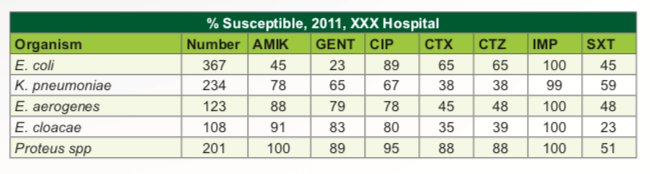
Click on image to enlarge
General principles
- Results will be expressed as % susceptible.
- Only the first isolate of a given species per patient is included i.e. multiple occurrences of the same organisms in the same patient are excluded to prevent double counting.
- If there are less than 30 isolates of a given species, the results will not be presented unless there are compelling reasons to do so. Any such data must be interpreted very carefully.
- Data should be requested at least annually. However, more frequent analyses may be necessary in certain situations. If more frequent analysis is performed, note must be taken of the recommendation that results should not be presented if <30 of a particular species are present.
- The antibiotics reported are those that are routinely tested and reported on all isolates, and that are appropriate for the species. This means that if some antibiotics are only tested on a selection of isolates (e.g. colistin, which is only tested on multi-resistant Pseudomonas aeruginosa; or nitrofurantoin which is only tested on urinary tract isolates), these will not be included in the routine report, although may be included in a special report.
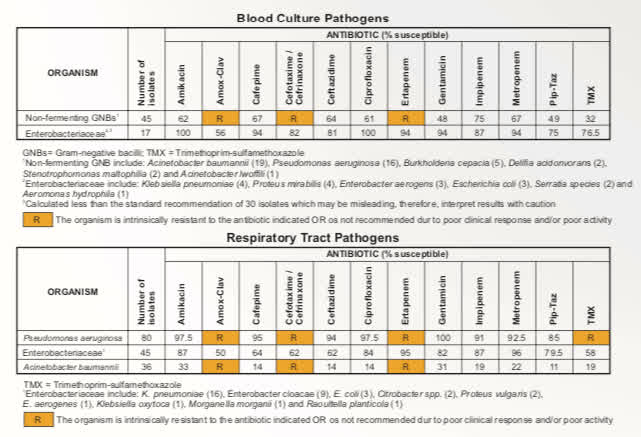
Antibiogram example
Click on image to enlarge
A common query about these reports relates to why some agents are NOT reported for certain organisms. There are three main reasons for this:
- The organism (or organism group) is intrinsically resistant, and the agent is not tested as it is of no clinical value. Examples would include vancomyin for Enterobacteriaceae; clindamycin for enterococci, cephalosporins for enterococci, macrolides for Enterobacteriaceae, ertapenem for Pseudomonas and Acinetobacter etc.
- Susceptibility can be deduced from results of other agents. The commonest example is beta-lactam antibiotics and S. aureus. If S. aureus is susceptible to oxacillin, it is regarded as susceptible to most other beta lactams (except the penicillins); and conversely, S. aureus resistant to oxacillin (i.e. MRSA) is regarded as resistant to all currently available beta lactams. Hence only oxacillin (or cloxacillin) susceptibility is reported. Another example would be S. pneumoniae, where the beta lactams commonly tested include penicillin and cefotaxime/ceftriaxone. The activity of other beta lactams (such as 2nd generation cephalosporins, co-amoxiclav, carbapenems) can be inferred from these data.
- Susceptibility testing is not routinely performed since no standardised methodology or interpretive criteria exist. Common examples of this would be certain topical agents (such as silver sulfadiazine, chlorhexidine, as well as ciprofloxacin or aminoglycosides against streptococci from eye swabs); certain nonfermentative Gram-negative bacilli (e.g. Stenotrophomonas, Burkholderia).
Limitations
The data presented does NOT provide an indication of infection rates and should not be used as such. The only exception would probably be susceptibility data from blood cultures.
It does not differentiate between healthcare-associated and community-acquired infection rates (this will hopefully change). Thus, the ability to use the data to drive empiric regimens may be limited. This can be circumvented to a degree by analysing data from specific units (rather than the hospital as a whole); however, this comes at the cost of reducing the number of isolates in the data.
The data is obtained from samples submitted to the laboratory as routine clinical samples, and thus if there are changes in specimen collection practices, the data will also change.