Annexure G: Antimicrobial Prescription Charts
Supporting the Antimicrobial Resistance Strategy Framework and the Guidelines on Implementation of the Antimicrobial Strategy in South Africa: One Health Approach and Governance, 2018
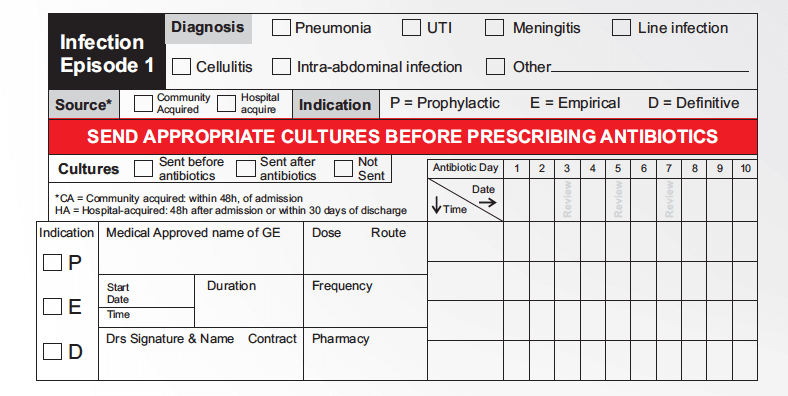
Ensuring information about how an antimicrobial prescription is recorded is critical to the implementation of sound AMS activities, either in the existing prescription chart or on a dedicated antimicrobial prescription chart (see example provided below).14 The core information about the antimicrobial prescription that needs to be included are:
- Infectious diagnosis for the antimicrobial - pneumonia, meningitis etc. This forces the prescriber to focus antibiotic choice on target organ and likely bacteria, e.g. Gramnegative Enterobacteriaceae in UTI.
- Indication for the antimicrobial - Mark indication as prophylactic, empirical or definitive:
- Prophylactic therapy, e.g. surgical prophylaxis and other antimicrobial prophylaxis;
- Empiric therapy refers to initiation of treatment prior to determination of a firm diagnosis;
- Definitive therapy refers to therapy that is adjusted according to the cultured organism.
- Whether appropriate cultures were sent prior to or after the first dose of antimicrobial.
- Microbiology results with susceptibility profile of microorganisms and any other diagnostic indicators such as AST, CRP, procalcitonin, white cell count.
- Determining the source of the infection, i.e. community- (commonly sensitive to 1st line antimicrobials) or hospital-acquired (more commonly caused by resistant bacteria).
- Patient’s weight.
- Documentation of antimicrobial allergies.
- Date and time of prescription.
- Dose.
- Duration of therapy.
- Route of administration.
- Day on which antimicrobial is to be stopped/deescalated or changed to oral.
- And if possible separating infection episodes to enable evaluation of an antimicrobial for each individual episode of infection, e.g. patient presents with a community-acquired pneumonia (infection episode 1) and receives antimicrobial for pneumonia. During hospital admission he/ she develops a CLABSI (infection episode 2) and is evaluated for a different set of antimicrobial/s.
Example of an Antimicrobial Prescription Chart developed by the South African Antibiotic Stewardship Programme
Implementation of the prescription chart
It is crucial to have a proper project plan for the introduction of an antimicrobial section in the existing prescription chart or of a dedicated antimicrobial prescription chart, if these are not yet in place. Thorough communication with all role players and adequate training for everyone that uses the chart is key to the success of the project.
References
Bratzler, D.W., Dellinger, E.P., Oslen, K.M. et al. 2013. Clinical practice guidelines for antimicrobial prophylaxis in surgery. ASHP report. Am J Health-Sys Pharm; 70:195-283. Available from: https://doi.org/10.2146/ajhp120568
Allegranzi B, Bischoff P, de Jonge S, et al. New WHO recommendations on preoperative measures for surgical site infection prevention: an evidence-based global perspective. Lancet Infect Dis 2016; published online Nov 2. Available from: http://dx.doi.org/10.1016/S1473-3099(16)30398-X
Gilbert, D.N., Moellering, R.C., Eliopoulos G.M. et al. 2015. Surgical antibiotic prophylaxis. The Sanford Guide to Antimicrobial Therapy. 45th ed. Antimicrobial Therapy, Inc.: USA. p191- 194.
Cosgrove, S.E., Avdic, E. 2016. Antibiotic guidelines 2015-2016. Johns Hopkins Medicines. Available from: http://www.insidehopkinsmedicine.org/amp