Annexure H: Diagnostic Stewardship
Supporting the Antimicrobial Resistance Strategy Framework and the Guidelines on Implementation of the Antimicrobial Strategy in South Africa: One Health Approach and Governance, 2018
Diagnostic stewardship is defined as the “coordinated intervention to improve and measure the appropriate use of microbial diagnostics to identify pathogens and guide therapeutic decisions by promoting appropriate and timely selection and collection of specimens, accurate and timely testing, accurate and timely reporting of results.”57
Diagnostic stewardship extends beyond the patient into the laboratory and relies on the skills, expertise, and capacity of the laboratory and its staff to accurately test and report on specimens it receives to guide treatment and active management of resistant organisms by the health professionals (see Figure below). Focus will be on providing timely microbiological data to deliver safer and more effective and efficient treatment; and accurate and representative AMR surveillance data to inform treatment guidelines, and AMR control strategies.
Diagnostic stewardship steps
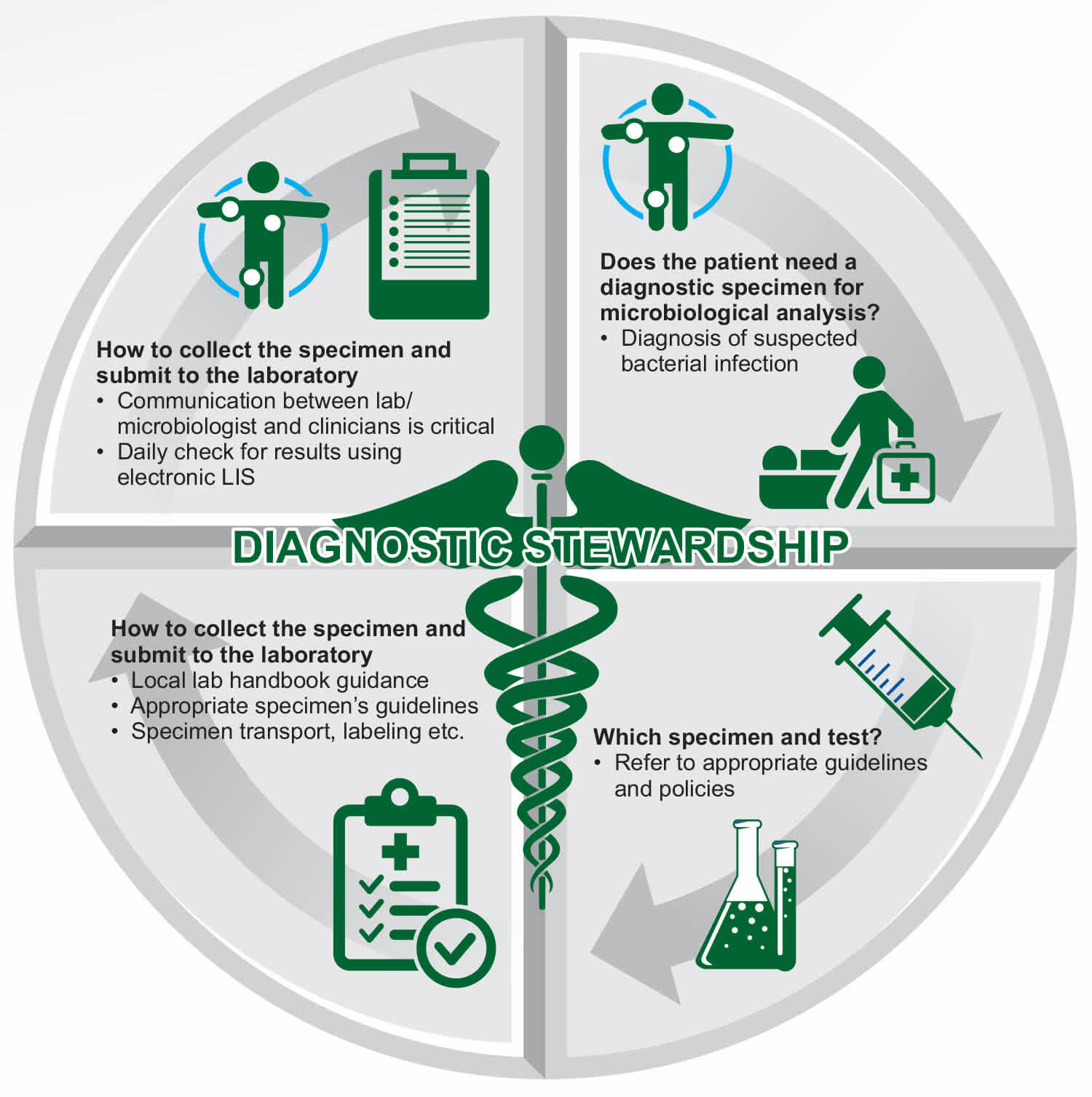
Section 1: Does the patient need a specimen for microbiological analysis?
Specimens for “diagnostic” purposes are usually submitted to identify causative organisms, rather than to confirm a clinical diagnosis. For example, a patient will present with symptoms of a lower respiratory tract infection (LRTI), and sputum and/or blood culture may help identify which organism is responsible. However, the presence of the organism does not confirm the diagnosis of LRTI; the absence of an organism does not exclude the diagnosis of LRTI.
Section 2: Which specimen and test
This would be informed by local guidelines and policies, as well as the likely site of infection (e.g. pneumonia guidelines, meningitis guidelines). Some general principles include:
- Sterile site samples are preferred to nonsterile site samples, as far as possible.
- Specimens should be submitted prior to antimicrobial administration if at all possible.
- The fact that a specimen has been collected must be documented in the patient notes.
Section 3: How to collect the specimen and submit to the laboratory
Local guidelines and SOPs normally specify how different specimens should be collected, including the appropriate material to be used (e. g. blood culture bottle, urine container, swabs), the required amount of specimen and technique for clean and safe sampling (e.g. sterile venepuncture for blood specimen) and the appropriate precautions, including use of PPE such as gloves, that must be adhered to.
Based on clinical symptoms implementation of related guidelines for specimens’ selection should apply.
General principles for specimen collection:
- Microbiology specimen selection and collection are the responsibility of the medical staff, not usually the laboratory. Continuous training on specimen collection practices for clinicians should be hosted annually at facility level.
- Importance of good specimen collection:
- It is the key to accurate laboratory diagnosis and confirmation;
- It directly affects patient care and patient outcomes;
- It influences therapeutic decisions;
- It impacts hospital infection control;
- It impacts patient length of stay, hospital costs, and laboratory costs, and influences laboratory efficiency.
The quality of a result is directly related to the quality of the specimen being cultured. The best results are obtained when the following guidelines are maintained:
- Follow standard precaution guidelines. Treat all specimens as potential biohazards.
- Collect the specimen before administering antimicrobial agents when possible.
- Collect the specimen with as little contamination from indigenous flora.
- Utilize appropriate collection devices, sterile equipment, and aseptic technique to collect specimens.
- Various types of transport media are provided, depending on the type of culture required.
- All swabs are to be kept moist in a transport medium after the specimen is collected.
- Clearly label the specimen container with: patient’s name, date, time of collection.
- Collect an adequate amount of specimen. Inadequate amounts may yield false negative results.
- Identify the specimen source and/or specific site correctly so that proper culture media will be selected during processing in the laboratory.
- Transport all specimens to the laboratory on time. This ensures the survival and isolation of fastidious organisms and prevents overgrowth by more hardy bacteria. It also shortens the duration of specimen contact with some local anaesthetics used in collection procedures, that may have antibacterial activity.
- Physicians or specialists with advanced training and skills should collect specimens requiring extreme invasive technique.
- Any other questions or requests should be directed to the microbiology laboratory.
- Microbiology should be informed in advance if there are any special requests that might require special handling.
- Clinicians should consult the laboratory to ensure that selection, collection, transport, and storage of patient specimens are performed properly.
Section 4: Accessing and interpreting the results
- An effective two-way communication system between the microbiology laboratory and clinical service must be in place.
- Results should be checked for every day (preferably using an electronic laboratory information system), until a final result is provided. (Note: due to the nature of microbiology laboratory work, provisional results may be amended or added to on a daily basis until finalised).
- Results must be documented in the patient’s file.
- Results should be appropriately interpreted. Some key points related to interpreting microbiology results include:
- Is the specimen appropriate for the suspected infection?
- How was the specimen collected, and is it a sterile or non-sterile specimen?
- Is/are the organism/s isolated likely to be pathogenic?
- Coagulase-negative staphylococci from non-sterile samples (and sometimes from sterile samples) are often skin flora (contaminant);
- Many non-fermenting Gram-negative bacilli are environmental and are uncommon pathogens (except for A. baumannii, P. aeruginosa, and to a lesser degree B. cepacia and S. maltophilia).
- Enterococci are recognised pathogens from UTIs and intra-abdominal sepsis, and as an uncommon cause of LRTI.
- Results of in-vitro susceptibility testing reflect the likely clinical response, but this may be influenced by site of infection, age of patient, severity of illness.
- Not all antimicrobials that are tested are necessarily reported – laboratories will often display the most appropriate agents based on how resistant the organism is. If an organism is resistant to 1st line antimicrobial, then 2nd or 3rd line agents will be displayed.
- Antimicrobials to which the organism is intrinsically resistant, or which have poor in-vitro efficacy, are usually not tested or reported. Common examples include:
- Macrolides, linocosamides and glycopeptides for most Gram-negative organisms;
- Colistin for Gram-positive organisms;
- Fluconazole for Candida krusei.
- Results of certain antimicrobial susceptibility results can be used to predict susceptibility to other agents:
- S. aureus susceptible to oxacillin (cloxacillin) is regarded as susceptible to all beta lactamase stable beta lactams;
- S. aureus resistant to oxacillin (cloxacillin) (MRSA) is regarded as resistant to all beta lactams with the exception of some of the newer 5th generation cephalosporins;
- S. pneumoniae susceptible to penicillin is regarded as susceptible to cephalosporins;
- Candida species susceptible to micafungin or anidulafungin is considered susceptible to caspofungin.
REFERENCES:
- World Health Organization. Diagnostic stewardship: A guide to implementation in antimicrobial resistance surveillance sites. Global AMR Surveillance System. Geneva; 2016. Available from http://apps.who.int/iris/bitstream/handle/10665/251553/WHO-DGO-AMR-2016.3-eng.f;-jsessionid=BCA2F0E5CF77E-3709C84387A49A6B93D?sequence=1
- Infectious Diseases Society of America and the America Society for Microbiology. A guide to utilization of the microbiology laboratory for diagnosis of infectious diseases: 2018 update. Clinical Infectious Diseases. 2018. Available from: www.idsociety.org/Guidelines/Patient_Care/ IDSA_Practice_Guidelines/Laboratory_Diagnosis_of_Infectious_Disease/
- South African Antibiotic Stewardship Programme mobile application, available for download from:
a. iPhone APP store
b. Android Google Play store - BacT/ALERT® Blood Culture Collection Procedure. Biomeriuex. Available from: www.biomerieux-usa.com/sites/subsidiary_us/files/worksafe-blood-culturecollectionprocedure-1.pdf
- Centers for Disease Prevention and Control. Specimen Collection Guidelines. Available from: www.cdc.gov/urdo/downloads/speccollectionguidelines.pdf
57 World Health Organization, Draft Implementation Manual on Global Surveillance of Antimicrobial Resistance (GLASS). Geneva; 2015.