Antepartum Haemorrhage
The guidelines recommend management of common obstetric conditions at primary and referral level, based on local experience and evidence-based practice. They are not intended as strict protocols nor as standard operating procedures, but rather as a guide to safe effective management of common obstetric problems. The guidelines should be most useful to interns, medical officers and registrars.
Antepartum haemorrhage of unknown origin
Antepartum haemorrhage (APH) is defined as bleeding from the genital tract from 26 weeks of pregnancy or from fetal viability, up to delivery of the baby.
CAUSES
- Placental – abruptio placentae, placenta praevia, vasa praevia
- Non-placental – vaginal & cervical lesions including cancer, cervical infections, trauma (including uterine rupture) and decidual bleeding
- Unknown – APH of unknown origin (APHUO)
All APH cases are regarded as obstetric emergencies until assessed
EMERGENCY MANAGEMENT OF APH
- Start an intravenous infusion of Ringer-Lactate solution with a large bore (16G) intravenous cannula
- If the woman is in shock, insert a second IV line & resuscitate with 1-2 L of Ringer-Lactate. Take blood for haemoglobin & cross-match
- Do not perform a digital vaginal examination, unless placenta praevia has been ruled out by a previous ultrasound scan
- Do an ultrasound scan to look for placenta praevia, to estimate fetal weight, identify a fetal heart beat & to demonstrate retroplacental clot (not always visible on ultrasound in abruption placentae)
- If no placenta praevia, examine the cervix by vaginal speculum & by digital examination for dilatation, presenting part & a local lesion
- Further management depends on the cause (below)
Differences between abruptio placentae and placenta praevia
| Abruptio placentae | Placenta praevia | |
| Patient | Frequently hypertensive | Frequently previous caesarean section |
| Symptoms | Pain almost always present. Fetal movements may be absent or reduced | Usually painless. Fetal movements usually normal |
| Abdominal examination | Hard, tender uterus, large for expected dates | Soft, nontender uterus, often with malpresentation or high presenting part |
| Bleeding | Dark blood with clots, at times no external bleeding | Bright red blood |
| Ultrasound | Fetus may be dead, placenta normally situated. Retroplacental clot may or may not be visible | Placenta implanted close to or over the cervix |
ANTEPARTUM HAEMORRHAGE ALGORITHM
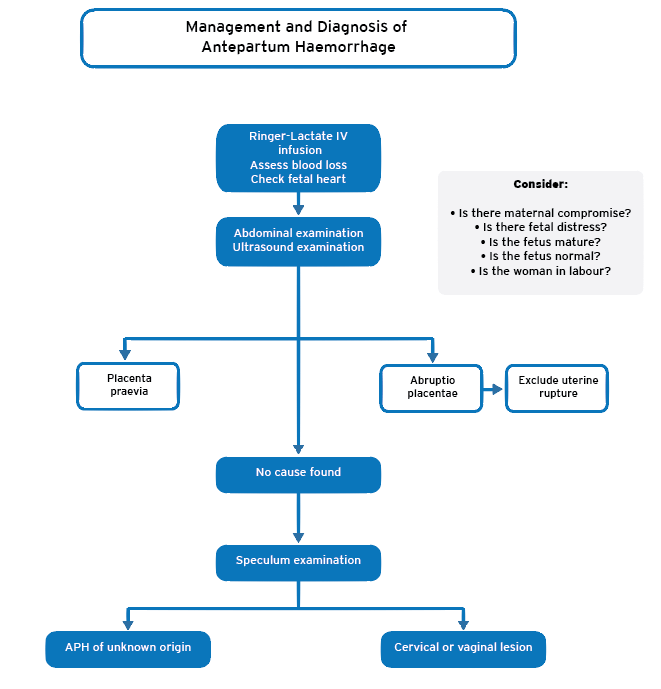
PLACENTA PRAEVIA
Placenta praevia may be major, with placenta covering the internal os, or minor, with placenta in front of the presenting part but not covering the os. Major placenta praevia may require caesarean section well before term, while the occasional woman with minor placenta praevia may do well with vaginal delivery. Principles of care are similar for both degrees.
At <37 weeks:
- Admit to hospital; do not discharge patients with major placenta praevia
- Check Hb
- Ensure that blood is available for transfusion
- If <34 weeks, give betamethasone 12 mg IM 12 hourly for 2 doses
- Perform CTG on admission & ask about fetal movements daily
- Plan elective caesarean section at 35-37 weeks
- Perform emergency caesarean section if transfusion becomes necessary, or if bleeding is considered to be severe, or if there is fetal distress
- With spontaneous labour/miscarriage at <26 weeks, aim for vaginal delivery
At 37 weeks or more, or in labour:
- If, on ultrasound, the placenta covers the cervix, perform caesarean section
- If the placenta does not cover the cervix, perform vaginal examination in theatre (with theatre staff & anaesthetist in attendance) and proceed immediately with caesarean section if the placenta can be felt next to or through the cervix. If the placenta cannot be felt, & the cervix is sufficiently open & effaced (favourable), rupture the membranes & induce labour
- Caesarean section for placenta praevia may result in severe haemorrhage. Be prepared to give blood transfusion, insert haemostatic sutures, use a balloon or do hysterectomy. Inform the woman of these when taking consent.
ABRUPTIO PLACENTAE
Abruptio placentae is associated with pre-eclampsia: the BP may be normal or high even in the presence of clinical shock. Proteinuria is an indicator of underlying pre-eclampsia in women with abruptio placentae.
If the fetus is alive:
- With expected weight >900 g, perform emergency caesarean section, unless delivery is imminent (cervix ≥8 cm dilated) and there is no fetal distress
- With expected weight <900 g, rupture the membranes & augment labour with oxytocin. Monitor blood loss carefully
If the fetus is dead:
Urgent delivery is essential, but vaginal birth is preferred. With a dead fetus, the abruption is likely to be severe & requires close observation & frequent reassessment.
Consider uterine rupture, which may mimic abruptio placentae as a cause of APH with fetal death. If suspected, resuscitate & arrange laparotomy.
- Admit to a high care area
- Take blood for cross-match, FBC, U&E, INR & fibrinogen degradation products (FDP)
- Blood transfusion (2-4 units) is usually necessary, with fresh frozen plasma if there is a clotting disorder. If the platelet count is <50´109/L, transfuse 1 megaunit of platelets
- Consider insertion of a central venous pressure (CVP) line for patients who are haemodynamically unstable or who have severe pre-eclampsia
- Insert a urinary catheter & monitor hourly urine output
- Give fluids to maintain a systolic BP ≥100 mmHg, or a CVP of 6 cm water
- Rupture the membranes & augment labour with oxytocin
- Aim for induction-to-delivery interval of ≤12 hours
- Give analgesia - morphine 0.1 mg/kg IM (maximum 10 mg) with metoclopramide 10 mg IM 4 hourly
- Caesarean section is indicated if:
- The cervix is closed & the membranes cannot be ruptured
- There is life-threatening haemorrhage at less than full cervical dilatation
- After delivery of the fetus & placenta, run a drip with oxytocin 20 units in 1L Ringer-Lactate to prevent postpartum haemorrhage, & observe closely for bleeding. Inspect the lower genital tract for bleeding lacerations
- Check FBC & U&E on the day after delivery
ACUTE KIDNEY INJURY
There is oliguria (<500 mL/24 hours) with rising serum urea & creatinine levels. Abruptio placentae is the most common obstetric cause, but this may also result from severe pre-eclampsia, severe haemorrhage, & severe sepsis.
The principles of management are as follows:
- Correct fluid deficit with intravenous crystalloids, with a CVP line if necessary
- Strict intake & output chart: total fluids given should be previous day’s output, plus 500 mL for insensible loss
- Take blood daily for U&E & FBC
- Call for a renal specialist opinion if renal function worsens. Indications for dialysis include rapidly rising urea & creatinine levels, pulmonary oedema, hyperkalaemia, severe acidosis, & clinical evidence of uraemia
- Avoid giving diuretics or dopamine unless instructed by renal specialists
VASA PRAEVIA
Vasa praevia is the presence of fetal blood vessels in the placental membranes below the level of the presenting part, as a result of velamentous cord insertion. This rare condition is associated with placental abnormalities, multiple pregnancy & low-lying placenta. Vasa praevia can be detected antenatally by vaginal ultrasound with colour Doppler studies, or during labour by palpating blood vessels on the membranes during vaginal examination. These blood vessels may be torn when the membranes rupture, resulting in severe fetal bleeding that presents as APH.
Suspect vasa praevia as a cause of APH with:
- Passage of dark blood from the vagina after membrane rupture
- Blood loss <300 mL
- Low-lying placenta, multiple pregnancy or placental abnormality
- No maternal haemodynamic abnormality
- Fetal heart rate abnormalities on CTG
The only treatment to save the baby’s life is immediate delivery, vaginally or by caesarean section
ANTEPARTUM HAEMORRHAGE OF UNKNOWN ORIGIN
In this condition, there is no evidence of abruptio placentae, placenta praevia, or local lesions. APHUO must be distinguished from show (mucus, no clots) and from cervical or decidual bleeding during vaginal examination.
- Admit to hospital
- At ≥37 weeks pregnant, induce labour
- If <37 weeks pregnant:
- Do daily CTG
- Observe for symptoms and signs of abruptio placentae
- Discharge from hospital 24-48 hours after bleeding has stopped
- Assess the cervix before discharge to exclude imminent preterm labour
- Continue antenatal care at hospital, with attention to fetal growth & fetal movements
- Consider induction of labour at 38-40 weeks