Appendix A: Governance
Code of conduct Scarce skills: anaesthetic services Safety incident reporting and learning Core standards Peer review document Code of conduct SASA member code of conduct for anaesthesia professionals Health Professions Council guidelines SASA expects its members to adhere to all Health Professions Council of South Africa (HPCSA) rules and regulations regarding good professional and ethical pract
Scarce skills: anaesthetic services
Safety incident reporting and learning
Code of conduct
SASA member code of conduct for anaesthesia professionals
Health Professions Council guidelines
SASA expects its members to adhere to all Health Professions Council of South Africa (HPCSA) rules and regulations regarding good professional and ethical practice. This document is to be read in conjunction with the HPCSA guidelines pertaining to good practice, ethical rules, etc. (http://www.hpcsa.co.za/ conduct/ethics). This incorporates the Generic Ethical Rules, Good Practice Guidelines, Patients’ Rights Charter, and other relevant guidelines.
Oath of care
Anaesthesia professionals are bound by the shared spirit and principles underlying the various oaths subscribed to by newly qualified healthcare professionals (i.e., revised Hippocratic Oath, and others). This social contract holds healthcare providers to a strict code of professional and personal conduct, forming the pillars of the SASA Code of Conduct for Anaesthesia professionals.
The practice of anaesthesia has its own, inherently unique demands and challenges regarding the nature of patient interaction, standards of care, quality of service delivery, safety requirements, and inter-collegial relationships. This Code of Conduct outlines the commitment every SASA member makes to ethical practice.
Basic components of ethical practice
An anaesthesia professional has ethical responsibilities to:
- Patients
- Colleagues and community
- Him-/herself
- Healthcare fraternity
- Workplace
Responsibilities to patients
- Always place the patient’s interests foremost.
- Be truthful to patients.
- Appreciate and respect the patient’s supreme rights in medical decision-making, appropriate to the patient’s developmental capacity and medical circumstances. Medical knowledge and skills should never be used to coerce or restrain patients with adequate decision-making capacity.
- Appreciate that patients are extremely vulnerable in the perioperative period. Take care of the patient’s physical and psychological wellbeing. The patient’s right to dignity, privacy, and comfort is paramount. Patients should always be treated with respect, regardless of their state of consciousness.
- Honour confidentiality regarding medical and personal information.
- Honour and respect religious and cultural beliefs and be sensitive in this regard in the provision of treatment.
- Provide appropriate postanaesthesia care, as and when applicable.
- Provide emergency care for all patients, irrespective of the patient’s financial status.
Responsibilities to colleagues and community
- Promote respectful and cooperative relationships with colleagues and healthcare workers to the benefit of patients.
- Consult with colleagues as and when appropriate.
- Cooperate and participate with colleagues to improve the quality and efficiency of anaesthesia care, and medical care in general.
- Advise and assist impaired/suspected impaired colleagues within the boundaries of your own abilities, to the benefit of patients.
- Immediately and adequately address any dangerous/ negligent practices that potentially endanger patients and/or healthcare personnel. This includes reporting a colleague to the relevant authority, sooner rather than later.
- Participate in keeping potentially dangerous substances secure from illicit use.
Responsibilities to yourself
- Maintain competence and skill as is necessary in your practice.
- Take responsibility for your own mental and physical wellness.
- Seek timeously assistance, evaluation, and care when in doubt about your own health and wellness.
- Seek timeous assistance and support when in doubt about your own clinical competence, be this in general, case or skill(s) specific.
- Modify or cease practice when incapacitated in any way that has the potential to be detrimental to patients.
- Take responsibility for your personal financial protection and wellbeing, preventing financial needs from interfering with clinical decision-making.
Responsibilities to the healthcare fraternity
- Refrain from seeking or accepting potentially compromising donations, gifts, or sponsorships from any source.
- Avoid placing yourself in a position of perversity, potential position of perversity, or potentially perceived perversity.
- Declare all donations, gifts, or sponsorships where the potential exists for undue influencing, or perceived influencing. This is specifically expected from faculty at events, conferences, and congresses. Any interest, whether perceived as a direct influence on the topic or not, should be declared at the start of a presentation.
- Adhere to ethical and consistent billing practices, refraining from overreaching and overservicing practices. Additionally, appreciate your responsibility as an anaesthesia professional in seeking cost-saving treatment mechanisms.
- Appropriately inform patients regarding cost and your billing practices, where possible, in order for the patient to make an informed financial decision.
- Refrain from participating in exploitative financial relationships.
Responsibilities in the workplace
- Dress appropriately and always maintain yourself in a clean, dignified, and presentable manner.
- Treat your co-workers with respect, including colleagues, nursing staff, cleaners, porters, etc.
- Refrain from using inappropriate and derogatory language and behaviour, in whatever situation.
- Maintain absolute professional conduct in theatre and in the workplace and refrain from doing anything that may make coworkers unhappy or uncomfortable.
This code of conduct represents the principles, values, and norms to be practised and maintained by all anaesthesia professionals as SASA members. The purpose of the code is to provide a clear framework within which SASA members are expected to conduct themselves. Continuous self and peer assessment against this code of conduct serves the best interest of patient and practitioner, contributing towards a healthy and prosperous anaesthesia community in South Africa.
Scarce skills: anaesthetic services
Specialist anaesthesiologists in SA
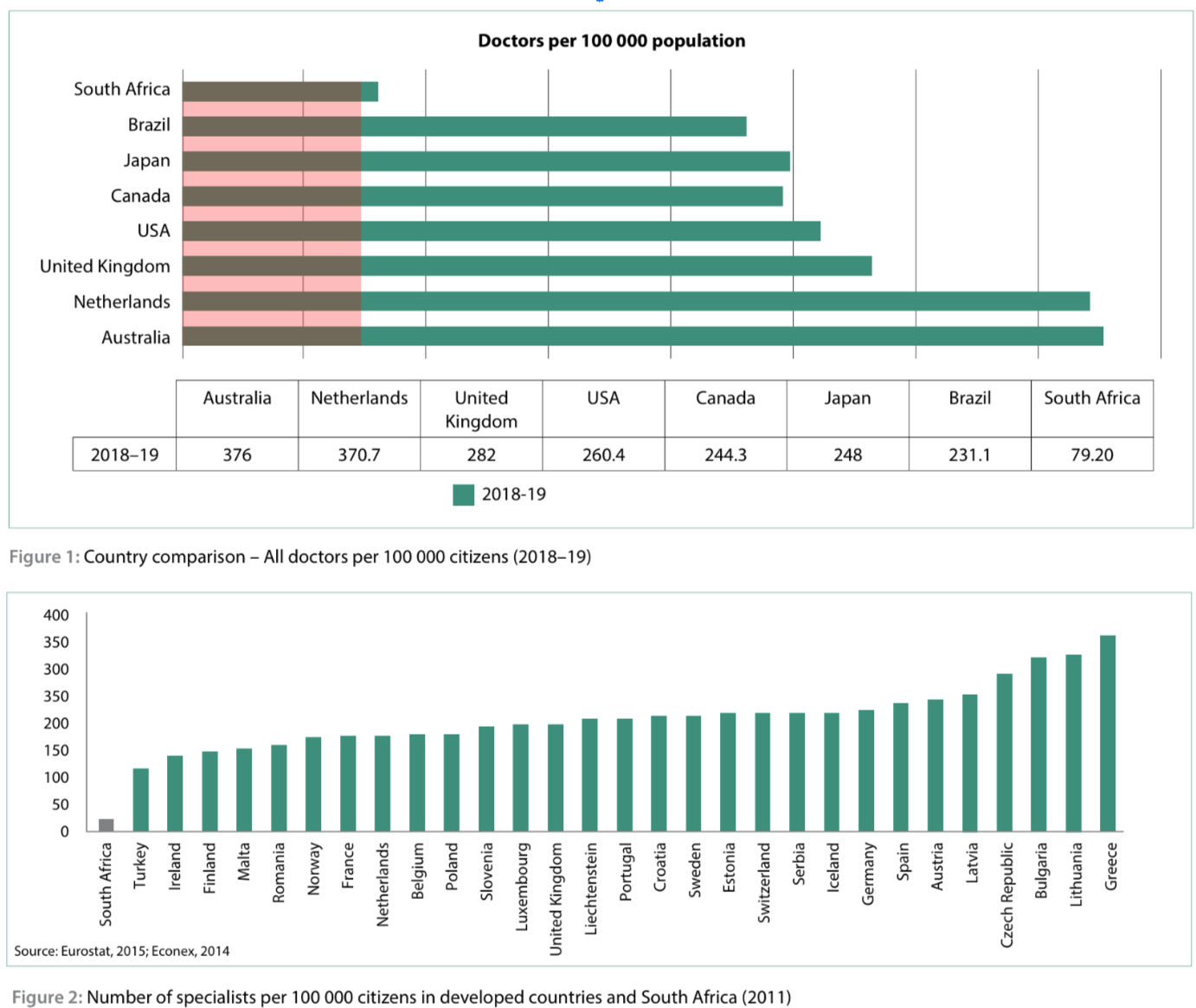
South Africa has an overall skills shortage, a problem significantly visible in the healthcare sector. The figure below published in 2015 by Econex on behalf of the Hospital Association of South Africa expresses the number of doctors per 100 000 citizens in various countries in 2013.
On average, South Africa has far fewer doctors per 100 000 population than any other BRICS (Brazil, Russia, India, China and South Africa) country – by 10 when compared to India and less than half of that of Brazil.
Importantly, from a SASA perspective, as a majority specialist representative society, the number of specialists per 100 000 citizens paints a woeful picture. When compared with multiple Organization for Economic Cooperation and Development (OECD) countries and resource-rich countries providing forms of national health insurance, the South African workforce of specialists is one-eighth to one-tenth of countries whose public health systems are considered to function effectively under a national health insurance scheme.
Click on the image to enlarge
Click on the image to enlarge
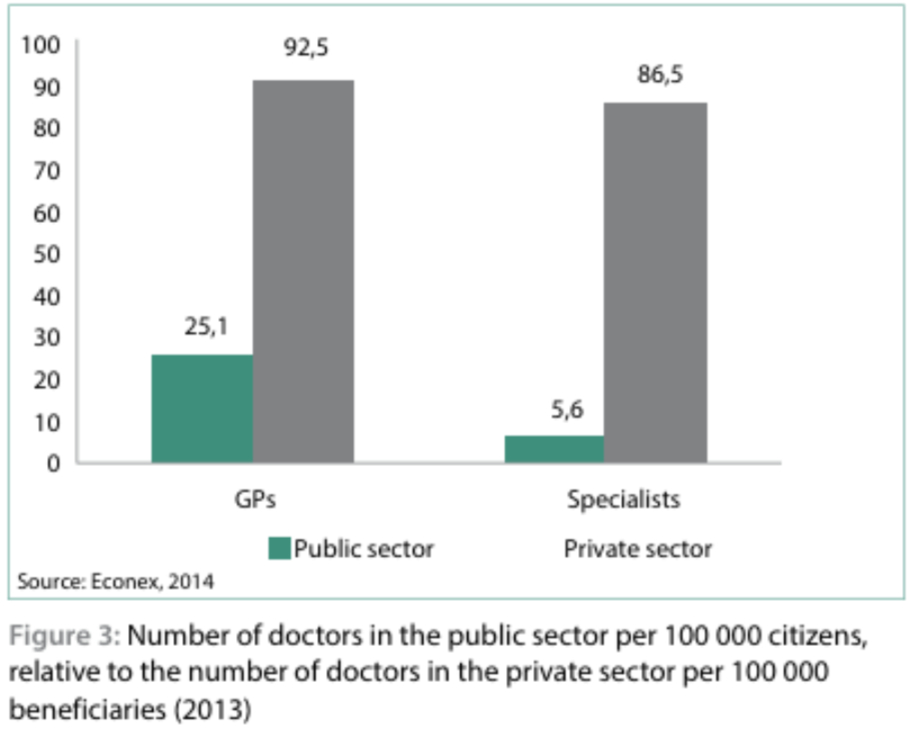
When considering public vs private sectors, there remains a considered opinion that a high-capacity workforce exists in the private sector that may, or is likely to, be able to meaningfully work and cope with the shortfall of service available in the public sector. While various options may exist to address such a shortfall, the figure above indicates that approximately 86.5 specialists per 100 000 citizens currently exist in the privately insured/ funded market of 8 800 000 lives. When assessing this number in conjunction with the prior figure, it is clear that at this ratio in the private sector, the number of specialists to population ratio remains less than half of almost all OECD countries’ ratios that provide social national health insurance.
This skills shortage has a significant impact on the number of people receiving surgery, especially in the public sector in South Africa. The comment published in The Lancet by Dare, OnajinObembe and Makasa, on the perioperative patient outcomes in the African Surgical Outcomes Study: (ASOS): a 7-day prospective observational cohort study by Biccard et al., quantifies this issue for Africa:
“In the study countries, the average provider-to-population density of specialist surgeons, anaesthetists, and obstetricians (another core surgical indicator) was around 30 times lower than the recommended global minimum.”
Although the main aim of Biccard and colleagues’ study was to quantify surgical outcomes, the most alarming finding was how few people received surgery. Surgical volume (the number of operations per 100 000 population) is an indicator of met need for surgical care. The ASOS findings suggested that this is unacceptably low in Africa. Among the 25 countries that contributed data, only a median of 212 operations (IQR 65–578) were done per 100 000 catchment population. These numbers are 20 times lower than the crucial surgical volume required to meet a country’s essential surgical needs each year (defined as 5 000 operations per 100 000 people).
Safety incident reporting and learning
This document is only available as part of the online publication of the SASA Practice Guidelines 2022 Revision on www.sasaweb.com.
Core standards
This document is only available as part of the online publication of the SASA Practice Guidelines 2022 Revision on www.sasaweb.com.
Peer review document
This document is only available as part of the online publication of the SASA Practice Guidelines 2022 Revision on www.sasaweb.com
South African Society of Anaesthesiologists (SASA) Practice Guidelines_2022