Approach
Approach to burns in paediatric patients
Acknowledgement:
Red Cross War Memorial Children's Hospital Burns Unit
Primary survey
Airway
Breathing
Circulation / Fluid Management
Disability
Environment/Expose
Secondary survey and adjuncts
Admission criteria
Investigation
Primary Survey
Minor burns:
- Cool wound under running tap water for 20 minutes or apply Burnshield if not already done.
- Remove all jewellery or constricting clothing.
Major burns:
- Stabilise cervical spine in all cases where mechanism of injury could indicate spinal injury
1: AIRWAY
Chin lift/jaw thrust to open airway.
Look for signs of inhalational burn- history of hot gasses, smoke, steam
- Carbonaceous sputum
- Burns to nose, mouth, pharynx
- Change of voice
- Tracheal tug
- Singed nasal hair
- Restlessness
- Hypoxia
INTUBATE if significant airway obstruction present or WORSENING symptoms. Adrenaline nebulisation with 3ml adrenaline could relief symptoms, but should not delay intubation in severe cases.
2: BREATHING
- Tachypnoea, confusion, drowsiness
- Carboxyhaemoglobin half- life 250 minutes. On 100% oxygen the half-life is 40 minutes.
- 15-20% - headache, confusion
- 20-40% - nausea, disorientation, irritability
- 40-60% - hallucination, ataxia, syncope, convulsions, coma
- >60% - death
Humidified oxygen at 8 litres per minute via non- rebreathing mask. Ventilation if intubated.
3: CIRCULATION / FLUID MANAGEMENT
Wound size assessment:
- The size of the patient’s palm plus palmar aspects of the fingers, constitute about 1% TBSA.
- Shave the hair to inspect burn % in hairline or your estimation will be wrong!!!
- Do not delay inserting an IVI line. Intra-osseous or central line should be obtained if peripheral vein lines fail!
Resuscitation fluid:
- 3ml/kg/% burn Ringers from TIME of BURN. (we find using 3,5ml or 4ml leads to fluid overload, please stick to 3ml/kg/%burn)
- For fire burns, give half of this in first 8 hours, starting time the actual time of burn, and the other half over next 16 hours.
- For hot water burns, the fluid is to be given as a continuous infusion.
- Inhalation injury: Add 2ml/kg/% burn to this regime.
- Associated trauma with blood loss, consider blood at 10ml/kg.
- On day 2 this resus amount is reduced to Ringers 1,5ml/kg/% burn/24 hours
- Electrical burns may require more fluid than expected due to underlying muscle and bone injury
- Haemoglobinuria/Myoglobinuria
- Increase urine output to 2 ml/kg/hr
- Sodium Bicarbonate 25 meq/litre in resuscitation fluid to alkalinise the urine.
- Mannitol 12,5 gram/litre fluid
REASSESS & RE-EVALUATE frequently
- Check pulse rate, capillary refill (<3secs), urine output (1 - 2ml/kg/hr), alertness.
- Lowered BP indicates DECOMPENSATED shock and all measures should be taken to avoid reaching this point.
- Fluid bolus for inadequate perfusion (urine output less than 1ml/kg/hr or tachycardia): WARM 20ml/kg Ringers lactate.
- Reduce fluids if urine output is more than 2ml/kg/hr, to avoid fluid creep
- In the event of pulmonary oedema, secondary to fluid overload, treat with furosemide 0,5mg/kg/intravenous dose.
- Consider inotropes if myocardial failure.
- Beware of hyponatraemia with major fluid shifts.
Suggested threshold limits for heart rate, respiratory rate and systolic blood pressure:
| Age Group | Heart Rate (upper limit) beats/min | Respiratory Rate (upper limit) breaths/min |
| Newborn – 3 months | 205 | 30 -60 |
| 3 months – 2 years | 190 | 24-40 |
| 2-5 years | 140 | 22-34 |
| 6-10 years | 140 | 18-30 |
| > 10 years | 100 | 12-16 |
| Age | Minimum systolic BP (mmHg) |
| Neonate | < 60 |
| Infant | < 70 |
| 1-10 years | < 70 + (age in years x 2) |
| >10 years | < 90 |
Maintenance Fluid:
- Start Rehydration fluid at admission, constant flow over next 24hours (separate cannula or Y-connecter line).
- This can be substituted (not added!) with NGT feeds/oral feeds at the same rate. Frebini Original to be used in this instance via NGT. Burns of more than 30% TBSA may have an ileus, and you may have to use PMS (and not NGT feeds) for the first 24hrs.
Example: Maintenance for 23kg child
Body weight 0-10kg: 100 ml per kg/24 hrs (10kg x 100ml = 1000ml) plus
Body weight 10-20kg, add: 100ml/kg/24 hrs + 50ml/kg for each kilo over 10kg (10kg x 50ml = 500ml plus
Body weight >20kg, add: 100ml/kg/24 hrs +50ml/kg for each kilo over 10kg + 20ml/kg for each kilo over 20kg (3 x 20ml = 60 ml
Total 1000ml +500ml + 60 ml 1560ml. Rate 1560/24 = 65 ml/hr
4: DISABILITY
A: alert
V: responds to voice
P: responds to pain
U: unresponsive
Depressed level of consciousness in burns: consider hypoxia, hypovolaemia, CO toxicity, head injury, drugs or toxins.
5: ENVIRONMENT/EXPOSE
Remove jewellery, examine back carefully, keep warm.
SECONDARY SURVEY AND ADJUNCTS
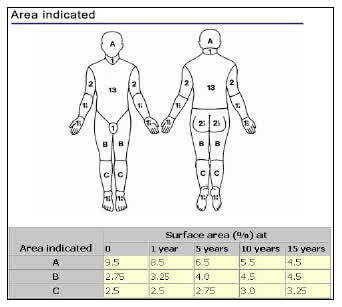
Click on image to enlarge
History:
- A - allergies
- M- medication
- P- past illness
- L- last meal
- E- events/environment related to injury
Mechanism of injury: Ask about duration of exposure, temperature of fluids, was first aid given – what and how long, history of associated injuries or trauma.
Head to toe examination:
- Head - singed eyebrows or lashes, corneal burns, bogginess, look carefully in hair for burns – shave IF needed – explain why this is required. Look for carbon deposits in mouth, blisters to lips and tongue, broken teeth
- Neck – swelling, step, tenderness – get C-spine X-Rays
- Chest – contusions, rib fractures, penetrating injury, escharotomy may be needed to aid respiration in deep circumferential burns. Listen for inhalation burns.
- Abdomen and pelvis– tenderness, distension, blood at external urethral meatus
- Limbs – fractures, circumferential burns, escharotomy may be required, compartment syndrome (pain, paraesthesia, pulselessness and paralysis). Motor and sensory examination.
ADMISSION CRITERIA
- 10% partial, or >5% full thickness burns
- Inhalation injury, regardless how “minor”
- All electric burns for ECG observation
- All chemical burns for proper washing
- All fire burns as these are invariable deep burns requiring excision and grafting
- Burns to face, neck, hand, foot, perineum, over major joints
- Septic burns
- Circumferential burns of limbs or chest
- All neonates (<28 days)
- Associated injuries requiring hospital management injuries
- Where non-accidental trauma is suspected
Patients for ICU admission:
- Suspected or confirmed inhalation burns
- 30% or more TBSA burns
- Under 1 year 20% or more TBSA burns
Tubes and lines:
- Nasogastric tube TBSA 10% and over and facial burns where oral feeding will be problematic.
- Nasojejunal tubes – TBSA 20% and over if radiologist available (if not, insert NGT)
- Urinary catheter- TBSA 15% and over.
- IV line – 10% or more TBSA AND consider in all patients younger than 2 years, regardless of size of burn.
- ECG monitoring for 48 hours after any electrical shock/burn.
- 6 hourly glucose checks for >20% burns
- 12 hourly glucose checks for all children under 2 years, regardless of burn size.
Investigations for patients with 10% or more TBSA:
- glucose,
- baseline FBC,
- renal profile, electrolytes,
- arterial blood gases (inhalation injury), lactate to assess perfusion
- CXR, if indicated
- total protein, albumin for baseline.
- Mg, Po4 and Ca for baseline.
- other as indicated for specific injuries or problem
Other medication:
- No routine antibiotics to be given
- No iron supplementation with fresh burns or infection/sepsis.
- Tetanus prophylaxis, depending on vaccination status
Vitamins and trace-element supplementation:
ONLY for burns 15% and more. Less than 15% only gets multivitamin syrup/ tablets.
| Infant < 1 year old | Child > 1 year |
|
|
Constipating meds for perineal burns:
- Loperamide 5ml po 8 hrly
Escharotomy:
An escharotomy is the longitudinal incision of full-thickness burned tissue to allow expansion of underlying viable tissue. Done for decompressing circumferential deep burns, where circulation (arterial and venous) is impaired or where respiratory function impaired due to inability to expand the chest wall. Correct placement is essential to avoid important neurovascular structures.
Ideally this should be done by Burns or paediatric surgery registrar – but outside of Red Cross Hospital, in a life-threatening emergency this procedure can be performed by any suitably trained medically qualified person. Escharotomy should always be extended 1cm into unburned tissue.
Washing of patients:
All paediatric burn patients, regardless of size of burn should be washed from head to toe with soap and water or chlorhexidine soap (avoid eyes) and hair should be shaved if the burn extends into the hairline. Early wound washing decreases the incidence of staphylococcal toxic shock syndrome.
Sepsis in the first 48 hours of burn injury
This is usually due to staphylococcal toxic shock syndrome and is a dire medical emergency. Children present with fever, rash, diarrhoea and vomiting. Immediate management includes fluid resuscitation, intravenous cloxacillin or vancomyin and clindamycin at 15mg/kg 8 hourly. Urgent referral to a burn centre is needed.
Investigation
| Have you counted burns within hair? | 10-14% TBSA | 15-19% TBSA | 20-29 %TBSA | 30+ %TBSA |
| IVI line (for all under 2 years) | ✓ | ✓ | ✓ | ✓ |
| nasogastric tube | ✓ | ✓ | ✓ | |
| nasojejunal tube | consider | ✓ | ||
| urinary catheter (all perineal burns!) | ✓ | ✓ | ✓ | |
| nasal prong oxygen (all likely inhalation burns) | ✓ | ✓ | if not intubated | |
| ICU admission | 20% and more if neonate | ✓ | ||
| supplemental vitamins | ✓ | ✓ | ✓ | |
| blood workup when needed | ✓ | ✓ | more often | |
| tetanus toxoid if not up to date | ✓ | ✓ | ✓ | ✓ |
| Constipating meds (all perineal burns!) | usually | usually | ||
| 6 hourly glucose monitoring (all <2 years) | ✓ | ✓ | ✓ |