Assessment of Pain
General principles and management of cancer pain in adults
Causes of pain and barriers to pain relief
Causes of pain and barriers to pain relief
In addition to the disease itself, there are multiple additional causes of pain in patients with cancer (Table 1). Pain tolerance may be reduced by various emotional or situational factors, including discomfort, insomnia, fatigue, anxiety, fear, anger, boredom, sadness, depression, social abandonment and mental isolation.9
Each of these will need to be considered when assessing and managing pain.
| Table 1: Causes of Pain in Cancer Patients10,22 | |
| Pain associated with the cancer itself | - Extension into soft tissues - Visceral involvement - Bone involvement - Nerve compression - Nerve injury - Raised intracranial pressure |
| Acute pain associated with patient handling, diagnostic or prognostic procedures |
- Blood sampling - Injections - Insertion and position of central line - Arterial line - Wound care - Moving the patient - Tissue biopsy - Lumbar puncture ± headache - Endoscopy ± visceral dilatation - Bone marrow aspiration/biopsy - Management of skin ulcers - Myelography and lumbar puncture - Thoracocentesis - Pleurodesis - Tumour embolization - Suprapubic catheterization |
| Iatrogenic pain |
- Surgery - Chemotherapy - Hormonal therapy - Radiation therapy - Targeted therapy for osteonecrosis of the jaw - Steroids can cause pain due to skin lesions, peripheral neuropathy, mucositis, aseptic necrosis of the femoral head, infection - Cryosurgery - Radiothermoablation - high intensity focused ultrasound - Transarterial chemoembolization - Nephrostomy insertion |
| Pain related to comorbidity |
- Cardiovascular - Pulmonary - Diabetic neuropathy - Vasomotor headache - Fibromyalgia - Postherpetic neuralgia - Acute thrombosis pain Comorbidity-related pain may be worsened by anticancer treatments and /or worsen cancer-related pain |
| Pain in cancer survivors | - Follow up procedures - Persisting postsurgical pain - Persisting anticancer drug-related pain - Persisting radiation therapy-related pain - Postherpetic neuralgia |
Evaluation of pain
A thorough evaluation of pain requires attention to all of the aspects of ‘total pain’, including physical, psychological, social and spiritual components. 10,16,17,22,23 This is best achieved by a multidisciplinary team approach and should include the following steps:
- Acknowledge and understand the patient’s report of pain
- Initiate discussions about the pain
- Evaluate the aetiology, nature and severity of the pain
- Evaluate psychosocial factors
- Evaluate spiritual factors
- Determine the occurrence and severity of breakthrough pain
- Ongoing assessment and reassessment of pain
- Be aware of patient groups who may be at risk of underassessment of pain
- Consider a pain diary to monitor pain levels, medication requirements, analgesic efficacy and side effects of medication
Each pain assessment and subsequent re-assessments must be adequately documented to ensure ongoing quality of care by all members of the team.
Acknowledge and understand the patient’s report of pain
The perception of pain is subjective and influenced by many aspects that may lower or raise pain tolerance. Cancer pain is complex and new pains may arise or previously controlled pain may escalate. Breakthrough pain may occur even in a patient with seemingly well controlled pain. It is important to listen to the patient’s account of their pain and understand the influence it is having on their quality of life.
Initiate discussions about the pain
Clinicians should proactively ask about pain. Some patients may be reluctant to spontaneously report pain. They may believe it to be part of having a cancer diagnosis. Fears of treatment and hospitalisation, or personal or cultural beliefs (e.g., ‘admitting pain is a weakness’; ‘I don’t want to be a burden’) may prevent them from expressing their pain. Speaking to caregivers, looking for signs of discomfort (vocalizations, facial expression, changes in physiological responses such as blood pressure) and gauging responses to analgesic medications are important means by which to determine the presence of pain. However, remember that adaptation can occur, especially with chronic pain, and the absence of physiological and even behavioural signs may not mean absence of pain.
Fears and expectations of pain treatment should be discussed with both family members/ carers and the patient. Misconceptions regarding pain treatment, such as fears of addiction or reaching a ceiling dose, or the belief that prescription of an opioid means the end of life must be addressed if treatment and compliance are to be optimised.
Evaluate the aetiology, nature, severity of the pain and impact on functional activities
A history and examination should be performed with relevant special investigations to determine the likely cause of pain and its functional and psychosocial impact. PQRST is a simple mnemonic that can be adapted to an individual patient to form a basis for history taking (Table 2). Typical descriptions of pain quality are summarised in Table 3. Most patients with advanced cancer have more than one type of cancer-related pain arising from different aetiologies.
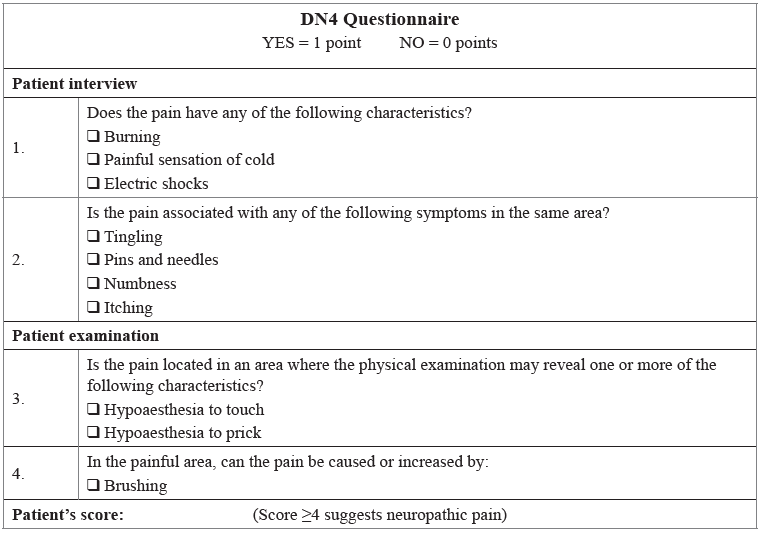
If neuropathic pain is suspected, the DN4 questionnaire is a brief and easily applied validated tool used to support the diagnosis. A score of 4 or higher suggests the presence of neuropathic pain (Figure 1)24
| Table 2: PQRST Mnemonic for Assessment of Pain | ||
| P | Provoking/ relieving | What brings the pain on; what makes it better; what makes it worse? What medications are you using at the moment? How often are you taking them? Do they help? Do they cause any side effects? Have you taken anything else in the past for this pain? What was the effect of that? |
| Q | Quality | Describe the pain. What does it feel like (e.g., stabbing, burning, sharp, aching)? |
| R |
Region and radiation | Where is the pain? Does it spread anywhere else? |
| S |
Severity | How severe is the pain? Now? At its worst? At its least Most of the time? How does the pain affect your daily activities? |
| T | Time | When did the pain start? Is it constant or intermittent? How often does it occur? How long does it last? |
| Table 3: Typical Qualitative Descriptions of Pain 10, 25,16 | ||
| Description | Response to treatment | |
| Nociceptive pain | - Superficial arising from skin, subcutaneous structures or mucous membranes: sharp, well localised - Deep arising from muscles, tendons, joints: diffuse and dull - Visceral pain (organs): dull, poorly localised; aching, cramping, gnawing, sharp (may be associated with autonomic responses; e.g., sweating, nausea) |
Opioids and non-opioid analgesics |
| Neuropathic pain | - Hot/burning, prickling, tingling, pins and needles, electric shocks, shooting | Responds to α2δ-ligands, SNRI or TCA. Unlikely to respond to NSAIDs or paracetamol; less responsive to opioids |
| CRPS | - Burning with hyperaesthesia - Localised vasomotor instability (erythema, pallor, oedema) - Trophic changes |
Responds to regional sympathetic block. Less responsive to opioid and non-opioid analgesics |
| Psychogenic pain | - Physical pain that is caused, increased, or prolonged by mental, emotional, or behavioral factors. Organic causes must be excluded - Examples include headache, muscle spasms, back pain, abdominal pain |
May respond to psychotherapy, antidepressants or non-narcotic analgesics |
| CRPS: Complex regional pain syndrome; SNRI: serotonin noradrenaline re-uptake inhibitor; TCA: tricyclic antidepressant | ||
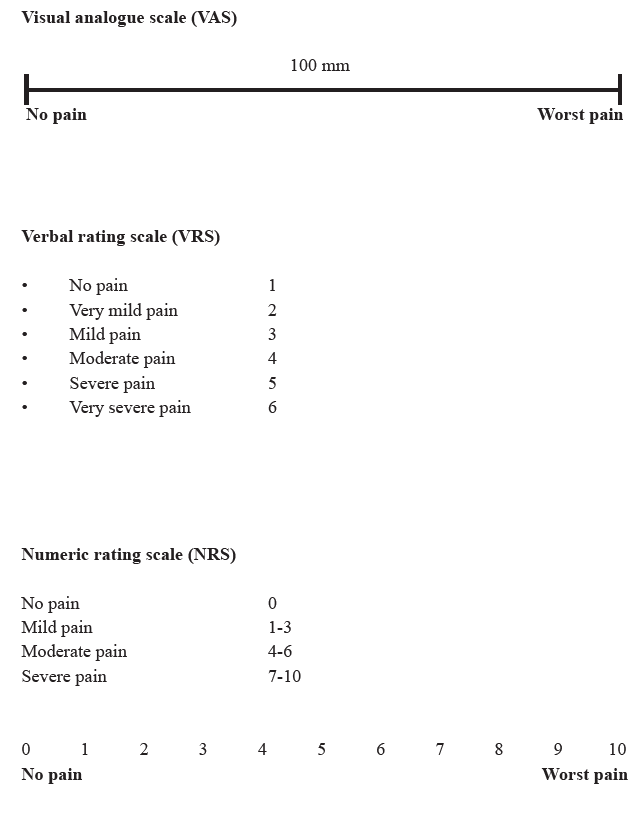
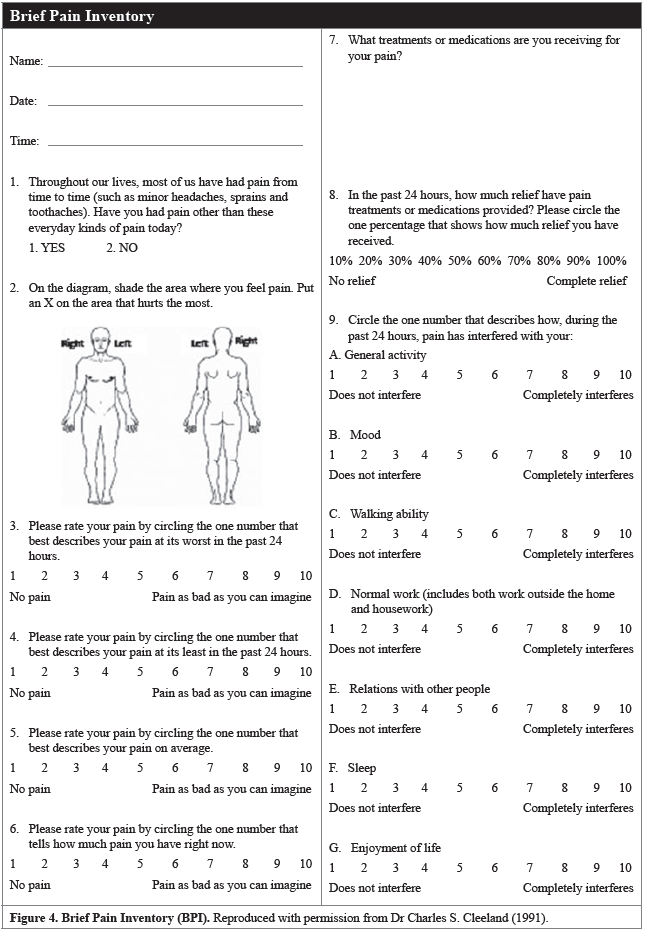
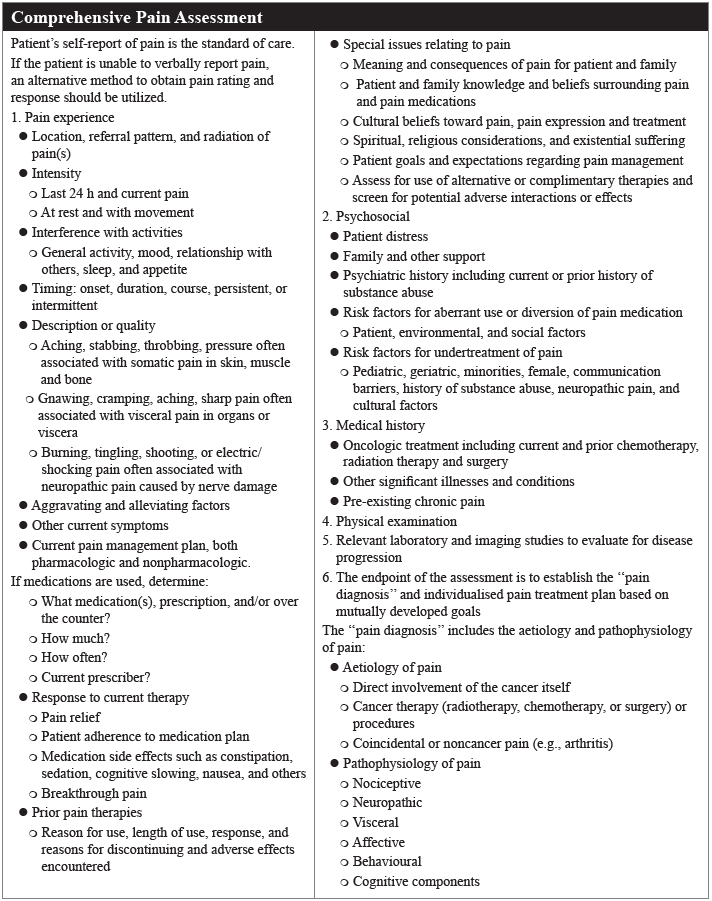
There are various tools to document pain severity and which can be compared from one visit to the next to monitor efficacy and continued response to treatment. The most commonly used tools in adults are the visual analogue scale (VAS), numeric rating scale (NRS) and verbal rating scale (VRS) (Figure 2). The Brief Pain Inventory (Figure 3) more thoroughly documents pain location and radiation, severity, the effect of treatment and the impact of pain on daily function, mood and relationships. Assessment of pain in children requires specialised tools described in Section B. A comprehensive checklist for pain assessment is listed in Figure 4.
Click on image to enlarge
Figure 1. DN4 (Douleur Neuropathique en 4 questions) Questionnaire to confirm neuropathic pain. If the patient’s score is ≥4, the test is positive (sensitivity 82.9%; specificity 89.9%).
This questionnaire has been reproduced with permission of the International Association for the Study of Pain® (IASP).24 The questionnaire may not be reproduced for any other purpose without permission.
Click on image to enlarge
Figure 2: Validated pain rating scales
Click on image to enlarge
Figure 3: Brief Pain Inventory (BPI). Reproduced with permission from Dr Charles S. Cleeland (1991)
Click on image to enlarge
Figure 4: Comprehensive pain assessment
Adapted with permission from the NCCN Clinical Practice Guidelines in Oncology (NCCN Guidelines®) for Adult Cancer Pain V.2.2013 © 2013 National Comprehensive Cancer Network, Inc.27 All rights reserved. The NCCN Guidelines® and illustrations herein may not be reproduced in any form for any purpose without the express written permission of the NCCN. To view the most recent and complete version of the NCCN Guidelines, go online to NCCN.org. NATIONAL COMPREHENSIVE CANCER NETWORK®, NCCN®, NCCN GUIDELINES®, and all other NCCN Content are trademarks owned by the National Comprehensive Cancer Network, Inc.
In terms of the clinical examination, pain is often associated with physiological, verbal, postural and behavioural responses that provide clues to its presence and severity (Table 4). These may be especially important in patients who are unable to communicate verbally.
| Table 4: Examples of Physiological, Behavioural and Verbal Responses to Pain | |
| Physiological | - Increased blood pressure - Increased heart rate - Increased respiratory rate - Dilated pupils - Perspiration - Flushing/pallor |
| Facial | - Grimace - Frowning - Wincing - Teeth clenching |
| Verbal | - Moaning - Screaming - Whimpering - Crying |
| Body movement | - Rigidity, splinting, tension - Slow, cautious movement - Arching - Clenched fists - Restlessness - Repetitive movements - Guarding |
The patient should undergo a full physical examination, paying particular attention to the factors listed in Table 5.
| Table 5: Physical Examination of a Patient with Pain 28 | |
| General | - General appearance and vital signs, including subjective indications of pain (see Table 4) - Overt abnormalities (e.g., weight loss, muscle atrophy, deformities, trophic changes) |
| Site of pain | - Appearance, colour, abnormalities of overlying skin - Muscle spasm - Tenderness - Brush, pin prick tests to evaluate for allodynia, hyperalgesia or hyperesthesia - Mass lesion - Evidence of incident pain (e.g., worse on movement or inhalation) |
| Neurological | - Sensory or motor deficits - Abnormalities of coordination - Orientation, memory, mood |
| Musculoskeletal | - Posture and symmetry - Deformities - Abnormal movements and/or gait - Muscle strength and joint range of motion |
Evaluate psychosocial factors
Both emotional and social influences can determine a patient’s experience of pain and response to treatment. Patients should be encouraged to express their emotions, thoughts, fears and expectations and more detailed examination and assessment is required in patients exhibiting features suggestive of emotional distress and/or depression. Examples of psychological and social issues that may need to be addressed include:17
Psychological issues
- The patient’s understanding of their condition
- What the pain means to them and their family
- The impact of pain on relationships within the family
- The influence of pain on the patient’s mood
- Investigation for the presence of anxiety, depression, suicidal thoughts and other psychiatric syndromes
- Fatigue and sleep
Social issues
- Functional capacity and coping strategies
- Social isolation
- Stigma of the diagnosis
- Transport difficulties
- Living circumstances
- Family and social support
- Economic impact
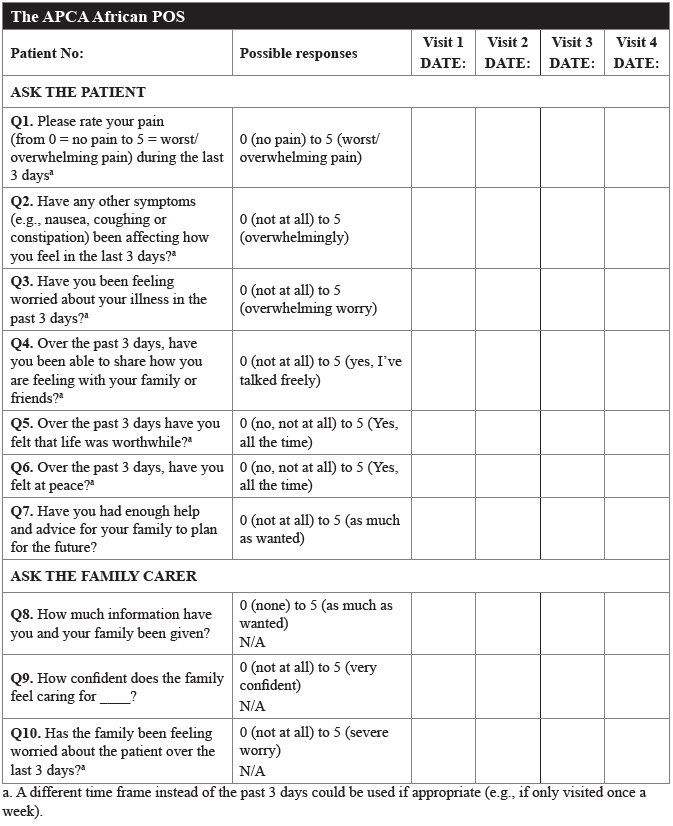
Various multidimensional tools are available to reliably assess psychosocial distress. These include the African Palliative Care Association’s (APCA) African Palliative Outcome Scale (POS), which is validated for use in Africa (Figure 5).29
Click on image to enlarge
Figure 5. APCA Palliative Outcome Scale (POS)
Reprinted with permission from Powell RA, Downing J, Harding R, et al, on behalf of the APCA M&E Group. Development of the APCA African Palliative Outcome Scale. Journal of Pain and Symptom Management 2007; 33: 229-232.29
Evaluate spiritual factors
Beliefs including, but not limited to, religious beliefs, emotions, self-awareness, ideas and attitudes influence attitudes towards health and sense of well-being. In addition to medical intervention, nonjudgmental, understanding and supportive care is required to address these needs for each patient as an individual.
Patients find it comforting that they can speak of spiritual issues in a clinical consultation. The clinician may need to specifically ask about these so that patients know that it is acceptable to talk about them. A useful guide to this discussion is the FICA tool (Table 6).
The value of proactively addressing spirituality is that the patient is offered a safe space to discuss these issues and the doctor or nurse can involve a spiritual counsellor in the patient’s care if necessary or if desired by the patient. It does not require that the clinician is of the same faith as the patient to offer this support.
|
Table 6: FICA Tool to Aid Discussion of Spirituality 30
|
|
Ask the patient:
- Do you have a Faith or belief? - How Important is this to you, especially in your illness? - Is there a faith Community that supports you? - How can I, as your doctor, Assist you in spiritual care? |
Determine the occurrence and severity of breakthrough pain
The occurrence of breakthrough pain needs to be identified. An assessment of breakthrough pain includes the documentation of frequency, duration, intensity, nature, precipitating factors, relieving factors and effect of analgesia.
Ongoing assessment and reassessment of pain
Regular ongoing pain assessment using a consistent instrument, such as PQRST or the Brief Pain Inventory, is required to monitor the efficacy of pain management strategies, to identify breakthrough pain and to review, add or change treatments when necessary. Furthermore, new reports of pain, which may indicate a change in the underlying pathological process, require urgent medical attention and must be appropriately investigated. When reassessing pain, in addition to pain features and impact on daily functioning, psychological status and quality of life, consider and document the following factors that may influence pain and the future management thereof:
- Progression of the disease
- Current pain management strategies, medications, doses and timing of administration
- Recent exposure to painful procedures that may influence pain tolerance
- Drug tolerance, withdrawal, side effects or oversedation
- Presence of a caregiver or family members
- New or pre-existing comorbidities
- New or changed attitudes towards the illness and/or management strategies
The frequency of review depends on pain severity and distress, but initially should be carried out every 24 hours until the patent is stable. In outpatients, review may be weekly or monthly and, where suitable, may be done telephonically by an appropriately skilled healthcare worker.
Consider a pain diary to monitor pain levels, medication requirements, analgesic efficacy and side effects of medication
A pain diary should be completed at least daily and should include the following information:31
- Date and time of pain experience
- Description and location of the pain
- What the patient was doing when they experienced the pain
- Medicine taken, dose and whether it helped to relieve the pain
- Other relieving factors
- Repeat pain rating an hour after taking the medicine
- Other effects of the pain; e.g., on sleep, mood, ability to be active
- Medication side effects
Be aware of patient groups who may be at risk of underassessment of pain
Patients who may be at risk of underassessment of pain include:
- Elderly and very young
- Cognitively impaired
- Communication difficulties
- Known or suspected substance abusers
- Patients at the end of life
- Patients at risk of painful syndromes consequent to cancer treatments
- Psychiatric patients
- Patients with a depressed level of consciousness
- Other marginalised groups (e.g., patients in prison; HIV and AIDS)
Special assessment tools are available for some of these patient groups (e.g., Pain Assessment in Advanced Dementia, PAINAD; Pain Assessment Checklist for Seniors with Limited Ability to Communicate, PACSLAC; Hand Scale).16,32,33