Assessment of Pain in Children
Management of cancer pain in children
QUESTT principle to assess paediatric pain
Summary of questions for the assessment of pain in children
Nonverbal expression of pain in children
Age-appropriate pain assessment tools
Neonatal Infant Pain Rating Scale (NIPS)
FLACC Score for nonverbal children or children <3 years
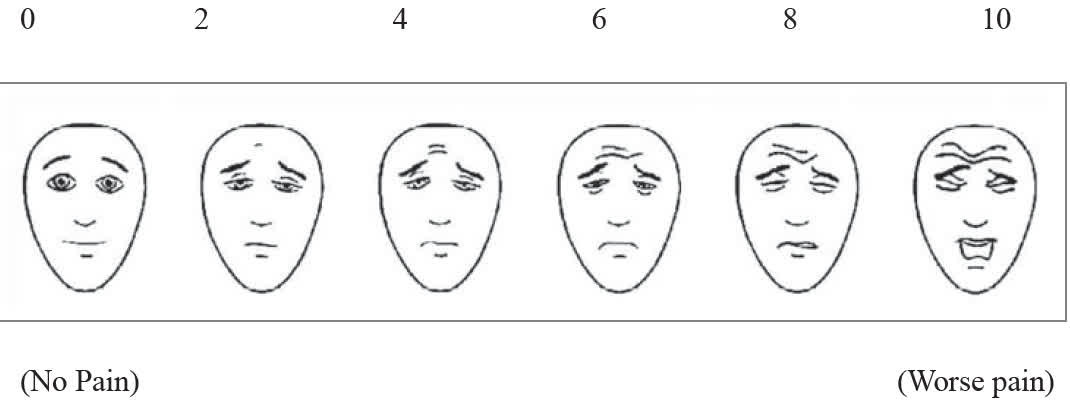
Revised Faces Pain Scale for children >4 years
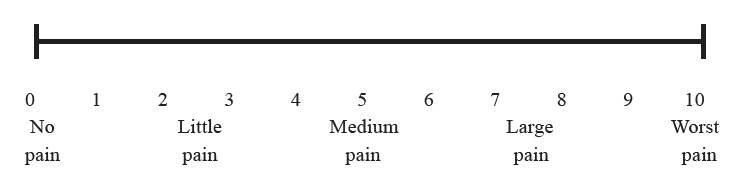
Numeric/word pain scale for children >7 years
Pain in children is often underestimated. Even though non-verbal children may not be able to report their pain, they do respond to pain in ways that are generally recognisable and many validated paediatric pain assessment tools are based on these behavioural and physiological responses.
Remember also that any illness or procedure that would cause pain in an adult will be painful to the child.
QUESTT principle to assess paediatric pain25
Question the parent/ caregiver
Use an age-appropriate pain rating scale
Evaluate behaviour, physical findings, and physiologic changes
Secure the parent’s or caregiver’s involvement
Take the cause of pain into account
Take action and evaluate results
Summary of questions for the assessment of pain in children13
- What words do the child and family use for pain?
- What verbal and behavioural cues does the child use to express pain?
- What do the parents and/or caregivers do when the child has pain?
- What do the parents and/or caregivers not do when the child has pain?
- What works best in relieving the pain?
- Where is the pain and what are the characteristics (site, severity, character of pain as described by the child/parent, e.g., sharp, burning, aching, stabbing, shooting, throbbing)?
- How did the present pain start (was it sudden/gradual)?
- How long has the pain been present (duration since onset)?
- Where is the pain (single/ multiple sites)?
- Is the pain disturbing the child’s sleep/ emotional state?
- Is the pain restricting the child’s ability to perform normal physical activities (sit, stand, walk, run)?
- Is the pain restricting the child’s ability/willingness to interact with others, and ability to play?
The PQRST approach used in adults is a useful reminder for pain assessment in children.
Children between the ages of 2-4 years will start to be able to express pain verbally. By the age of 5 they will be able to describe pain and its intensity, and by the age of 6, will be able to differentiate levels of pain intensity. Children older than 7 years will be able to explain why it hurts.
Children may be reluctant to report their pain if they are afraid of consequences, such as injections. Nonverbal cues that indicate the presence of pain and parental behaviours used to console the child (e.g., rocking, touch, verbal reassurance) must also be taken into account when assessing pain. Ask the parents or caregiver about the child’s pain. They often know best about how the child expresses pain and what will comfort the child and they should be included in making decisions about symptoms and management.
Nonverbal expression of pain in children13
| Main Indicators of Acute Pain | Behaviours in Chronic Pain |
| - Facial expression - Body movement and body posture - Inability to be consoled - Crying - Groaning | - Abnormal posturing - Fear of being moved - Lack of facial expression - Lack of interest in surroundings - Undue quietness - Increased irritability - Low mood - Sleep disruption - Anger - Changes in appetite - Poor school performance |
Reprinted with permission from the publisher from World Health Organisation. WHO guidelines on the pharmacological treatment of persisting pain in children with medical illnesses. World Health Organisation; Geneva, Switzerland; 2012. Available at: http://apps.who.int/medicinedocs/en/m/abstract/Js19116en/.
Age-appropriate pain assessment tools
- Neonate: Neonatal pain rating scale
- Nonverbal children or <3 years: FLACC Score
- Children >4 years: Revised Faces Pain Scale
- Children >7 years: Numeric/word pain scale
Neonatal Infant Pain Rating Scale (NIPS)
| Assess | Examination | Score | Description | Score |
| Facial expression | Relaxed muscles | 0 | Restful face, neutral expression | |
| Grimace | 1 | Tight facial muscles, furrowed brow, quivering chin, tightjaw | ||
| Cry | No cry | 0 | Quiet, not crying | |
| Whimper | 1 | Mild moaning, intermittent | ||
| Vigorous cry | 2 | Loud scream, rising, shrill, continuous (Silent cry may be scored if baby is intubated and ventilated as evidenced by obvious mouth and facial movements) | ||
| Breathing pattern | Relaxed | 0 | Usual pattern for infant | |
| Change in breathing | 1 | Laboured, irregular, faster than usual, gagging, breath holding | ||
| Arms | Relaxed | 0 | No muscle rigidity, occasional random movement of arms | |
| Flexed, extended | 1 | Tense, straight arms; rigid and/or rapid extension/ flexion of arms | ||
| Legs | Relaxed | 0 | No muscle rigidity, occasional random movement of legs | |
| Flexed, extended | 1 | Tense, straight arms; rigid and/or rapid extension/ flexion of legs | ||
| State of arousal | Sleeping/awake | 0 | Quiet, peaceful or alert, random leg movement | |
| Fussy | 1 | Alert/restless and thrashing |
Reprinted from Hospice Palliative Care Association of South Africa.25
FLACC Score for nonverbal children or children <3 years
| Item | Score | ||
| 0 | 1 | 2 | |
| Face | No particular expression or smile | Occasional grimace or frown, withdrawn, disinterested | Frequent to constant frown, clenched jaw, quivering chin |
| Legs | Normal position or relaxed | Uneasy, restless, tense | Kicking, or legs drawn up |
| Activity | Lying quietly, normal position, moves easily | Squirming, shifting back and forth, tense | Arched, rigid or jerking |
| Cry | No cry (awake or asleep) | Moans or whimpers, occasional complaint | Crying steadily, screams or sobs, frequent complaints |
| Consolability | Content, relaxed, no need to console | Reassured by occasional touching, hugging or “talking to”, distractible | Difficult to console or comfort |
Reprinted from Hospice Palliative Care Association of South Africa.25
Revised Faces Pain Scale for children >4 years
Tell the child: “These pictures show how much something can hurt. No pain (on left); very much pain (on right). Point to the picture that shows how much you hurt.”
Click on image to enlarge
- Do not use words like ‘happy’ and ‘sad’
- The pictures represent how the child is feeling inside and not how their face looks
This Faces Pain Scale-revised has been reproduced with permission of the International Association for the Study of Pain® (IASP).79 The figure may not be reproduced for any other purpose without permission.
Numeric/word pain scale for children >7 years
“Choose the number and word that best describes your pain”
Click on image to enlarge
Mild pain: 0-3
Moderate pain: 4-6
Severe pain: 7-10
Reprinted from Hospice Palliative Care Association of South Africa.25
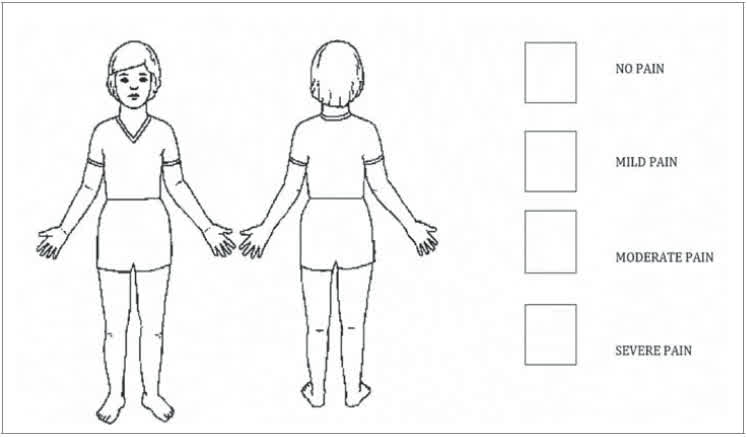
Eland body tool
Ask child to colour the picture of the body using colour to represent the level of pain in that area; e.g.,
Green: no pain
Yellow: little pain
Orange: moderate pain
Red: severe pain
Reprinted from Hospice Palliative Care Association of South Africa.25