Asthma Monitoring
Peak expiratory flow rates Calculating % predicted peak flow rate Calculating bronchodilator responsiveness using peak flow in Adults Calculating peak flow varibility in children and adults Asthma control test PEAK EXPIRATORY FLOW RATES Click on above image to enlarge CALCULATING % PREDICTED PEAK FLOW RATE Take the best of 3 of the patient’s observed peak flow rates (l/min): e.g. 200, 180, 190 pe
Calculating % predicted peak flow rate
Calculating bronchodilator responsiveness using peak flow in Adults
Calculating peak flow varibility in children and adults
PEAK EXPIRATORY FLOW RATES
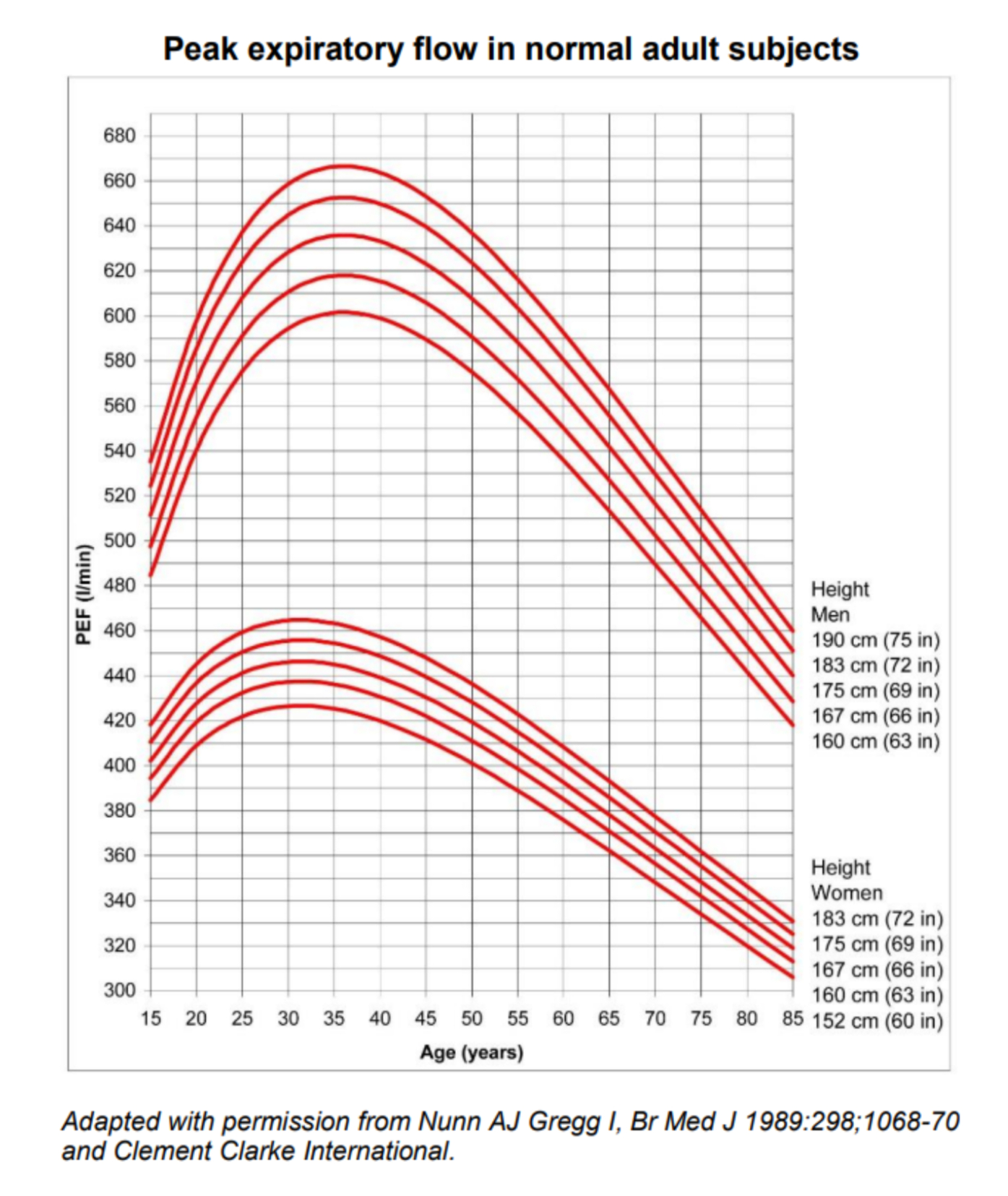 Click on above image to enlarge
CALCULATING % PREDICTED PEAK FLOW RATE
- Take the best of 3 of the patient’s observed peak flow rates (l/min): e.g. 200, 180, 190 performed – so take 200.
- Find the patient’s sex, age and height predicted value from the nomogram. e.g. 440 l/min for a woman of age 25 years and height 167 cm
- Divide patient’s observed peak flow rate over their predicted peak flow rate: e.g. 200/440 = 0.45
- Multiply by 100: e.g. 0.45 X 100 = 45%
So, in this example, the patient’s observed peak flow rate is 45% of their predicted.
CALCULATING BRONCHODILATOR RESPONSIVENESS USING PEAK FLOW IN ADULTS
Perform peak flow testing and select the best of the 3 values to use as the pre-bronchodilator peak flow.
- Administer salbutamol 400 μg using a metered dose inhaler and spacer without a mask.
- Wait 15 minutes before repeating peak flow
- Repeat peak flow testing to obtain a post-bronchodilator peak flow.
- Subtract the pre-bronchodilator reading from the post-bronchodilator reading.
- Divide the difference by the pre-bronchodilator reading.
- Multiply by 100.
For example, a patient with readings that improve from 300 to 400, has reversibility of 33%. Measurements that improve by >20% strongly suggest a diagnosis of asthma. (See: Asthma, acute and Asthma, chronic persistent).
CALCULATING PEAK FLOW VARIABILITY IN CHILDREN AND ADULTS
- Perform peak flow measurements 4 times per day spread over the course of the day.
- Subtract the lowest reading of each day from the highest reading.
- Calculate the mean/average reading by adding all 4 readings from that day and dividing total by 4.
- Calculate PEF variability:

Determine this value on each day over two weeks, and average the results.
Excessive diurnal PEF variability defined as >10% in adults and >12% in children strongly supports a diagnosis of asthma.
ASTHMA CONTROL TEST™
This is a validated measure of clinical asthma control that can be completed by the patient (after initial instruction) at each visit to the clinic prior to consultation.
A value of ≥19 suggests adequate asthma control.
Online version of the test is accessible at: https://www.asthmacontroltest.com/
Reference: Nathan RA, Sorkness CA, Kosinski M, Schatz M, Li JT, Marcus P, Murray JJ, Pendergraft TB. Development of the asthma control test: a survey for assessing asthma control. J Allergy Clin Immunol. 2004 Jan;113(1):59-65. http://www.ncbi.nlm.nih.gov/pubmed/14713908
Standard Treatment Guidelines and Essential Medicines List for South Africa, Hospital Level, Adults_Asthma Monitoring_V1_June 2024