Background Information
National Neonatal Resuscitation Guidelines
Transition from fetal to neonatal life
Before birth, the placenta, not the lungs, is responsible for providing oxygen and removing carbon dioxide in the fetus. Fetal lungs are fluid filled. Blood flow through the fetal lungs is much less than after birth due to constriction of the arterioles in the lungs (see Figure 1 below).
Major physiological changes occur in the first few minutes after birth. Regular breathing is established within 45 seconds. The heart rate stabilises at 120 to 140 beats per minute and the central cyanosis rapidly clears. Clamping the umbilical cord, tactile stimulation and the cooler environment stimulate the baby to start breathing. The baby’s lungs are filled with fetal lung fluid at birth.
Very high pressures (twice normal) may be required to overcome the fluid forces and inflate the lungs initially. As the lungs expand with air, the fetal lung fluid is reabsorbed. The process of labour, which results in a surge in endogenous steroids and catecholamines, helps to clear the lungs of fluid. Babies who have poor respiratory effort or who are apnoeic at birth may not clear the lung fluid effectively.
After birth, the blood flow through the lungs increases from less than 10% to 50% of the biventricular output and good oxygenation is established. The neonatal PaO2 is much greater than that of the fetus. The arterioles within the lungs open and blood flow increases dramatically after the lungs are filled with air. As the oxygen levels within the baby’s blood increase, so the ductus arteriosus closes, allowing more blood to flow through the lungs.
Clamping of the umbilical cord removes the low resistance placenta from the systemic circulation and left sided pressures increase. This causes the foramen ovale to close and blood that was previously shunted from right to left now flows through the lungs.
The transition from fetal to neonatal circulation is a gradual process. A healthy newborn should maintain pink mucous membranes without supplementary oxygen, but healthy babies may take 10 minutes for pre-ductal saturations to reach >95% and up to 1 hour for post ductal saturations to be >95%.
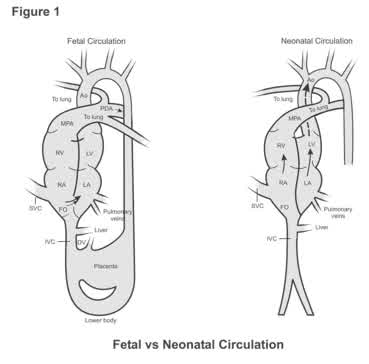
Key:
RA Right Atrium
MPA Main pulmonary artery
LV Left Ventricle
Ao Aorta
LA Left Atrium
FO Foramen Ovale
IVC Inferior Vena Cava
DV Ductus Venosus
SVC Superior Vena Cava
RV Right Ventricle
PDA Patent Ductus Arteriosus