Bag and Mask Ventilation
National Neonatal Resuscitation Guidelines
Assembling and checking the equipment
How to ventilate with a bag and mask
Common mistakes during bag and mask ventilation
Why am I not managing to ventilate the baby adequately
During this section you should learn
- The characteristics of an ideal bag and mask
- How to prepare the equipment needed for bag and mask ventilation
- How to do bag and mask ventilation.
- When to start and stop bag and mask ventilation.
- The baby’s saturations should improve to the targeted preductal saturations (see Algorithm).
Assembling and checking the equipment
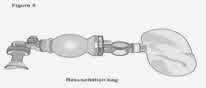
Connect the flow meter to the oxygen source and set the rate of flow at 5 litres per minute. Connect the oxygen tubing from the flow meter to the resuscitation bag. Connect the oxygen reservoir to the end of the self-inflating bag (e.g. Laerdal ). It is not possible to get the oxygen concentration in the bag above 40% without the oxygen reservoir. The correct size facemask should be connected to the resuscitation bag.
The mask must be big enough to cover the baby’s mouth and nose without covering any part of the eyes. Make sure that you can get a proper seal and that enough pressure can be generated with the bag and mask assembled. Check the bag for leaks. The Laerdal self-inflating bag has a pressure pop-off valve that prevents pressures above +40cm H2O being delivered. These devices give a “peaked” pressure wave, rather than a square wave, which may not oxygenate the baby properly.
These resuscitators should not be used where possible. Ventilation with a T piece device where available (see 1.5.5 below) should rather be used.
How to ventilate with a bag and mask
The key to successful neonatal resuscitation is establishing adequate ventilation.
The majority of babies can be successfully resuscitated with bag and mask ventilation alone, without the need for intubation or cardiac massage.
Bag and mask ventilation should be started if the baby is apnoeic or gasping, has a heart rate below 100 beats per minute or saturations or central colour do not improve with free flowing oxygen. In cases of meconium stained liquor in babies who require positive pressure ventilation, it has been previously recommended that any visible meconium should be rapidly cleared from the airway by suctioning using an endotracheal tube before starting bag and mask ventilation. However, there is insufficient evidence that this prevents meconium aspiration and this should only be considered when someone experienced in endotracheal intubation is present.
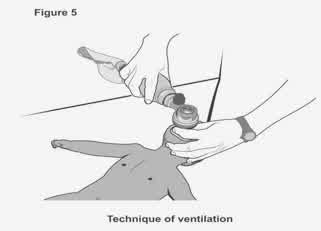
Position the baby correctly in the “neutral position”; a folded towel under the shoulders may be helpful. Apply the mask firmly to the baby’s face to achieve a seal.
The ventilation bag is then squeezed firmly and regularly at a rate of about 30-40 breaths per minute. (Counting “bag, 2, 3”, with each breath will achieve the correct rate.) If ventilation is effective, there should be good equal chest movement with equal air entry bilaterally and the baby’s heart rate and colour should improve immediately.
Although the first few breaths may require higher pressures and longer inflation times than other breaths, looking for good chest movement (i.e. just enough to see the chest rise) is the best sign of adequate ventilation pressure rather than any particular pressure reading. The use of initial sustained inflation is not recommended. Ventilate the baby for 30-60 seconds and then reassess.
Stop ventilating the baby when the baby is breathing regularly and is centrally pink or the saturations have improved adequately (based on the expected range as per the box on the Algorithm) or the heart rate is greater than 100 beats per minute. Continue to give free flowing oxygen to the baby if required, based on central colour or preductal pulse oximetry when ventilation (bag and mask) has been stopped.
Both too much oxygen (hyperoxia) and too little oxygen (hypoxia) are harmful. In babies born at term, it is best to start resuscitation with air and not oxygen. If the baby’s saturations (colour) do not improve after 30-60 seconds, supplementary oxygen should be given. Once again, the oxygen should be blended with air and the amount guided by pulse oximetry.
The oxygen concentration should be regulated aiming to achieve oxygen saturation levels in the physiological range. However, many resuscitation areas will not have either or both of these options available. This is an area of ongoing research and more concrete recommendations may be possible in the future. At no time should resuscitation be delayed or withheld simply because the desired gas (air, oxygen or a mixture) is not immediately available.
Supplementary oxygen should be weaned as soon as possible after the return of regular respiration and spontaneous circulation.
Preterm infants
The lungs of preterm infants are easily damaged by large volume inflations so do not use too much pressure when bagging a preterm infant – this can be assessed by excessive chest wall movement. Make sure that there is a tight seal around the mask and no obstruction to the airway before increasing the pressure. The use of positive end expiratory pressure (PEEP) ventilation is recommended in the resuscitation of preterm infants.
The use of continuous positive airway pressure (CPAP) may be useful after resuscitating a preterm infant.
Common mistakes during bag and mask ventilation
Pushing heavily downwards on the facemask may flex the baby’s head resulting in closure of the airway. Hold the facemask firmly on the baby’s face with the thumb and index finger. Place the middle finger under the baby’s chin to keep the head in the correct position (EC clamp technique). Do not press down on the trachea. (Too Flexed!)
Do not squeeze the bag completely empty. The baby has a relatively small lung volume and there is a danger of over expanding the lungs, which can result in a pneumothorax. (Too Forceful!)
Do not ventilate too fast, as this may cause over distension of the lungs and does not allow enough time for expiration. (Too Fast!)
A poor seal either from an inappropriately sized mask, or bad technique when applying the mask and thereby resulting in an air leak. (Too Flimsy!)
Why am I not managing to ventilate the baby adequately?
The following points should be checked if the baby is not responding to bag and mask ventilation:
Make sure that there is an adequate seal between the facemask and the baby’s face. You can reposition the baby’s head and apply the facemask again. Remember to use the ‘EC’ clamp technique of applying the mask to the face, which will be demonstrated to you on the course.
Make sure that the bag is delivering an adequate amount of pressure – there may be tears in the bag itself.
Check that the baby’s airway is clear and that the head is in the correct position. You may need to reposition the baby’s head and suction the airway again. It may help to ventilate the baby with its mouth open. Oral airways are not often used in neonatal resuscitation.
Check that the oxygen supply has not run out. Make sure that the flow is set at greater than 5 litres per minute, that the tubing and connections are working properly and that the reservoir bag is filling properly. In this case, the baby’s chest will move with ventilation, but oxygenation is impaired.
Prolonged bagging (>10 minutes) causes the stomach to fill with air and prevents good movement of the diaphragm. A nasogastric tube should be passed to remove the air from the baby’s stomach.
The baby may have developed a pneumothorax. If so, an intercostal drain needs to be inserted.
Ventilation with a T Piece
Newborn infants that need positive pressure ventilation during resuscitation can be ventilated using a T Piece device (e.g. Neopuff).
T piece resuscitator
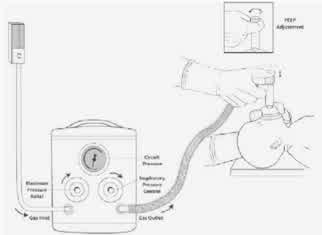
The T piece device can deliver a pre-set peak inspiratory pressure (PIP) and positive end expiratory pressure (PEEP). The PIP should initially be set between 20 and 25cm H2 O and increased as required to achieve adequate chest movement. The PEEP should be set to 5cm H2 O. Target inflation pressures and sustained inflation is better with a T piece than a self-inflating bag. In addition, PEEP cannot be delivered by a self-inflating bag without a PEEP valve.
However, there are no clinical studies in newborns requiring resuscitation to confirm the superiority of the T Piece. Babies can be successfully resuscitated with either a T Piece or a self-inflating bag – a lot depends on local experience and expertise.
Administration of Naloxone
Administration of naloxone is not recommended as part of initial resuscitation. Heart rate and colour must first be established by adequate ventilation. Naloxone (Adult Narcan ) could be given to any baby whose mother received a narcotic analgesic (Pethidene or morphine) within 4 hours of delivery. The recommended dose of naloxone is 0.1mg/kg (0.25mls/kg) given intramuscularly or intravenously; the endotracheal route is not recommended.
Naloxone may cause withdrawal symptoms in the baby of a mother who abuses narcotic drugs. The duration of action of narcotics may be prolonged, so the baby needs to be monitored and the dose of naloxone may need to be repeated after 2 hours to prevent recurrent apnoeas. Avoid using naloxone where the mother has had long term exposure to narcotics.
Note: Neonatal Narcan should not be used as the concentration is too low to be of any practical use.