Bleeding Disorders
General Principles Haemophilia A and B Acute Management of Bleeds Haemophilia A - Factor VIII Deficiency (No Inhibitors) Haemophilia B - Factor IX Deficiency (No Inhibitors) Haemophilia with Inhibitors Von Willebrand Disease GENERAL PRINCIPLES A bleeding tendency may result from: a coagulation defect (congenital/acquired), a vessel wall defect, or a platelet defect (quantitative/qualitative). A c
Haemophilia A - Factor VIII Deficiency (No Inhibitors)
Haemophilia B - Factor IX Deficiency (No Inhibitors)
GENERAL PRINCIPLES
A bleeding tendency may result from:
- a coagulation defect (congenital/acquired),
- a vessel wall defect, or
- a platelet defect (quantitative/qualitative).
A careful and detailed history, thorough examination and review of relevant laboratory investigations will allow differentiation between these three categories, as the management of each of these groups differs significantly.
Screening tests include: FBC, prothrombin time (PT) and activated partial thromboplastin time (aPTT; if prolonged, mixing studies are required).
Patients with a chronic bleeding tendency should be advised to wear a medic alert bracelet which clearly mentions the type of disorder he/she suffers from, e.g. severe Haemophilia A, Factor VIII <1%, no inhibitors.
HAEMOPHILIA A AND B
D66.7/D66.8
DESCRIPTION
Haemophilia A and B are lifelong chronic bleeding disorders caused by a lack of clotting factor VIII and clotting factor IX, due to mutations in the Factor VIII and Factor IX genes respectively. Acute bleeding presentation depends on the severity of the condition (see classification below). Bleeding can occur into any tissue, but intraarticular bleeds are the clinical hallmark of haemophilia.
Haemophilia complications include haemarthrosis that may lead to chronic arthropathy, intracranial haemorrhage, soft tissue and muscle haematomas. In a known person with haemophilia, pain/tingling in a joint suggests early-onset bleeding.
Early consultation and regular follow-up with a haematologist or clinician with expertise in managing such patients is advisable. All patients diagnosed with haemophilia should attend a designated specialised Haemophilia Treatment Centre with a dedicated multi-disciplinary health care team at least annually for adults. The details of available Haemophilia Treatment Centres can be accessed at: https://haemophilia.org.za/haemophilia-treatment-centres-htcs/. All patients diagnosed with haemophilia should be enrolled in the South African Bleeding Disorders Registry (access relevant co-ordinators at: https://haemophilia.org.za/haemophilia-nurses-office/)
Those eligible for prophylaxis with factor VIII or IX (see below) may receive factor replacement therapy at a healthcare facility twice a week. Where appropriate, home-based care can be considered.
Table 2.2: Classification of haemophilia severity (Adapted from White et.al. Journal of Thrombosis and Haemostasis. 2001)xviii
Haemophilia severity classification
| Class | Clotting factor | Factor level | Signs |
| Mild | VIII or IX | > 5 – <40% | Occasional bleeds, usually after trauma or surgery. |
| Moderate | VIII or IX | 1–5% | Less frequent bleeds than severe; usually post trauma/surgery/dental extraction. Some patients may, however, display a severe bleeding phenotype. |
| Severe | VIII or IX | < 1% | Spontaneous bleeds, particularly joint and muscle. |
DIAGNOSTIC CRITERIA
Clinical
- Major bleeds:
- central nervous system (CNS) – intracranial
- gastrointestinal tract
- severe injury
- neck/throat (airway)
- muscle compartment (e.g. forearm and calf)
- advanced joint and soft tissue
- hip and ilio-psoas muscle
- Minor bleeds:
- early joint bleed
- muscle
- soft tissue
- epistaxis
- mouth and gum
- haematuria
- Pain/tingling in a joint of a patient with haemophilia suggests bleeding.
Investigations
Baseline
- Normal white cell count and platelets; may have anaemia due to blood loss or iron deficiency.
- Normal INR
- Prolonged activated partial thromboplastin time (aPTT)
- APTT correction studies
- Factor VIII or IX plasma levels < 50%
- HIV, hepatitis B, and hepatitis C testing if status not known
Non-responders to factor replacement or those previously diagnosed with inhibitors
- Inhibitor screen (Bethesda or Nijmegen assays)
GENERAL MEASURES
- Patient, family and community education
- Enrolment in the South African Bleeding Disorders Registry (access relevant co-ordinators at: https://haemophilia.org.za/haemophilia-nursesoffice/)
- MedicAlert bracelet (or similar)
- Dental care (see below for management of tooth extraction)
- Avoid contact sport
Exercise great caution when taking blood specimens (no arterial samples).
Taking blood from femoral veins is contra-indicated.
Do not insert or use central lines unless done as part of life-saving efforts.
Do not aspirate joints.
Avoid IM injections.
Avoid aspirin and other NSAIDs.
MEDICINE TREATMENT
Treatment approaches are divided into two main categories: prophylaxis and on demand (episodic) treatment following a bleed.
Prophylaxis
Prophylaxis aims to prevent the number of bleeds and prevent or delay the development of joint arthropathy and other sequelae. Primary and secondary prophylaxis can be considered in consultation with a Haemophilia Treatment Centre.
In consultation with a Haemophilia Treatment Centre, prophylaxis is sometimes needed in patients presenting with a target joint.
Treatment on Demand (episodic treatment)
Episodic treatment for bleeding episodes is referred to as on demand therapy (i.e. the use of factor replacement therapy when bleeding occurs).
Home treatment
Haemophilia Treatment Centres promote home treatment of bleeds. Patients or caregivers must be educated on the storage, reconstitution and administration of clotting factor concentrate and provided with a supply of clotting factor concentrate to be kept at home for use in case of a bleed and/or for prophylaxis. Clotting factor concentrate use and bleeding episodes are monitored through an appropriate chart (or bleeding diary), which can be reviewed at consultations and medication collection.
ACUTE MANAGEMENT OF BLEEDS
For pain (as required):
Refer to Medical conditions associated with severe pain and Postoperative pain in the recovery room.
Do not use NSAIDs, including aspirin.
For bleeding episodes
Emergency treatment while awaiting transfer, if indicated.
If serious bleeding in a known patient with haemophilia, and no factor is available:
- Lyophilised plasma (FDP), IV, 15 mL/kg over 20-30 minutes. Lyophilised plasma contains a minimum of 0.4 units/mL of each coagulation factor.
OR
LoE:IIIbxix
- Fresh Frozen Plasma (FFP), IV, 15 mL/kg over 20-30 minutes.
Acute joint bleeds – Infuse intravenous factor concentrate first (refer to Haemophilia A - Factor VIII Deficiency (No Inhibitors) or Haemophilia B - Factor IX Deficiency (No Inhibitors) below for dosing guidance) with the following adjunctive measures:
- Apply ice packs: 5 minutes on and 10 minutes off.
- Rest the affected joint/limb until pain-free and there is no further swelling.
- Avoid weight-bearing.
- Splint. Do not use circumferential casts.
- Do not aspirate affected joints.
- Do not request an X-ray of the affected joint unless there is a strong suspicion of fracture.
Give clotting factor concentrate until the patient is pain-free and the joint's range of motion is normal. Administration should be 12 hourly (for Haemophilia A) for major bleeds but may be daily for minor bleeds.
For mucous membrane bleeds
- Tranexamic acid, oral, 1 - 1.5 g (15 - 25 mg/kg) 6-8 hourly.
For dental extraction/male circumcision/minor surgical procedures
Check that inhibitors are absent.
Admit for the procedure and post-procedure care and observation in a facility with experience in haemophilia management.
Haemophilia A:
- Factor VIII, intravenous, 40 units/kg, immediately before extraction.
AND
- Tranexamic acid, oral, 25 mg/kg/dose 6–8 hourly, starting 2 hours before the procedure and continued for 5 days post-procedure.
Haemophilia B:
- Factor IX/factor IX complex, intravenous, 40 units/kg, immediately before extraction.
Ideally, elective surgery should be performed at a tertiary/quaternary centre in consultation with a clinical haematologist.
In emergencies, treat it as a major bleed and consult the local Haemophilia Treatment Centre as soon as feasible.
HAEMOPHILIA A - FACTOR VIII DEFICIENCY (NO INHIBITORS)
D66
PROPHYLAXIS
Prophylaxis (primary and secondary) should be considered for patients with severe haemophilia A (<1% factor activity) who can access the health facility twice weekly for infusions; or have indwelling venous catheters or are candidates for home-based care.
Primary prophylaxis: Prophylaxis started in the absence of documented joint disease/damage.
Secondary prophylaxis: Prophylaxis initiated after joint damage has occurred.
- Factor VIII, intravenous 25 units/kg, twice weekly.
- The clotting factor should be rounded to the nearest full vial to avoid wastage.
- Proposed rounded dosing (see table below)
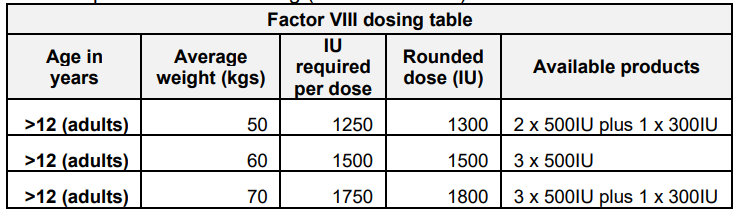
Click on image to enlarge
TREATMENT ON DEMAND
Minor bleeds:
Bleeds into the muscle or soft tissue, mouth or gums, epistaxis, painless haematuria and early joint bleeds.
- Factor VIII, intravenous, 20 - 40 units/kg.
- If there is evidence of ongoing bleeding after 12 hours, consult with local haemophilia treatment centre.
Major bleeds:
Advanced muscle or joint bleeds result from severe injury or bleeds that affect the central nervous system, gastrointestinal system, neck or throat, hip or iliopsoas muscle, or forearm compartment.
LoE:IIIxx
- Factor VIII, intravenous, 40 - 50 unit/kg.
- Use all the contents of the appropriate volume ampoule.
- All of these patients need hospitalisation.
- Discuss all patients promptly with the local Haemophilia Treatment Centre.
Intracranial bleeds (paediatrics and adults)
- Factor VIII, intravenous, 40 - 50 units/kg 6 hourly.
- Decrease frequency of dosing if the trough factor level is > 50%, if possible.
HAEMOPHILIA B - FACTOR IX DEFICIENCY (NO INHIBITORS)
D67
PROPHYLAXIS
Prophylaxis (primary and secondary) should be considered for patients with severe haemophilia B (<1% factor activity) who can access the health facility twice weekly for infusions; or have indwelling venous catheters or are candidates for home-based care.
Primary prophylaxis: Prophylaxis started in the absence of documented joint disease/damage.
Secondary prophylaxis: Prophylaxis initiated after joint damage has occurred.
- Factor IX, intravenous 25 units/kg, twice weekly.
TREATMENT ON DEMAND
Minor bleeds
Bleeds into the muscle or soft tissue, mouth or gums, epistaxis, painless haematuria and early joint bleeds.
- Factor IX/factor IX complex, intravenous, 40 units/kg immediately as a single dose.
- If there is evidence of ongoing bleeding after 12 hours, consult with local haemophilia treatment centre.
Major bleeds
Major muscle or joint bleeds result from severe injury or bleeds that affect the central nervous system, gastrointestinal system, neck or throat, hip or iliopsoas muscle, or forearm compartment.
- Factor IX/factor IX complex, intravenous, 60 units/kg.
- All these patients need hospitalisation.
LoE:IIIxxi
Discuss all patients promptly with the local Haemophilia Treatment Centre to plan ongoing treatment and factor replacement.
HAEMOPHILIA A WITH INHIBITORS
Refer for assessment and planning with a haematologist.
REFERRAL
- All cases with suspected or established haemophilia (prolonged PTT and normal INR), for assessment, genetic counselling and planning of management, to a Haemophilia Treatment Centre.
VON WILLEBRAND DISEASE
D68.0
DESCRIPTION
Von Willebrand disease is the most common congenital bleeding disorder and is due to reduced amounts or abnormal forms of von Willebrand factor.
DIAGNOSTIC CRITERIA
Clinical
- Recurrent epistaxis, prolonged bleeding from lacerations, easy bruising or gum bleeds.
Investigations
- Reduction in one or more of the following:
- von Willebrand factor antigen,
- Ristocetin co-factor and/or collagen binding activity,
- factor VIII coagulant activity.
GENERAL AND SUPPORTIVE MEASURES
- Apply pressure to the bleeding site.
- For tooth socket bleeds, bite down on a piece of gauze.
Caution
Avoid aspirin and other NSAIDs.
MEDICINE TREATMENT
Mild bleeding
Such as epistaxis and menorrhagia.
- Antifibrinolytics, e.g.:
- Tranexamic acid, oral, 1 g 6-8 hourly.
Recurrent menorrhagia can also be treated effectively with oral contraceptives. See: Uterine bleeding, abnormal.
More severe mucous membrane bleeding
Consult a local haemophilia treatment centre.
During surgery or after major trauma, patients should receive:
- Factor VIII (Factor VIIII-containing von Willebrand factor VIII), IV, 30 IU/kg/dose given every 12 hours.
- Continue for 48–72 hours to ensure optimal haemostasis.
- For major surgical procedures, use for 7–10 days.
LoE:IVb
REFERRAL
- All suspected cases of von Willebrand disease to a Haemophilia Treatment Centre for assessment.
- Symptomatic thrombocytopenia.
Standard Treatment Guidelines And Essential Medicines List For South Africa, Adult Hospital level_Version 1_30 March 2026
Chapter 2: Blood and Blood Forming Organs; 2.4 Bleeding Disorders