Blood Product Administration Guidelines (Adult)
Blood Product Administration Guidelines
Responsibilities of the doctor
Informed consent
Assessing benefits and risks
Drawing and cross-match samples
Labelling of cross-match samples
Sending of samples to blood bank
Receiving of blood products from blood bank
Checking of blood products
Monitoring of the patient
Suspected blood transfusion reaction
Signs of blood transfusion reaction
Special precautions
Temperature of blood
After the blood transfusion
Extra educational notes
Responsibilities of the doctor:
- Transfuse blood only when it is absolutely necessary.
- Do not transfuse non-emergency blood products outside of working hours (blood transfusion is a labour-intensive practice for nursing staff).
- Obtain informed consent and document this in the clinical notes.
- Correctly identify the patient, blood specimens sent and receipt of blood products to be transfused.
- Ensure that blood products have not passed their expiry date/time.
- Ensure that a clear and exact written prescription on the front page of the drug chart or prescription record exists for the transfusion of blood products, and that the Professional Nurse in charge of the patient is aware of this.
- Where shift changes occur before the commencement of prescribed blood product transfusions, it is the responsibility of the doctor going off duty to provide a detailed verbal hand-over to the doctor coming on duty.
Informed consent:
- This must be documented in the patient’s clinical notes.
- The risks, benefits and alternatives to transfusion must be explained, except where an emergency situation exists, whereby consent will be assumed.
- The risks of not receiving blood should be explained.
- The patient should be given the opportunity to ask questions.
Assessing benefits and risks:
- Transmission of infections such as HIV, HBV, HCV, CMV, malaria and bacterial contamination.
- Red cell incompatibility, immune-modulation and transfusion-related acute lung injury.
Drawing of cross-match samples:
- The correct patient and folder must be identified, the cross-match tube must be correctly labelled at the bedside, and the blood specimen drawn into the correct cross-match tube.
- The label must include: patient’s name, date of birth, folder number, date of sample and patient location.
- The required WPBTS requisition form must be completed, and must accompany the blood specimens.
Labelling of cross-match samples:
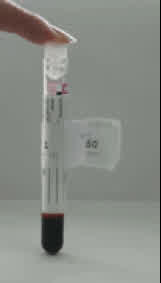
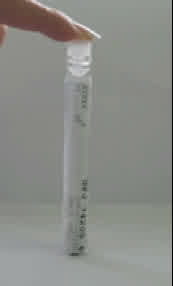
The following guidelines are recommended when labelling the cross-match sample:
- The sample should not be pre-labelled.
- The sample should be labelled immediately at the patient bedside.
- The sample should be labelled with the patient name/initial, surname, identity number/folder number and hospital/ward.
- If hospital stickers are used, check that they are not covering another patient’s identity sticker.
In order to prevent the cross-match tubes from being damaged in the Blood Bank, ward staff are encouraged to place the hospital sticker along the length of the cross-match tube and not horizontally around it. The sticker may be trimmed to remove the extra label that does not contain the required information.
Sending of samples to blood bank:
- Check your local collection times and make sure a sample has indeed gone off and is not lying in a collection bin all day.
- For emergency specimen collection, please contact your local blood bank.
Receiving of blood products from blood bank:
- Blood products must be received from the blood bank driver and must be signed for on receipt.
- All blood products in the WPBTS blood “hamper” (cooler box) must be checked immediately on receipt of the hamper, and reconciled against the doctor’s written prescription.
- Any discrepancies must be reported to the prescribing doctor without delay.
- Blood products must be checked and the transfusion commenced as soon as possible, according to the written prescription.
- The patient must be monitored throughout the transfusion process.
- All details of the transfusion process and patient monitoring must be recorded in the nursing process.
Checking of blood products:
- Plastic tags securing the blood products into the hamper must not be broken until the unit is ready for transfusion. Unbroken tags indicate to the blood bank staff that the unit was not removed from the hamper at any time and that the cold chain is therefore intact. Units with broken tags will not be taken back into stock, will therefore be wasted, and the hospital will be charged for these units.
- All units of blood products must be checked by two individuals, of which at least one must be either a Professional Nurse or Medical Practitioner.
- All information is read aloud by both attendants checking the blood products.
- Extra care must be taken in patients unable to identify themselves, such as the unconscious, anaesthetised or otherwise unidentified patient.
- Blood products are checked at the patient’s bedside against the patient’s identity (wrist band), the blood bank requisition form (inside the hamper) and the patient’s folder.
- Items to check include:
- Patient’s name.
- Patient’s folder number.
- Patient’s date of birth.
- Blood product unit identification number.
- ABO and Rhesus groups.
- Expiry date/time.
Monitoring of the patient:
The unit number, date of transfusion, and the starting and finishing times of each unit should be recorded and signed off.
Baseline observations should be recorded prior to the commencement of the transfusion (Temperature, blood pressure, heart rate, respiratory rate, note urinary output, skin colour and temperature).
The above observations should be recorded every 30 minutes while the transfusion is underway.
Suspected blood transfusion reaction:
- If a transfusion reaction is suspected because the patient complains of symptoms or because of clinically significant changes in vital signs, the transfusion must be stopped immediately, the drip set changed and the line kept open with crystalloid (normal saline or equivalent).
- The doctor in charge must be called immediately.
- Continue supportive or resuscitative management.
- All clerical and identity checks on blood products must be repeated.
- The used blood administration set, all empty, partially-transfused and un-used blood products must be returned to blood bank.
- One EDTA (purple top) blood tube and one 10ml post-transfusion urine sample must be sent to blood bank with all blood products (as above).
- Blood bank must be informed immediately.
- The WPBTS “Untoward Reaction Report” (SER 46) form must be completed by the attending doctor.
- Order fresh blood products as necessary with new cross-match specimen tubes and requisition forms.
Signs of blood transfusion reaction:
- Rigors
- Sweating
- Pyrexia
- Facial flushing
- Urticaria
- Chest and flank pain
- Bronchospasm
- Hypertension
- Hypotension
- Tachycardia
- Haematuria
- Acute renal failure
- Coagulopathy (DIC and shock)
- Hyperventilation
- Jaundice (hyperbilirubinaemia)
- Nausea and vomiting
Special precautions:
- Packed red blood cells, whole blood, fresh frozen plasma and cryoprecipitate may be transfused through a standard blood administration (filter) set.
- Transfusion of platelets requires a special filter (supplied by blood bank) because the standard blood filter traps platelets in the mesh.
- Blood administration sets should be changed:
- When a transfusion reaction is suspected.
- Every 12 to 24 hours in patients requiring long-term transfusion.
Temperature of blood:
- Blood warming is not routinely indicated, as refrigerated blood may be transfused without harm over several hours.
- When rapid transfusion is required, blood must not be warmed to more than 37O C.
- Over-heating can cause extensive haemolysis with renal failure and death.
- Blood should be warmed in a specially-designed purpose-built blood warmer.
After the blood transfusion:
- All empty blood unit bags should be returned to the blood bank.
- These should be kept for 48 hours post transfusion at a temperature of 1O to 6O C.
Extra Educational Notes — Blood Product Administration
Compatibility testing:
Grouping or typing of blood:
Detection of antibodies against the ABO system (anti-A and anti-B antibodies, and detection of Rhesus system anti-D antigen.
Antibody screen:
Detection of non-ABO antibodies in the recipient’s serum that commonly cause delayed haemolytic reactions.
“Group and screen”:
The incidence of serious haemolytic reactions in ABO- and Rhesus-compatible blood, with a negative screen but without cross-match, is less than 1%.
Cross-matching:
Cross-matching mimics the transfusion – donor red cells are mixed with recipient serum. This confirms ABO and Rhesus typing, it detects antibodies of other blood group systems, and it detects antibodies in low titre that do not agglutinate easily. The test takes 45 minutes.
Blood transfusion reactions:
This is usually as a result of sensitisation of the recipient to donor cells. Less commonly, transfused cells or serum may mount a response to the donor’s cells.
Haemolytic reactions:
Are classified as (1) acute – intravascular, or (2) delayed – extra-vascular, and result in the destruction of transfused (donor) red blood cells.
Acute haemolytic reactions:
Is the result of ABO incompatibility, occurs in about 1:6000 transfusions, and is fatal in about 1:100 000 transfusions.
In awake patients, symptoms and signs may include fever, rigors, nausea, chest and flank pain.
In anaesthetised or unconscious patients, signs may include unexplained tachycardia, hypotension, shock, renal shut-down, and coagulopathy (DIC).
Severity depends on how much incompatible blood has been transfused. Treat as indicated above, with supportive measures including osmotic diuresis.
Delayed haemolytic reactions:
Is usually the result of non-D antigens of the Rhesus system such as Kell, Duffy and Kidd antigens. Haemolysis is extra-vascular, delayed and usually mild. Antibodies develop as a result of previous antigen exposure (previous blood transfusion). By the time significant antibodies develop, the transfused red cells have been removed from the circulation.
On subsequent red cell transfusion, an antibody response is mounted with haemolytic reactions occurring 2 to 21 days after transfusion, in about 1% of previously transfused patients. Malaise, jaundice and fever with a falling haematocrit are seen. Serum unconjugated bilirubin is seen (as a result of haemolysis). Treatment is supportive.
Febrile reactions:
White cell or platelet sensitisation manifests as a febrile reaction. These are common (1 to 3%) and are characterized by an increased temperature without haemolysis. Such patients should receive leukocyte-depleted “washed” red cells.
Urticarial reactions:
Urticarial reactions are characterized by erythema, hives and itching, without fever. These occur commonly (1%) and are due to the patient becoming sensitised to transfused plasma proteins. These reactions are minimised by the transfusion of packed red cells, and are treated with common antihistamine drugs).
Anaphylactic reactions:
These reactions are rare, occurring in about 1:150 000 transfusions. They usually occur in IgA deficient patients with anti- IgA antibodies, who have received IgA-containing blood. IgA deficiency occurs in 1:600 - 800 in the general population. Treat as for full anaphylaxis.