GuidelinesOther guideline
Bone and Joint Infections
This guideline aims to assist healthcare workers with antibiotic prescribing for common clinical syndromes in adult patients in South Africa, utilizing Local and International guidelines, key publications, and expert opinion.
Septic arthritis
Osteomyelitis
SEPTIC ARTHRITIS
Definition
Bacterial joint infection, usually due to haematogenous spread.
Common aetiologies
- Non-gonococcal
- S aureus most common
- Streptococcus spp. (S pyogenes, S pneumoniae, S agalactiae)
- Gram‐negative organisms (elderly, immunocompromised, comorbidities)
- N gonorrhoeae
Tests
In all cases:
- Joint aspirate BEFORE ANTIBIOTICS
- Cell count plus differential: high neutrophil count in most cases
- Gram stain and culture
- Microscopy for crystals
- Plain X‐ray
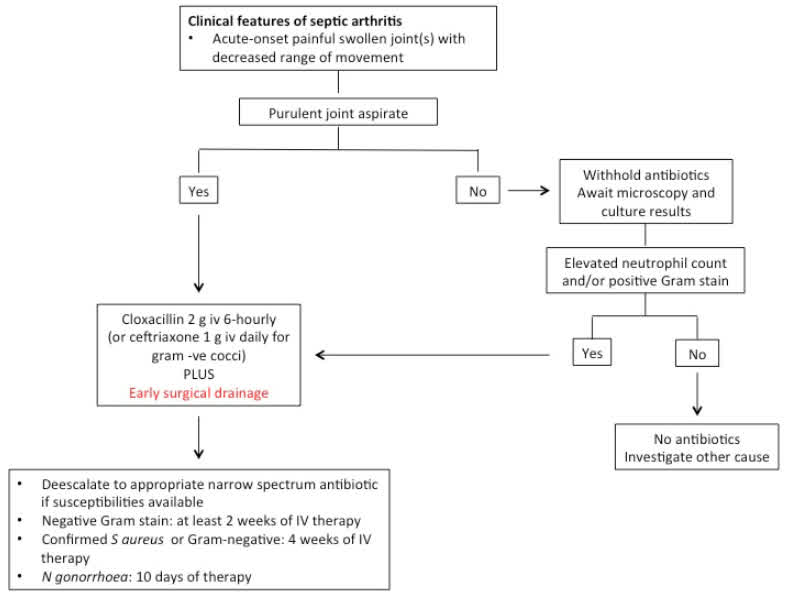
Diagnosis and management
OSTEOMYELITIS
Definition
Bacterial infection of bone due to contiguous spread from soft tissues, haematogenous seeding, or direct inoculation.
Common aetiologies
- Common
- S aureus
- Coagulase-negative staphylococci
- Occasional
- Streptococci
- Enterococci
- Gram-negative bacilli
- Other
- M tuberculosis
- Fungal infections
Tests
- Always send specimens for culture
- Deep tissue specimen: open surgical procedure or guided needle aspiration
- Blood culture
- Imaging
- Plain X‐ray in all cases
- May require other modalities such as bone scan, CT or MRI
- CRP may be useful to monitor response to therapy
Diagnosis and management
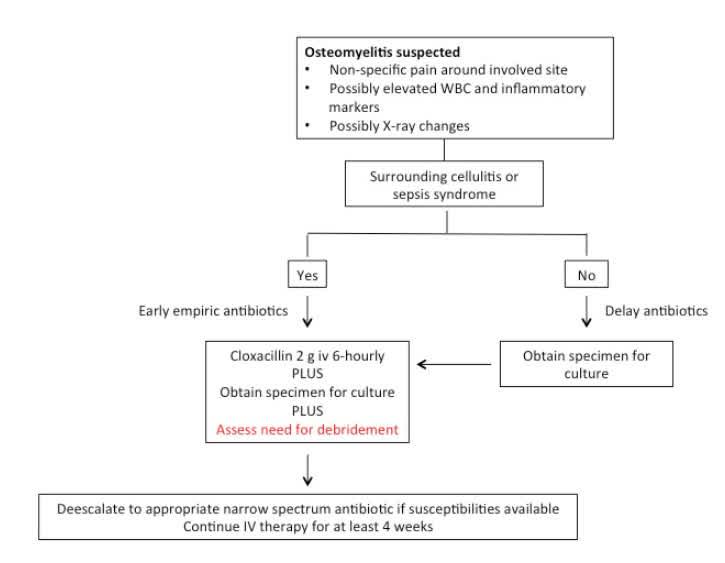
Notes:
- May need to continue IV therapy for 6 weeks or longer
- Do not add rifampicin in cases without foreign material
- Consider tuberculosis if culture-negative or no clinical improvement
- Vancomycin is used for health care-associated osteomyelitis or confirmed MRSA (loading dose 23 – 30 mg/kg followed by 15 – 20 mg/kg 12-hourly; maintain trough levels 15 – 20 mg/mL)
- See Prophylaxis for management of open fractures
- Infections associated with prosthetic material should be discussed with an expert