Breathlessness
An approach to symptom management to guide decision-making in the management of patients with life-threatening illness
Definition of breathlessness or dyspnoea
Reversible factors and specific therapy
Non-pharmacological interventions
Review assessment and management
Definition of breathlessness or dyspnoea
Dyspnoea is defined as a subjective experience of breathing discomfort, not necessarily related to exertion, that compels an individual to increase his ventilation or reduce his activity.
Assessment and severity
Grading of dyspnoea gives the health professional an objective framework to assess a patient but breathlessness is multi-dimensional and does not necessarily correlate with a lung function test.
The important questions to ask are:
- How does the patient experience his/her shortness of breath?
- Is this a first occasion of shortness of breath? Has there been a sudden or gradual onset?
- Precipitating factors? What makes it better? What makes it worse?
- Precipitating conditions e.g. heart failure
- Concurrent symptoms e.g. cough, haemoptysis, fatigue, loss of concentration, loss of appetite, pain and insomnia.
- Associated unpleasant emotions.
- Impact on daily functions.
- Impact on social well being
Physical Assessment:
- Assess for pallor or central and peripheral cyanosis, clubbing, oedema, venous engorgement and palpable nodes
- Chest examination
- Abdominal assessment (ascites and masses)
- Cardiac examination
Investigations (will depend on the most likely cause determined clinically)
- Haemoglobin
- Temperature
- Sputum if infection suspected
- If possible:
- CXR
- FBC
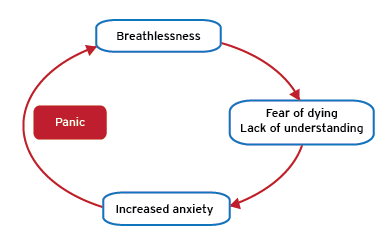
Recognise the role of anxiety in dyspnoea and the cycle of increasing anxiety and dyspnoea that needs to be addressed:
Explanation to family
Reassure the patient and family where possible. Explain the probable cause in terms they can understand and describe the plan of action and how therapies will assist the physical and/or emotional distress.
Describe and encourage the use of distraction and relaxation techniques as appropriate.
Reversible factors and specific therapy
| Lung Tumour | Review for further RT or chemotherapy. Discuss with oncologist |
| Bronchospasm | Bronchodilators and corticosteroids |
| Infections | Bacterial: antibiotics Tuberculosis: TB drugs PCP: Bactrim |
| Effusions | Pleural: pleural, tap and/or pleurodesis Pericardial effusions: Refer specialist |
| Ascites | Paracentesis |
| Lymphangitis carcinomatosis | Corticosteroids (high dose) Bronchodilators Diuretics? |
| Large airway obstruction | High dose corticosteroids Refer/manage as an emergency if airway not patent Refer to oncologist |
| SVC obstruction | High dose corticosteroids Refer for emergency RT |
| Anaemia | Blood Transfusions, Iron, Erythropoetin |
| Cardiac failure | Diuretics and disease specific treatment |
| Pneumothorax | Intercostal drain and refer |
| Pulmonary Embolism | Anticoagulants and refer |
Non-pharmacological interventions
- Relaxation Techniques:
- Try to stay calm
- Purse your lips
- Relax shoulders, back, neck and arms
- Concentrate on breathing out slowly
- Visualisation
- Soothing music
- Physiotherapy
- Increasing airflow across the face by means of a fan or open window
- Calm and containing environment
- Positioning in bed in a upright position
- Adaption to daily living
First line treatment
Nebulised medication (to be used if there is an element of reversible bronchospasm)
- Salbutamol 2.5mg-5mgq6h or 2 puffs q 6h
- Ipratroprium bromide 250-50mcgq6h or 2 puffs q 6h
Benzodiazepines (Panic with hyperventilation and fear of suffocation may worsen breathlessness)
- Lorazepam 0.5mg -2 mg SL
- Midazolam 2,5mg q 6h SC or IM
Opioids (Morphine reduces inappropriate and excessive respiratory drive and substantially reduces the ventilatory response to hypoxia and hypercapnia. By slowing respiration, breathing may be made more efficient, and the sensation of breathlessness reduced)
- Mist Morphine
- For opioid naive patients: 2,5mg q4h
Oxygen Therapy
Oxygen may help breathlessness in patients who are hypoxic. A trial of oxygen should be considered if available.
Second line treatment
- Theophyllines sustained release tablets 200mg-300mg b.d. (if there is an element of reversible bronchospasm)
- Diazepam 2-5mg b.d.
- Regular standard dose inhaled corticosteroids plus regular long-acting inhaled B2-stimulants (salmeterol 50 mcg b.d)
Review assessment and management
- Review within an hour.
- Have we achieved our goals to control and relieve dyspnoea?
- Is the cause of the dyspnoea more evident to us?
- Have plans been put in place to treat reversible causes?
- Has second line treatment been considered?
Interdisciplinary Team
At all stages consider interdisciplinary team involvement including referral to specialised palliative care service.