Burns-Wound Management
Management of Burn Wounds
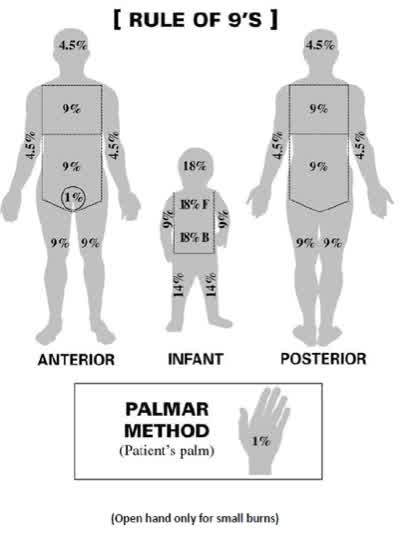
Determining Surface area of burn
Burn depth
Important: Determining the size/ surface area and type/ degree of the burn.
Determining surface area of burn
(Open hand only for small burns) 2
Burn depth
Most burns are a combination of superficial and deeper burns and the best assessment is made 3 to 4 days after the injury when wound evolution is complete.
1. Superficial partial thickness: destruction of only superficial layers of the skin.
These wounds will re-epithelialise spontaneously within 3 weeks; excision is contra-indicated and the wounds rarely cause functional or cosmetic defects or hypertrophic scars. They characteristically have an erythematous,moist, homogeneous surface with blister formation, are painful and hypersensitive to touch, blanch readily on pressure and have a normal to firm texture on palpation.
2. Indeterminate depth (deep dermal burn): destruction of epidermis and varying amounts of dermis.
These wounds are difficult to assess during the first 3 to 4 days after injury due to the ongoing evolution within the burn wound, which can be modulated by infection and dehydration. These wounds present with articulated red, white, dry surface and may blister. Capillary circulation maybe sluggish or absent when pressure is applied to the wound. Wound pain is perceived as discomfort and the wound is often less sensitive to pinprick than the surrounding normal skin. The healing time for these wounds may be variable and may require several weeks leading to severe hypertrophic scarring. It is better to graft the wound if not healed within 2 weeks.
3. Unequivocally full thickness: total irreversible destruction of all elements of the skin with or without extension into the deeper tissues and structures.
These wounds will not heal spontaneously within 3 weeks and have unsatisfactory functional and cosmetic results. There is general consensus that the best treatment entails early eschar excision and immediate grafting.These wounds may mimic the appearance of an indeterminate burn and are usually mottled, white, red or charred and dry in appearance, insensitive to pain and leathery to palpation. Blisters are unusual and if present are thin walled and do not enlarge. Clotted superficial vessels may be visible. The appearance of the burn remains static with little change over the ensuing days.