Cardiopulmonary Resuscitation (CPR) in Pregnancy
The guidelines recommend management of common obstetric conditions at primary and referral level, based on local experience and evidence-based practice. They are not intended as strict protocols nor as standard operating procedures, but rather as a guide to safe effective management of common obstetric problems. The guidelines should be most useful to interns, medical officers and registrars.
Management of cardiorespiratory arrest
CPR in cardiac arrest is the same for pregnant & non-pregnant patients. Only 3 evidence-based interventions are proven to be effective in cardiac arrest: 1) good chest compressions; 2) early defibrillation; & 3) treating the cause of the arrest.
The pregnant uterus interferes with venous return & needs to be displaced to the side by 15 to 30 degrees. This is accomplished by manual shifting & position maintenance by an assistant. Placing a wedge to perform a lateral tilt interferes with the performance of chest compressions.
For women in the third trimester of pregnancy, perimortem caesarean section is performed primarily to improve maternal outcome & not to save the baby, & must be performed within 5 minutes of the cardiac arrest – in the absence of a maternal pulse – in order to be effective.
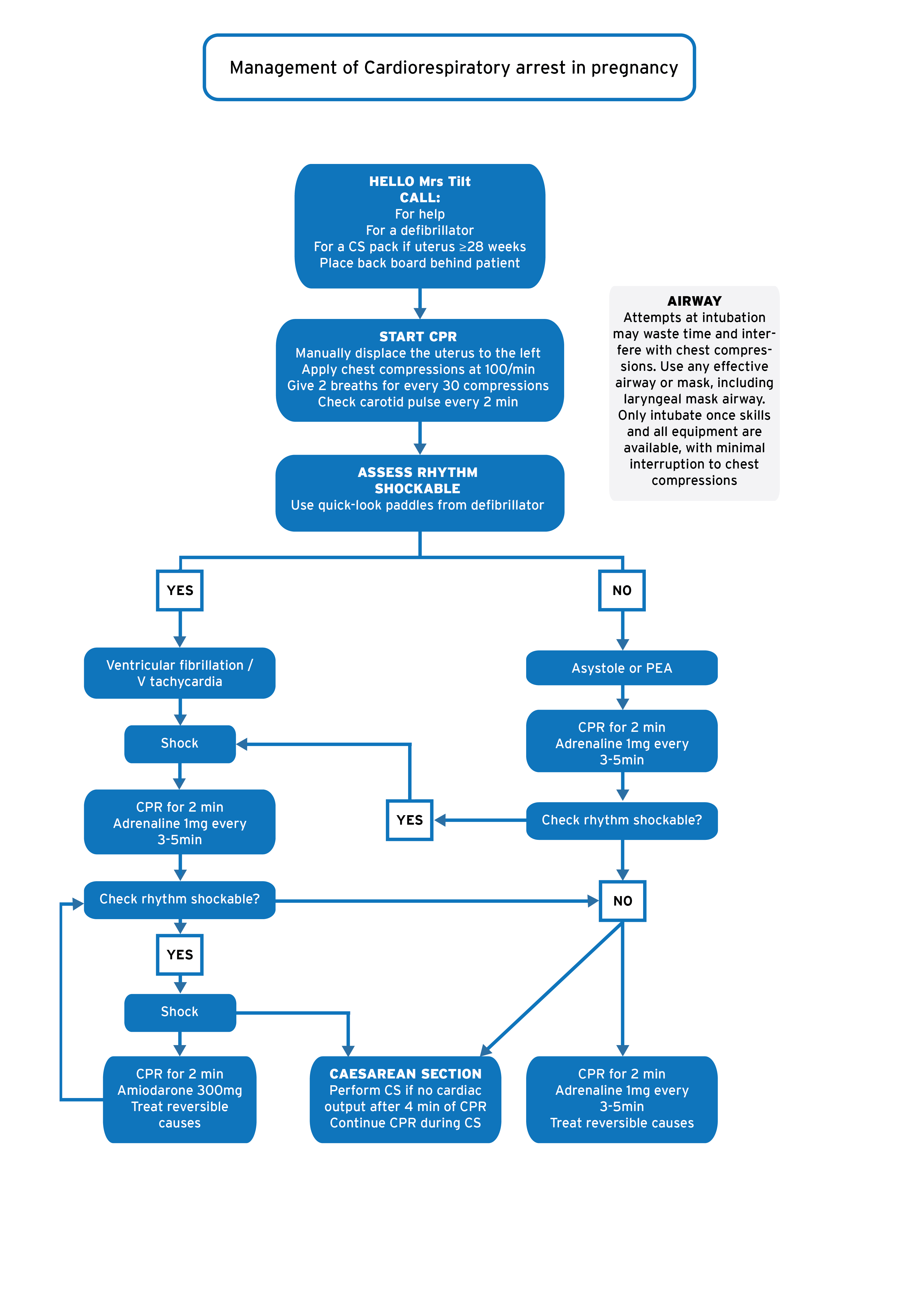
MANAGEMENT OF CARDIORESPIRATORY ARREST
- ”Hello Mrs Tilt”
- Call for help & for a defibrillator. A caesarean section pack may be needed.
- The uterus must be displaced to the left side manually by an assistant.
- Check for a carotid pulse.
- If absent, begin CPR starting with chest compressions, using the principle of CAB (Chest compressions, Airway, Breathing).
- Perform chest compressions at a rate of at least 100/minute.
- Push hard (at least 5 cm) and push fast. Allow full recoil of the chest.
- Give 2 breaths (1 second each) for every 30 compressions
- Repeat for 5 cycles or 2 minutes before checking for a pulse. Persons performing the chest compressions must change every 5 cycles or 2 minutes.
- When the defibrillator arrives, immediately perform ‘quick-look paddles’ ECG for ventricular fibrillation (VF) or ventricular tachycardia (VT). If these shockable rhythms are present, defibrillate. Shock with 360 J (monophasic) or 200 J (biphasic). For a non-shockable rhythm (asystole or pulseless electric activity), continue CPR.
- After the first shock, give adrenaline 1 mg with a flush and repeat every 3-5 minutes, IV or intraosseous (IO). After the 2nd shock, give amiodarone 300 mg IV with a flush if the rhythm is VF or pulseless VT. After the 4th shock, give amiodarone 150 mg IV with a flush.
- Intubate only when skill and all equipment are available, with a minimum of interruption to chest compressions. Consider using a laryngeal mask airway.
- If cardiac output is not restored in 4 minutes, with a uterus of >28 weeks, perform caesarean section at the site of resuscitation. Continue CPR during the operation. If CPR is successful, the operation may be completed in theatre.
- Treat the cause of asystole or pulseless electric activity
5H’s
- Hypoxia
- Hypovolaemia
- Hyper/Hypokalaemia
- H+-acidosis
- Hypothermia
5T’s
- Thromboembolism
- Thrombosis (myocardial infarction)
- Toxins or medications
- Tension pneumothorax
- Tamponade
How long to continue CPR
- Are there any reversible causes? Yes, continue
- Is the patient cold? Yes, warm patient and continue
- Did the patient use any drugs?
- Otherwise stop CPR after 20 minutes if no response
Algorithm