Chest Compressions
National Neonatal Resuscitation Guidelines
During this section you should learn:
- How to do correct chest compressions on a baby
- When to start and when to stop chest compressions
Background information
Hypoxia causes poor cardiac output. Correction of the hypoxia by giving oxygen and establishing ventilation will usually correct the circulatory problems as well.
If the heart is severely affected and the heart rate and cardiac output do not improve with bag and mask ventilation, start chest compressions. In infants, the cardiac output is dependent on heart rate, as the stroke volume cannot be increased. Chest compressions are given to improve the cardiac output and increase the blood supply to the lungs, myocardium and brain. This allows well-oxygenated blood to supply the myocardium so that the heart can recover its function
Technique
The resuscitator stands to the right side of the baby. The baby must lie on a flat firm surface. You can feel the baby’s pulse at the base of the umbilical cord or you can listen to the baby’s heart with a stethoscope. Chest compressions are started if the baby’s heart rate has not improved to more than 60 beats per minute after 30 seconds of bag and mask ventilation with supplementary oxygen.
Ventilation is the most effective action in neonatal resuscitation and chest compressions may interfere with ventilation, so always make sure that you are ventilating the baby properly before starting chest compressions. An assistant able to do a full resuscitation should be called when chest compressions are started.
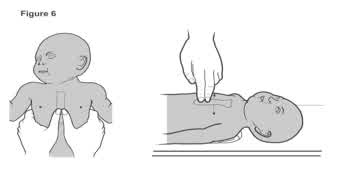
There are two ways of doing chest compressions (see Figure 6 below):
- “Hand encircling” technique: Encircle the baby’s chest with both hands and use both thumbs held at 90 degrees to the baby’s chest. This is the preferred method as better cardiac output can be achieved.
- “Two finger” technique: Using the second and third fingers held at 90 degrees to the baby’s chest. This method should be used if an umbilical catheter needs to be inserted or the resuscitator is on his/her own.
The Rule of Three: (i) Chest compressions are given to the lower third of the baby’s sternum, just below the inter-nipple line. (ii) Compress the chest to 1/3 the depth of the baby’s chest. A palpable pulse should be produced.
Deliver chest compressions smoothly. Allow the chest to expand fully between compressions, but do not remove your thumbs from the chest. Allow a slightly longer relaxation time compared to the compression time when bagging the baby, as this may improve blood flow in the baby. (iii) Give three compressions followed by one breath during a two second cycle (ratio 3:1).
This gives an effective heart rate of 90 beats per minute and breath rate of 30 per minute. Compressions are timed together with bag and mask ventilation. Stop chest compressions once the baby’s heart rate has improved to >60 beats per minute.