Child Abuse vs Trauma (Orofacial Manifestations)
And recognising and reporting of suspected cases of abuse
With children presenting with trauma one should always be aware of the possibility of abuse. Children who are abused are often too scared to speak and do not know who to trust. Professionals who the child comes into contact with on a daily basis have an important role to play in recognising potential abuse cases.
A thorough history should be taken for every suspected unintentional or accidental injury to determine whether the history and timing of the injury is consistent with the clinical findings. Any warning signs should be meticulously documented.
The following should be noted:
- Details of events surrounding the injury especially the parents’ or caregivers’ account of how the injury occurred
- A history of prior incidents or hospitalisation and reports of “clumsiness” on the child’s part could be potential warning signs of abuse.
- Unexplained or inconsistent injuries
- Delay on the parent’s part to seek treatment
- Varying explanations from one visit to the next should also raise suspicion.
Unusual behaviour patterns and bruising on the child’s face or body can be observed while the child is waiting to be consulted. Particular attention should be paid to the child’s outward appearance and interaction with others. Warning signs in a child that is being abused may include the following:
- Withdrawal
- Lack of eye contact
- Refusal to speak/communicate
- Fear of being touched
- Wariness of the parent/ guardian
- Misses school often
- Displays behaviour that parents cannot cope with or control
- Inappropriate aggression and temper tantrums
- Child displays extremes in behaviour
- Child is over-anxious
- Child wears inappropriate clothing e.g. long sleeves in hot weather to cover up bruises/ injuries.
A potential abuser may show the following signs:
- an exaggerated, defensive response to questioning i.e. hostile or aggressive attitude
- Delay in seeking medical or dental care for the child
- Provides an explanation of the injury that is inconsistent with the injury/ies
- A history that changes with time
- A ‘vague’ account with few details of the reason for the injury
- Detachment i.e. plays down the incident and comes across as being indifferent
- Presence of a “live-in” boyfriend
- Inflexible, controlling parent
- A domineering male partner who does not want the mother to be left alone with the examiner and who answers questions on her behalf could be indicative of domestic violence
In all suspected child abuse cases, a thorough examination of peri-oral and intra-oral structures is necessary. Clinical signs manifesting in the head and neck region are discussed below.
Bruises
Bruising or injuries especially injuries of soft tissues which do not cover bone are highly suggestive of abuse. The cheek is the most frequently traumatised part of the face. A handprint may present as parallel linear spaced marks. Bruises in the shape of a finger-tip especially in the neck region are usually indicative of a “gripping” action. Multiple bruises of different colours are indicative of various stages of healing and could be as a result of a history of previous abuse.
Bite marks
Bite marks, whether healed or not, may be an indicator of abuse especially when they occur in areas where it is unlikely that the wound is self-inflicted. Sometimes a bite mark is not clearly distinguishable but should be suspected in the presence of lacerations, contusions or bruises in an elliptical or oval pattern. Severe human bite marks should be managed appropriately as they could result in serious complications ranging from recurrent infections to the need for amputation of extremities. Administration of antibiotics and tetanus toxoid is recommended.
Peri-oral injuries
Injuries, bruising or the leathery appearance of skin near the corners of the mouth may indicate ‘gagging with a cloth or rope’.
Intra-oral injuries
Oral injuries could be caused by forcing hands or fingers into the mouth, forced feeding using bottles or eating utensils and the use of caustic substances or scalding liquids.
Intra-oral injuries may occur on the tongue, lips, hard or soft palates, mucosa, frenum or gingiva. Tears near the frenum of the upper lip often occur in children between the ages of 6 and 18 months who fall while learning to walk. However, in children younger than a year old who are not mobile or in children older than 2 years, a frenum tear is a strong indicator of non-accidental injury. This type of injury could result from force feeding where a spoon or bottle is shoved into the mouth. It may also be due to a blow to the mouth.
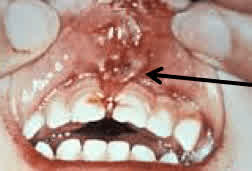
Frenum tear
Other oral injuries include:
- Fractures of teeth
- Discoloured teeth could be indicative of previous trauma/ abuse
- Displaced or avulsed teeth
- Fracture of the jaws/ skull (see section on extra-oral trauma)
Sexual abuse (including oral sexual abuse)
Sexually transmitted diseases include gonorrhoea, syphilis, chlamydia, human papilloma virus (HPV) and human immunodeficiency virus (HIV). Oral injuries or infections such as oral and peri-oral gonorrhoea or oro-genital warts may be indicative of sexual abuse. In adults, pre-existing infections can be due to prior sexual activity. However, in children, infections can be acquired vertically, horizontally or through previous sexual activity or abuse.
In cases where oro-genital contact is suspected, verification by means of laboratory investigations is recommended. Isolation of an organism in children may be the first indication that abuse has occurred.
Unexplained injuries or petechiae at the junction of the hard and soft palate may also be indicative of sexual abuse.
Caries
Dental neglect is defined as the ‘wilful failure of parent or guardian to seek and follow through with treatment necessary to ensure a level of oral health essential for adequate function and freedom from pain and infection’.
However, one should distinguish between ill-informed or ignorant parents/ caregivers from those who understand the consequences of not taking their child for dental treatment but yet refuse to do so. The latter would warrant referral to child protective services if, after the parent has been made aware of the extent of the child’s condition, what his/ her needs are and where treatment can be sought, the parent still refuses to comply despite having the means to do so.
Reporting of cases of suspected abuse/ neglect
All professionals or anyone who comes into contact with children have a moral and legal responsibility to report cases of suspected child abuse/ neglect. The Children’s Act (Act 38 of 2005, as amended by Act 41 of 2007) is a comprehensive law which deals with all matters which affect children. It has replaced the Child Care Act of 1983 and Section 4 of the Prevention of Family Violence Act of 1993.
Section 110 of the amended Children’s Act states that:
“Any correctional official, dentist, homeopath, immigration official, labour inspector, legal practitioner, medical practitioner, midwife, minister of religion, nurse, occupational therapist, physiotherapist, psychologist, religious leader, social service professional, social worker, speech therapist, teacher, traditional health practitioner, traditional leader or member of staff or volunteer worker at a partial care facility, drop-in centre or child youth and care centre who on reasonable grounds concludes that a child has been abused in a manner causing physical injury, sexually abused or deliberately neglected, must report that conclusion in the prescribed form (Form 22) to a designated child protection organisation, the provincial department of social development or a police official”.
The Children’s Act also states that: “failure to report a reasonable conclusion that a child has been abused or deliberately neglected would make the health professional liable to be found guilty of an offence and liable upon conviction….” It is important to note that there must be more than a suspicion of abuse and the conclusion must be reached on reasonable grounds. However, proof of abuse is not required.
When reporting a case, Form 22 must be completed. It can be downloaded from http://www.kzneducation.gov.za/Portals/0/Circuiars/KZN/2010/FORM%2022%20DOE.pdf
One of the following people should then be contacted:
- the appropriate child protection organisation e.g. Child Welfare
- the provincial department of social development or a
- police official
- social worker
Usually, a police official is contacted first. He/ she must then make sure that the child is safe before contacting the Department of Social Development or Child Welfare within a 24 hour period. It is not the job of the person who reports the case to identify the perpetrator—this is for the police or social services to follow-up on
The following information is required when a report is filed:
- the name, address and telephone number of the child
- the name, address and telephone number of the parent or guardian
- reasons for concern
- documentation of indications/ suspicions of abuse
- documentation of relevant statements made by the child
- as much information as possible should be provided
The person reporting the incident should also provide the following information:
- their full name
- contact details
- profession
- their relationship to the child
- circumstances surrounding the case
- whether or not information was imparted by a third party
- the identity of witnesses where applicable
After the report has been filed, the social worker must ensure the safety of the child and confirm that the information in the report is truthful. Only after questioning the child or investigating the situation through medical assessments/ radiographs or physical assessment can a conclusion be reached regarding the possibility of abuse. The child must consent to these investigations either verbally or in writing.
However, if it is in the best interest of the child or the child is too young to give informed consent, assessment may proceed without consent but reasons for proceeding should be noted in writing. According to the Children’s Act, this should be explained to the parents/ caregivers. If parents refuse to allow the child to undergo the assessment, it might be necessary to override this decision by applying to the court or referring the matter to the police or the Department of Social Development.
USEFUL CONTACT NUMBERS
- Childline: 080 005 5555
- Child Welfare South Africa: 011 492 2884
- South African Police Service emergency number: 10111
- Crime Stop: 086 001 0111
- Western Cape Department of Social Development: 021 483 4153/ 3858
References
American Academy of Pediatric Dentistry. (2010- 2011) Guideline on oral and dental aspects of child abuse and neglect. Clinical guidelines 32 (6): 137- 140.
Department of Social Development. The Children’s Act explained. Booklet 3: The courts and the protection of children. Available from: http://www.dsd.gov.za/index2.php?option=com_docman&task=doc_view&gid=111&1temid=3 [Accessed 5 February 2014].
Kellogg, N. (2005) Oral and dental aspects of child abuse and neglect. Pediatrics116; 1565- 1568.
Maguire, S., Mann, M. K., Sibert, J. & Kemp, A. (2005) Are there patterns of bruising in childhood which are diagnostic or suggestive of abuse? A systematic review. Archives of Disease in Childhood 90: 182- 186.
Sugar, N. F., Taylor, J. A. & Feldman K. W. (1999) Bruises in infants and toddlers: those who don’t cruise rarely bruise. Puget Sound Pediatric Network. Archives of Pediatric and Adolescent Medicine 153: 399- 403.