Child Contacts: Children Weighing Less Than 25 Kilograms and Infants
TPT should be offered to TPT should be deferred or not offered if the child Management of TPT in children weighing less than 25 kilograms Management of TPT in children living with HIV (irrespective of TB exposure) Management of TPT in TB-exposed newborns (babies born to mothers diagnosed with pre-natal or peripartum TB or with other significant TB exposure) Significant exposure is known (document
TPT should be deferred or not offered if the child
Management of TPT in children weighing less than 25 kilograms
Management of TPT in children living with HIV (irrespective of TB exposure)
Significant exposure is known (documented) exposure to a person (adult or adolescent) with pulmonary TB who shared the same enclosed space for one or more nights (e.g. at home or similar) or for frequent or extended daytime periods (e.g. at a school, crèche or similar) during the three months before the index patient started TB treatment.
TPT should be offered to
All children <25kg with significant TB exposure (child contacts – for older contacts, refer to Section 4 - Adult, Adolescent and Older Child Contacts).
TPT should be offered regardless of the child’s HIV status and age. The practical 25kg cut-off is used since heavier children can be offered 3HP if available. There is not enough evidence yet on dosing or safety or the appropriate formulations available to recommend 3HP in children <25kg.
The prior completion of either TB treatment or TPT does not exclude a new course of TPT in a child.
TPT should be deferred or not offered if the child:
- is diagnosed with TB disease
- has active liver disease (acute or chronic)
- has symptoms and signs of severe peripheral neuropathy (a clinician may consider a rifampicin only regimen on and individual basis)
- has a history of adverse reactions to any medication used for TPT
Management of TPT in children weighing less than 25 kilograms
All children (HIV-negative and HIV-positive) with significant exposure to TB require TPT once TB disease has been excluded through clinical evaluation and testing.
When an adult or adolescent patient is diagnosed with pulmonary TB disease it is essential to conduct a thorough contact investigation to establish who had significant exposure to this index patient. Each child with TB exposure is evaluated for TB disease and offered either treatment or TPT (if disease excluded), i.e., the TB test and treat approach.
Evaluation of child contacts
Evaluation for TB disease includes symptom screening, clinical examination and diagnostic testing. These are similar for HIV-negative children and in children living with HIV (see Figure 3).
TB testing strategies are different in older children and younger children, who typically cannot spontaneously expectorate sputum. Sputum testing or CXR in well young children (i.e. without symptoms or signs suggestive of TB) is therefore not a requirement for the initiation of TPT. Sputum testing (and Xpert) should be attempted in older children, who can expectorate spontaneously. Sputum should also be collected in a young child if they are able to expectorate sputum (such children are usually symptomatic).
If parents or guardians of child contacts decline TPT (despite counselling) then they should be counselled further regarding potential TB symptoms and should be offered TPT again at the next opportunity. If the child develops symptoms suggestive of TB, the child should be evaluated for TB disease and be offered TB treatment (if diseased) or be offered TPT again if TB disease has been excluded.
Symptom screening for TB disease amongst children – regardless of HIV status:
- current cough
- poor weight gain or failure to thrive or documented weight loss
- fever or night sweats
- lethargy/fatigue (decreased playfulness)
- visible neck mass or swelling
Note:
Note that symptoms may be acute in young children, in severely malnourished children and in those living with HIV
Diagnostic tests for TB disease amongst children – regardless of HIV status:
- sputum testing (and Xpert) should be attempted in older children, who can expectorate spontaneously and in any other children who can expectorate spontaneously. If a young child can expectorate sputum, a sample should also be attempted
- CXR is a valuable tool to rule out TB disease in children. The absence of a CXR should however not pose a barrier to starting TPT in well children. In a well child with no TB signs or symptoms, a CXR is therefore not required to initiate TPT. Clinical follow-up remains important
- in any child with signs or symptoms suggestive of TB, either at initial screening or at follow-up, a CXR should be obtained if available
- tests of TB infection (TST/IGRA) are not a requirement to initiate TPT. A positive test of infection in a well child however indicates a higher risk of future TB disease progression. Tests of infection may be used at clinician discretion
Figure 3. Algorithm for provision of TB preventive treatment for infant and child contacts, children living with HIV and other high-risk groups
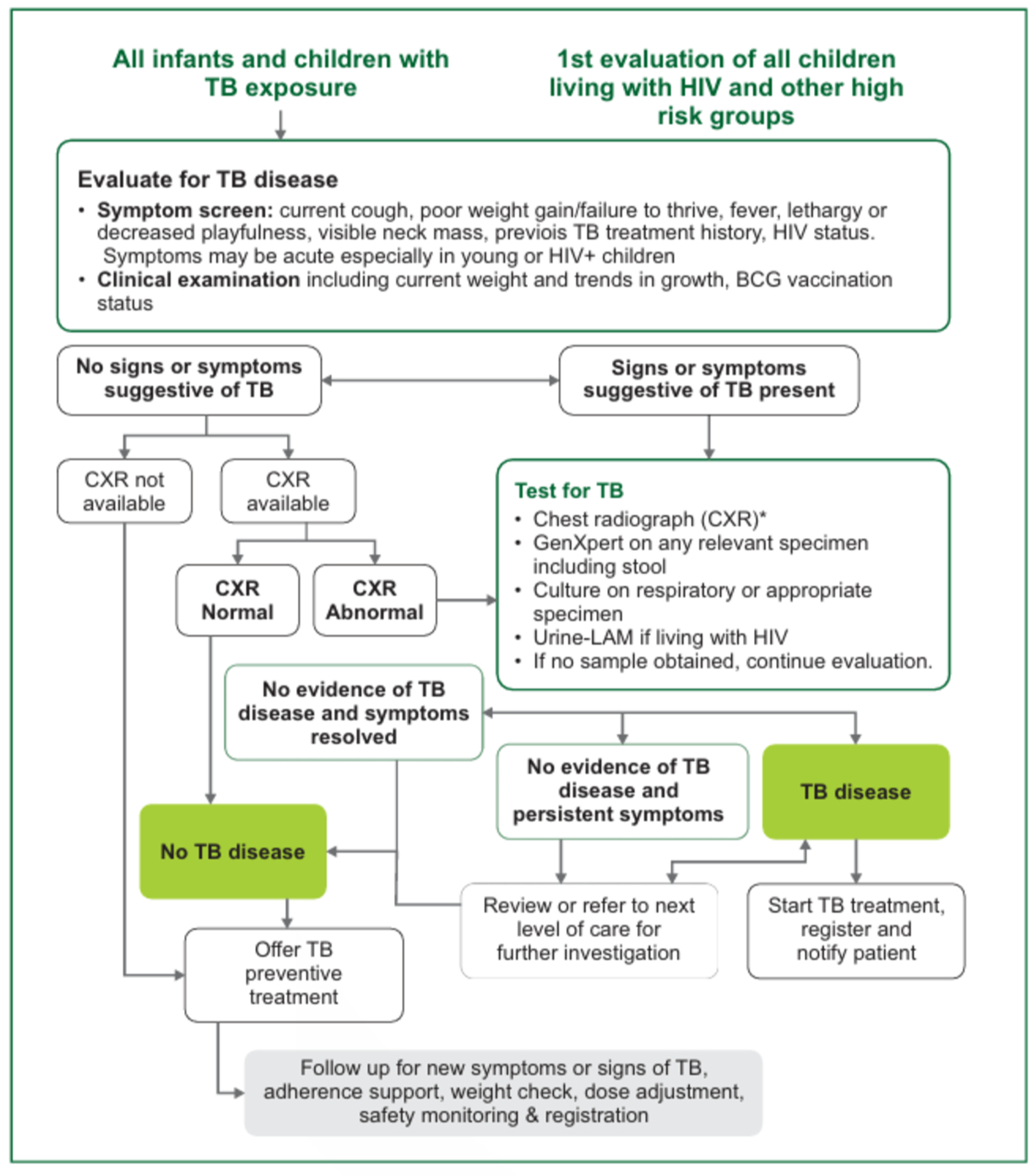
Click on the image to enlarge.
- If a CXR has already been done recently in a child who presented with no signs or symptoms, do not repeat the CXR
- Culture should NOT be attempted from stool given high contamination rates
- Tests of TB infection (tuberculin skin test/ TST or IGRA) are not required to initiate TPT in children who are TB contacts
- For the management of DR-TB exposure, refer to the latest National DR-TB Guidelines
TPT regimens for children weighing less than 25 kilograms
There are three potential regimens for children: 3RH, 3HP, and 6H. The choice depends on the child’s weight, HIV status or HIV exposure (maternal HIV) status:
- in HIV-negative children <25kg, the priority regimen is 3RH
- in children living with HIV and on DTG (dolutegravir) containing ART, the preferred regimen is 6H to avoid drug-drug interactions with ART
- in infants born to HIV-positive women (HIV-exposed but HIV-negative infants) on nevirapine, 6H is the priority regimen as rifampicin lowers nevirapine levels below efficacy
All children and breastfeeding infants require pyridoxine (vitamin B6) for the duration of their TPT as follows: Children younger than five years 12.5mg and children five years or older 25mg, once daily. Lack of pyridoxine access should not be a barrier to receiving TPT.
For HIV-positive infants who have just had the Bacillus Calmette-Guérin (BCG) vaccine and are not TB-exposed, TPT should be deferred for 14 weeks as Isoniazid (INH) impairs the effect of live BCG (M.bovis BCG) vaccine.
Recommended daily dosages for 3RH in HIV-negative children <25kg
| Child’s Weight (kg) | RH (Daily) fixed dose combinations | Duration | |
| 75/50 | If dispersed in water | ||
| 2-2.9 | ½ tablet | 5ml | 3 months |
| 3-3.9 | ¾ tablet | 7.5ml | |
| 4-5.9 | 1 tablet | 10ml | |
| 6-7.9 | 1 ½ tablet | 15ml | |
| 8-11.9 | 2 tablets | 20ml | |
| 12-15.9 | 3 tablets | 30ml | |
| 16-24.9 | 4 tablets | 40ml | |
| ≥25 | Use adult formulations and doses | ||
Recommended daily dosages for the 6H regimen amongst children living with HIV
| Weight band (kg) | Daily INH 100mg tablet | Duration |
| 2 – 3.4 | ¼ tablet | 6 months |
| 3.5 – 4.9 | ½ tablet | |
| 5 – 7.4 | ¾ tablet | |
| 7.5 – 9.9 | 1 tablet | |
| 10 – 14.9 | 1 ½ tablet | |
| 15 – 19.9 | 2 tablets | |
| 20 -24.9 | 3 tablets (or one 300mg tablet) | |
| ≥25 | Use adult formulations (maximum dose 300mg per day) | |
Management of TPT in children living with HIV (irrespective of TB exposure)
All children living with HIV (irrespective of significant TB exposure), require a course of TPT once TB disease has been excluded through evaluation and testing.
For any new TB exposure, TB evaluation is again required along with offering TPT or TB treatment.
Evaluation for TB disease is identical to that described under HIV-negative children (Figure 3). Refer to Section 7 (People living with HIV (PLHIV): Adults, Adolescents, and children irrespective of age) for more information.
Management of TPT in TB-exposed newborns (babies born to mothers diagnosed with pre-natal or peripartum TB or with other significant TB exposure)
Infants have a high risk of developing severe and disseminated TB if exposed to TB and if not given TPT. Babies born to mothers diagnosed with TB in the last two months of pregnancy or at/after birth, or who are still infectious (culture positive), or who are not clinically responding to TB treatment at the time the baby is born, are classified as TB exposed. Infants may also be exposed to another person with TB inside or outside the household.
In newborns, TB disease should be excluded by thorough clinical evaluation of the baby, including respiratory and abdominal examination; respiratory sampling (gastric aspirates) for Xpert and mycobacterial culture and CXR should be done. An abdominal ultrasound is needed in case of abnormal clinical findings (distension or hepatomegaly).
The newborn should be managed according to the algorithm outlined in Figure 4. Referral for further evaluation should be done if disease is suspected, TPT is not well tolerated or new symptoms develop. There should be a low threshold for rapidly referring an unwell TB-exposed neonate or infant for further evaluation given the high risk of TB and non-specific clinical presentation of TB in infants.
BCG vaccination should be deferred in newborns starting TPT to after TPT completion since TB drugs impair the effect of live BCG (M.bovis BCG) vaccine. It is important that BCG vaccination is given after completion of TPT.
Figure 4. Algorithm for TB preventive treatment for TB-exposed newborns
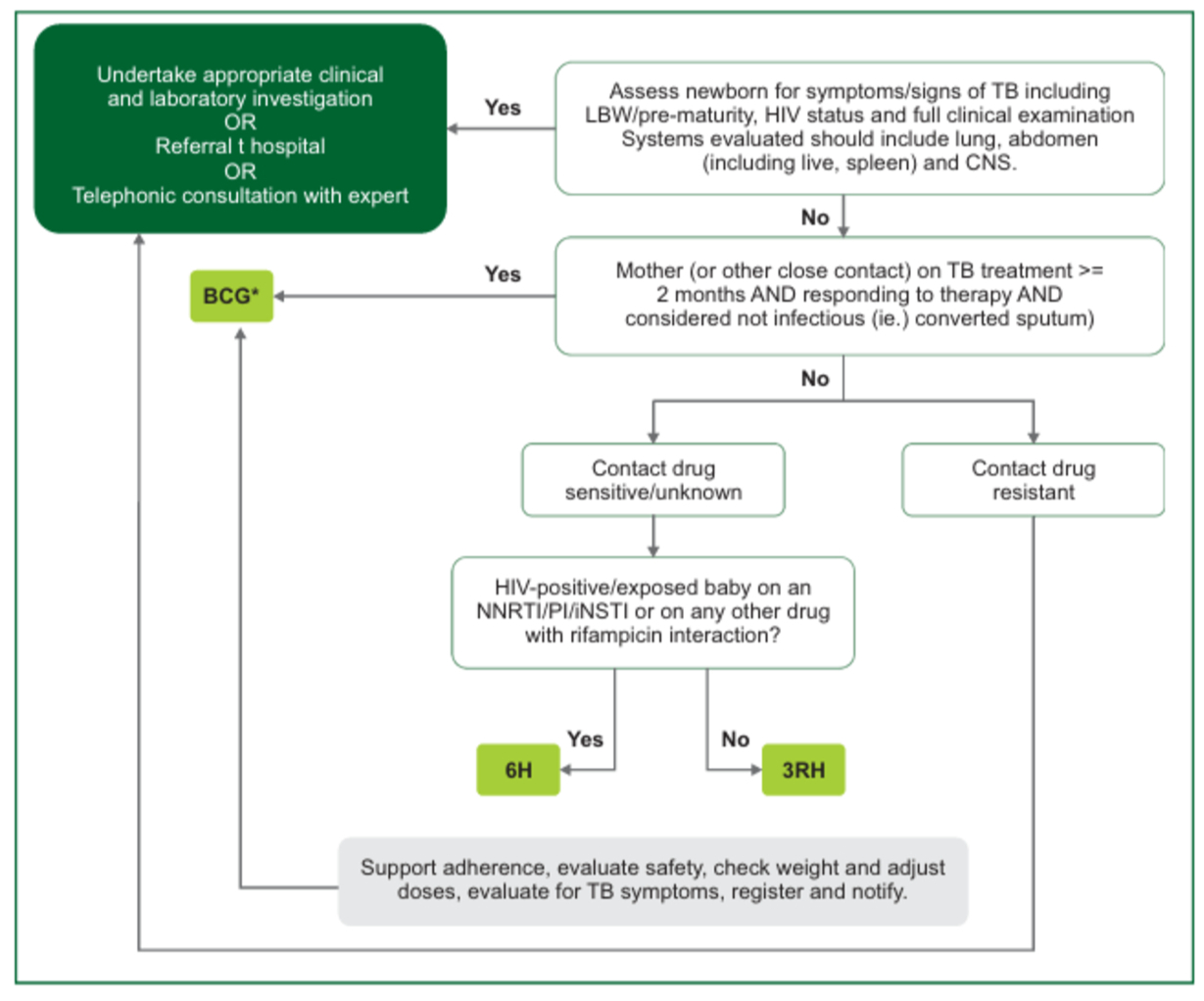
Click on the image to enlarge.
- These infants must be investigated for TB disease – if TB disease is definitely excluded, infants should also return to algorithm for TPT
- It is critical that BCG should be given immediately after the completion of TB preventive treatment or TB treatment. BCG is a live attenuated M.bovis vaccine and is killed by TB medications. If the child is also living with HIV, discuss with HIV clinician to decide when BCG should be given.
- ART=antiretroviral treatment; BCG=Bacillus Calmette-Guérin; CNS=central nervous system; DST=drug susceptibility testing; INH=isoniazid; RIF=rifampicin; Rx=treatment; TPT=tuberculosis preventive treatment; NNRTI=Non-nucleoside reverse transcriptase inhibitors; PI=Protease Inhibitor; iNSTI=Integrase strand transfer inhibitors.
- For management of DR-TB exposure, refer to the latest National DR-TB Guidelines
National Guidelines on the Treatment of Tuberculosis Infection, February 2023
Child Contacts: Children Weighing Less Than 25 Kilograms and Infants