Chloroquine Toxicity
Division of Clinical Pharmacology, Department of Medicine, Faculty of Medicine and Health Sciences
Chloroquine [CQ] is an aminoquinoline which is rapidly and completely absorbed. It has a large volume of distribution and undergoes hepatic metabolism. About 50-70% of the drug is renally excreted as unchanged drug.[1]
In South Africa, it has been used in low doses in the management of autoimmune diseases and parasitic infections. Current doses used in rheumatic conditions are well tolerated. CQ will potentially be used more widely in the near future in higher doses, as it is being investigated in the management of COVID-19. Toxic doses of CQ are close to the therapeutic dosing range. Toxic effects can be seen from doses equal to 10 mg/kg per dose.[2,3] In children, doses as little as 300mg may be fatal.[1]
Drug interactions:
- Any drug with QT-prolongation risk[1]
- May potentiate QT prolongation and increase risk of torsades de pointes [TdP] - Any drug with significant liver enzyme inhibition[1]
- Potential CQ toxicity by increased CQ concentrations and decreased elimination, e.g. lopinavir/ ritonavir, cimetidine, ketoconazole/ itraconazole
Signs of severe toxicity:
- Severe toxicity classically presents as a triad of:
- Hypotension
- Hypokalaemia
- QRS prolongation - After a large ingestion, life-threatening symptoms may develop within 1 to 2 hours[3]
Adverse effects that may be seen with chloroquine use[5]:
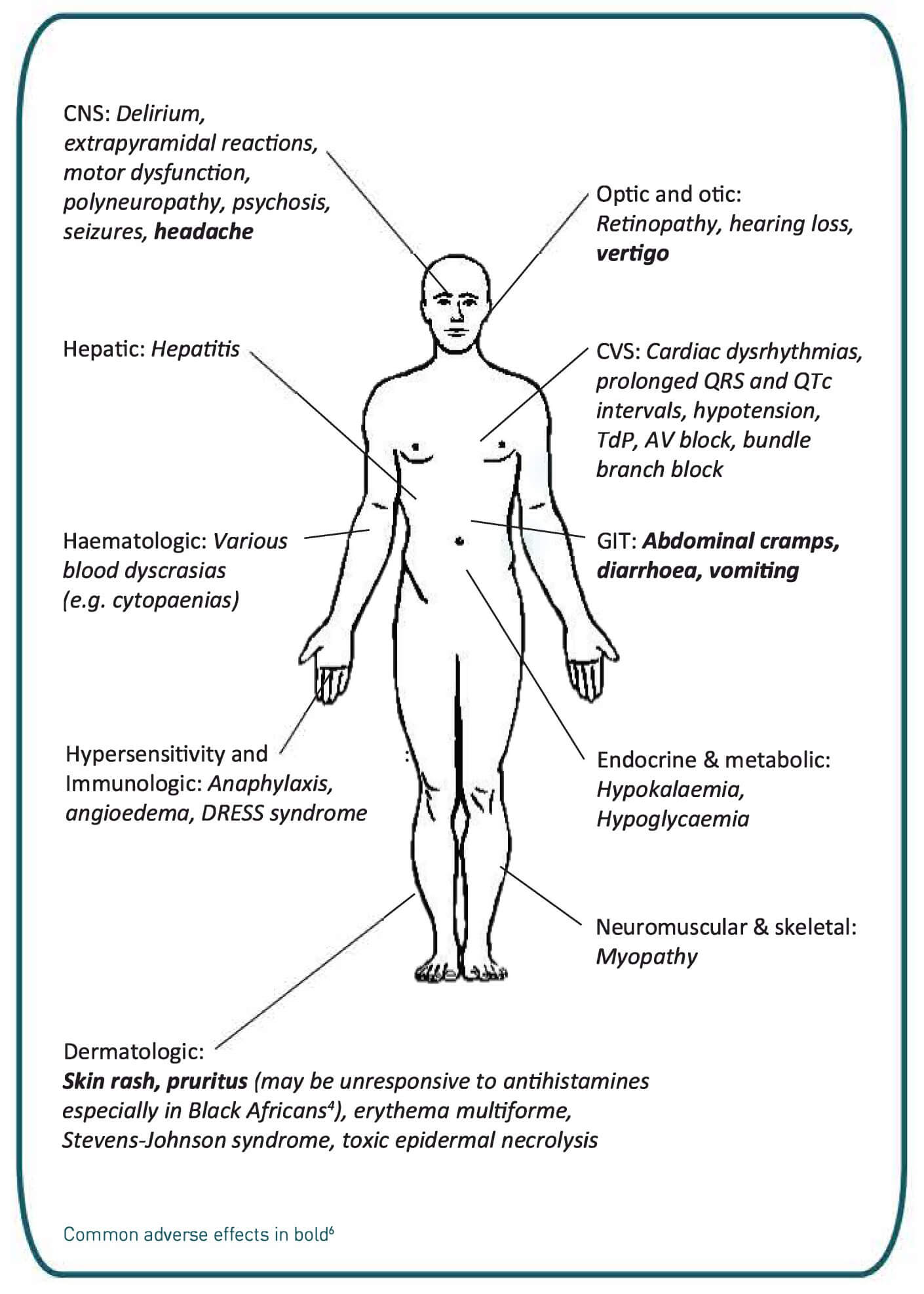
Click on image to enlarge
Management of chloroquine toxicity:
|
Management recommendation
|
|
|
Decontamination
|
|
|
Supportive therapy
|
|
|
Directed therapy
|
|
|
Enhanced elimination
|
|
*Dose obtained from observational studies
Monitoring:
- Continuous ECG monitoring
- Vital signs and mental status
- Basic bloods, especially urea, creatinine, electrolytes and glucose
References:
- Micromedex Drug Interaction Checker
- Micromedex monograph: Chloroquine toxicology
- AfriTox monograph: Chloroquine
- Ajayi AA, Akinleye AO, Udoh SJ, et al. The effects of prednisolone and niacin on chloroquine-induced pruritus in malaria. Eur J Clin Pharmacol. 1991;41:383-385.
- Anatomical position figure copyrighted to Clipart Panda
- South African Medicines Formulary (SAMF), 13 edition