Chronic Asthma
Conditions with Predominant Wheeze
J45.0-1/J45.8-9
DESCRIPTION
A chronic inflammatory disorder with reversible airways obstruction. In susceptible patients, exposure to various environmental triggers, allergens or viral infections results in inflammatory changes, bronchospasm, increased bronchial secretions, mucus plug formation and, if not controlled, eventual bronchial muscle hypertrophy of the smooth muscle in the airways. All these factors contribute to airway obstruction.
Asthma varies in intensity and is characterised by recurrent attacks of:
- Wheezing
- Dyspnoea or shortness of breath
- Cough, especially nocturnal, and
- Periods of no airways obstruction between attacks
Acute attacks may be caused by:
- Exposure to allergens
- Respiratory viral infections
- Non-specific irritating substances, and
- Exercise
Asthma must be distinguished from COPD, which is often mistaken for asthma. (See: COPD). The history is valuable in assessing treatment response.
|
Asthma |
COPD |
|
- Young age onset, usually <20 years
- History of hay fever, eczema and/or allergies
- Family history of asthma
- Symptoms are intermittent with periods of normal breathing in between
- Symptoms are usually worse at night or in the early hours of the morning, during an upper respiratory tract infection, when the weather changes or when upset
- Marked improvement with ß2-agonist
|
- Older age onset, usually >40 years
- Symptoms slowly worsen over a long period of time
- Long history of daily or frequent cough before the onset of shortness of breath
- Symptoms are persistent rather than only at night or during the early morning
- History of heavy smoking (>20 cigarettes/day for ≥15 years), heavy cannabis use or previous TB
- Little improvement with ß2-agonist
|
Asthma cannot be cured, but it can be controlled with regular treatment.
If symptoms suggest TB (e.g. weight loss, night sweats, etc.) investigate and manage accordingly.
Note:
- The diagnosis of asthma can be difficult in children <6 years of age
- Refer the patient if the diagnosis of asthma is uncertain
ASTHMA DIAGNOSIS AND SEVERITY
Peak Expiratory Flow Rate (PEFR)
See: PEFR charts in Appendix I: Asthma monitoring
The PEFR may provide additional information for diagnosis and assessing response to therapy.
- PEFR is best assessed in the morning and evening
- Instruct the patient to blow forcibly into the device after a deep inspiratory effort
- The patient must perform three blows at each testing point
- Take the highest value as the true value
- The PEFR can be helpful in confirming a diagnosis of asthma in primary care
- An improvement of 60L/min or ≥20% of the pre-bronchodilator PEFR, 10–20 minutes after inhalation of a beta2 agonist e.g. salbutamol, inhalation, 200 mcg, confirms a diagnosis of asthma
- A normal PEFR excludes the possibility of moderate and severe COPD
- PEFR may be useful in assessing response to therapy
- Any value >80% of the personal best before the use of a bronchodilator is regarded as confirmation of adequate control. Ensure that pre-bronchodilator values are measured at follow-up visits
Note:
Initiating and optimising inhalation corticosteroid therapy for step 1 to 3 asthma therapy should always be done with the use of a peak flow meter to assess asthma control and treatment response of asthma.
Starting asthma treatment in children aged 6-11, adolescent > 12 years of age and in adults
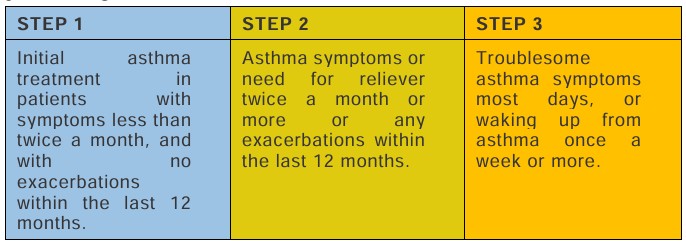
Click on the image to enlarge.
Figure 17.1 Guidance for assessing asthma treatment in children and adolescents (adapted from the GINA 2023)
LoE:IIb21
GENERAL MEASURES
- Avoid irritant triggers and relevant allergic triggers
- Advise patient to stop smoking, and to avoid smoke exposure from others
- Avoid exposure to known allergens if avoidance measures are feasible and sensitisation has been proven
- Educate patient and caregiver on:
- Early recognition and management of acute attacks
- Emphasise the diagnosis and explain the nature and natural course of the condition
- Use a spacer for all children and all adults with step 3 therapy and above
- Teach and monitor inhaler technique; and
- Reassure parents and patients of the safety and efficacy of continuous regular controller therapy
MEDICINE TREATMENT
Medicine treatment is based on severity and control of the asthma and consists of therapy to prevent the inflammation leading to bronchospasm (controller) and to relieve bronchospasm (reliever).
Reliever medicines in asthma:
- Short acting beta2 agonists (SABAs), e.g.:
- Salbutamol
- Indicated for the immediate relief of the symptoms of acute attacks, i.e. cough, wheeze and shortness of breath
- Can be used as needed
- Increasing need for reliever medicine indicates poor asthma control
Controller medicines in asthma:
- Inhaled corticosteroids, e.g.:
- Beclomethasone
- Must be used twice daily every day, even when the patient feels well
Inhalation therapy
Inhaled therapy is preferable to oral therapy.
See Appendix II: Devices for Respiratory Conditions for guidance on inhaler and spacer device techniques.
STEP 1
Adults and children > 6 years
As reliever/rescue therapy:
- Short acting beta2-agonists, e.g.:
- Salbutamol, MDI, 200 mcg, as needed
AND
- Inhaled corticosteroids, e.g.:
- Budesonide, inhalation, 200 mcg whenever salbutamol is taken
Note:
Beclomethasone is the preferred ICS in patients on protease inhibitors due to drug interactions between protease inhibitors and budesonide:
- Beclomethasone, inhalation, 200 mcg whenever salbutamol taken.
LoE:IIb22
STEP 2
Children < 6yrs (wheeze ≥ 3 times a year):
- Inhaled corticosteroids e.g.:
- Beclomethasone, inhalation, 100 mcg 12 hourly
AND
- Short acting beta2-agonists agonist e.g.:
- Salbutamol, inhalation, 100–200 mcg (1–2 puffs), 6–8 hourly as needed (until symptoms are controlled)
Adults and children ≥ 6yrs
As controller therapy:
- Inhaled corticosteroids, low dose, e.g.:
- Budesonide, inhalation, 200 mcg 12 hourly
- Well and stable after 6 months: can attempt to reduce budesonide dose to 200 mcg daily
- Dose adjustments may be required at change of seasons
- Budesonide, inhalation, 200 mcg 12 hourly
LoE:IIIb23
Note:
Beclomethasone is the preferred ICS in patients on protease inhibitors due to drug interactions between protease inhibitors and budesonide.
- Beclomethasone, inhalation, 200 mcg 12 hourly for 6 months; reduced to 200 mcg daily once well and stable.
AND
As reliever/rescue therapy:
- Short acting beta2-agonists, e.g.:
- Salbutamol, MDI, 200 mcg, 6 hourly as necessary
Review treatment every 3 months. Adequate control is defined as:
- ≤ 2 episodes of daytime cough and/or wheeze per week
- No night-time cough and/or wheeze
- No recent (within the last year) admission to hospital for asthma
- PEFR ≥ 80% predicted between attacks
LoE:IIIb24
If control is inadequate:
- Check adherence and inhaler technique, and
- Exclude ongoing exposure to irritants and allergens. After excluding those causes, refer to a doctor to confirm the diagnosis of asthma, to exclude other diagnoses. Once the diagnosis is confirmed, step-up treatment to STEP 3 as below
STEP 3
Children
- Inhaled corticosteroids, e.g.:
- Beclomethasone, inhalation, 200 mcg 12 hourly
Adults
- Inhaled corticosteroids, e.g.:
- Budesonide, inhalation, 400 mcg 12 hourly
Note:
Beclomethasone is the preferred ICS in patients on protease inhibitors due to drug interactions between protease inhibitors and budesonide:
- Beclomethasone, inhalation, 400 mcg 12 hourly.
If control is still inadequate in adults, re-evaluate inhaler technique (See Appendix II: Devices for Respiratory Conditions for guidance on inhaler and spacer device techniques) and consider treatment with combination of corticosteroid and long acting beta agonist (LABA):
Stop corticosteroid inhaler (e.g. budesonide) and replace controller therapy with:
- Inhaled long-acting beta agonist (LABA)/corticosteroid combination, e.g.:
- Salmeterol/fluticasone, inhalation, 50/250 mcg (1 puff) 12 hourly (Doctor initiated)
LoE:IVb25
AND
As reliever/rescue therapy:
- Short acting beta2-agonists, e.g.:
- Salbutamol, MDI, 200 mcg, 6 hourly as necessary
Note:
Fluticasone interacts with protease inhibitors. Refer all patients on protease inhibitors requiring inhaled fluticasone for further management.
LoE:IIIb26
Stepping down treatment:
Attempt a reduction in therapy if the patient has not had any acute exacerbation of asthma in the preceding 6 months, and day-time and night-time symptoms are well controlled. Gradually reduce the dose of inhaled corticosteroid therapy. If the symptoms are seasonal, corticosteroids may be stopped until the next season. If symptoms re-appear, increase therapy to the level at which the patient was previously controlled.
REFERRAL TO DOCTOR
- All children <6 years of age for assessment and confirmation of diagnosis
- Any patient, who has received >2 courses of oral prednisone within 6 months
- Brittle asthma (very sudden, very severe attacks)
- All patients without adequate control on step 2 or 3 of treatment
- Patients on protease inhibitors, requiring inhaled fluticasone
REFERRAL TO HOSPITAL
- Uncontrolled asthma
Note:
In patients with new onset of exercise-related symptoms, consider other diagnoses, particularly if no response to pre-treatment with SABA is noted.
Standard Treatment Guidelines and Essential Medicines List for South Africa, Primary Healthcare, 2020-4-Version 1.0_16 September 2024
Chapter 17: Respiratory Conditions_17.1. Conditions with Predominant Wheeze_17.1.3. Chronic Asthma