Chronic Cancer Pain
Pain
Please click on the link below to access the most up-to-date version of this guideline. The content on this page is currently being updated to align with the latest publication. Always check the version number at the bottom of the screen to confirm which version you are using.
Stepwise Aproach in Management of Cancer Pain
R52.1/R52.2/R52.9
DESCRIPITION
Cancer pain is usually persistent and progressive. Pain assessment requires training in:
- Psycho-social assessment
- Assessment of need of type and dose of analgesics
- Pain severity assessment
|
Under-recognition of pain and under-dosing with analgesics is common in chronic cancer pain. Analgesics should be given regularly rather than only when required in patients with ongoing pain. |
GENERAL MEASURES
- The need for treatment is determined by pain severity rather than the presence of pain.
- Do not withhold pharmacological treatment for pain.
- Pain is what the patient says it is.
- Arrange counselling/hospice care.
- Occupational therapy may be required.
- Manage contributing psycho-social factors.
Note:
Appropriate care should be provided from the time of diagnosis.
Home palliative care is provided by the family or caregiver with the support of health care professionals: Medicines used in palliative care.
MEDICINE TREATMENT
- Pain should be controlled as rapidly as possible.
- If pain is not adequately controlled within 2 days, proceed to the next step.
- Cancer pain in children is managed by the same principles but using lower doses of morphine than adults.
STEPWISE APPROACH IN MANAGEMENT OF CANCER PAIN
Adults
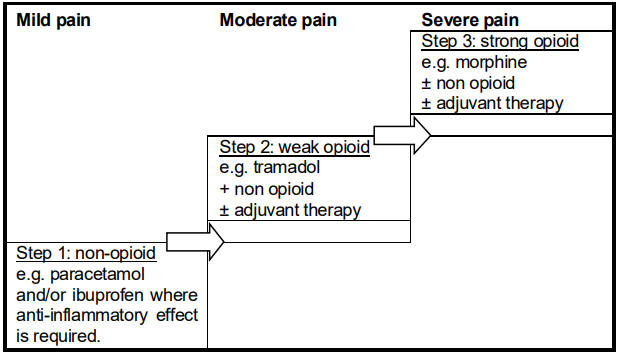
Step 1: Non-opioid
- Paracetamol, oral, 500 mg–1 g, 4–6 hourly as required (to a maximum of 4 g in 24 hours).
- Maximum dose: 15 mg/kg/dose.
LoE:IIb22
AND/OR
- NSAIDs, e.g.:
- Ibuprofen, oral, 400 mg, 8 hourly with or after a meal
LoE:IIb23
Step 2: Add weak opioid to Step 1
- Tramadol, oral, 50–100 mg, 6 hourly as a starting dose (Doctor prescribed).
- May be increased to a maximum daily dose of 400 mg.
CAUTIONUse with caution when administered with antidepressants e.g. amitriptyline to avoid over sedation. |
LoE:IIb24
Step 3: Replace weak opioid with strong opioid, i.e. morphine, and add to paracetamol and/or ibuprofen
-
Morphine, oral, 4 hourly (Doctor prescribed).
- Start with 5–10 mg.
- Titrate the dose and dose frequency against the effect on pain.
If dosage is established and patient is able to swallow:
- Morphine, long-acting, oral, 12 hourly (Doctor prescribed).
- Start with 10–20 mg/dose.
- Titrate the dose and dose frequency against the effect on pain.
LoE:IIb25
If breakthrough pain occurs: See Breakthrough pain
Elderly adults or severe liver impairment:
- Morphine solution, oral, 4 hourly. (Doctor prescribed).
- Start with 2.5-5 mg/dose.
- Titrate the dose and dose frequency against the effect on pain.
Note:
- There is no maximum dose for morphine – Titrate the dose against the effect on pain.
- For the management of morphine overdose, see: Exposure to poisonous substances.
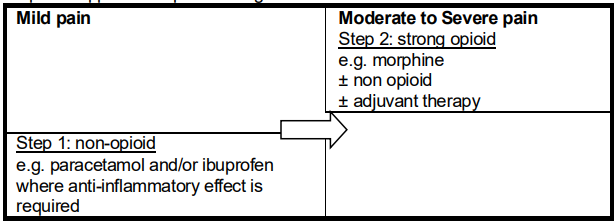
Children
Stepwise approach to pain management is recommended:
LoE:IVb26
Step 1: Non-opioid
- Paracetamol, oral, 10–15 mg/kg/dose 6 hourly when required. See: dosing table.
- NSAIDs, e.g.:
- Ibuprofen, oral, 5–10 mg/kg/dose 8 hourly with or after a meal. See: dosing table. Where anti-inflammatory effect is required.
- Can be used in combination with paracetamol or opioids.
- Discontinue if not effective after 2–3 days.
LoE:IIb27
Step 2: Add opioid to paracetamol and/or ibuprofen
- Morphine, oral, 0.2–0.4 mg/kg/dose 4–6 hourly according to severity of the pain. See: dosing table (Doctor prescribed).
LoE:IIb28
Adjuvant therapy:
Children
See the Paediatric Hospital STGs and EML, Pain control.
Adults
In addition to analgesia as above:
- Amitriptyline, oral, 10 mg at night. (Doctor initiated).
- Titrate up to a maximum of 75 mg at night.
LoE:IVb29
Significant nausea and vomiting:
Adults
- Metoclopramide oral, 10 mg, 8 hourly as needed.
- Maximum daily dose: 0.5 mg/kg
Children
For treatment of nausea and vomiting in the palliative care setting, see: Nausea and vomiting.
Constipation:
A common problem due to long-term use of opioids, which can be prevented and should always be treated.
For management of constipation in palliative care, see Constipation.
Children
- Lactulose, oral, 0.5 mL/kg/dose once daily. See: dosing table.
- If poor response, increase frequency to 12 hourly.
Adults
- Lactulose, oral, 10-20mL once daily.
- If poor response, increase frequency to 12 hourly.
Pruritus:
Children
- Chlorphenamine, oral, 0.1 mg/kg/dose 6–8 hourly. See: dosing table
Adults
- Chlorphenamine, oral, 4 mg, 6–8 hourly
|
CAUTION |
Anxiety related to pain:
Children
- Diazepam, oral, 0.04 mg/kg/dose 8–12 hourly (Doctor prescribed).
|
Weight |
Dose |
Tablet |
Age |
|
>9–17.5 kg |
0.5 mg |
¼ tablet |
>12 months–3 years |
|
>17.5–25 kg |
1 mg |
½ tablet |
>5–7 years |
|
>25–35 kg |
1.5 mg |
¾ tablet |
>7–11 years |
|
>35 kg |
2 mg |
1 tablet |
>11 years |
- May be increased up to 0.2 mg/kg/dose 8–12 hourly.
- Beware of respiratory depression if given with morphine.
If an increase in dosage is required follow the weight band dosing guidance of 0.2 mg/kg/dose (see table below).
- Diazepam, oral, 0.2 mg/kg/dose 8–12 hourly (Doctor prescribed).
- Beware of respiratory depression if given with morphine.
|
Weight |
Dose |
Use one of the following tablets: |
Age |
|
|
2 mg |
5 mg |
|||
|
>9–11 kg |
2 mg |
1 tablet |
- |
>12–18 months |
|
>11–14 kg |
2.5 mg |
- |
½ tablet |
>18 months–3 years |
|
>14–17.5 kg |
3 mg |
1½ tablets |
- |
>5–7 years |
|
>17.5–25 kg |
4 mg |
2 tablets |
- |
>5–7 years |
|
>25 kg |
5 mg |
- |
1 tablet |
>7 years |
Adults
- Diazepam, oral, 2–5 mg every 12 hours for a maximum of two weeks (Doctor prescribed)
Standard Treatment Guidelines and Essential Medicines List for South Africa, Primary Healthcare, 2020-2024_Version 1.0_07 November 2024
Chapter 20: Pain_20.4 Chronic Cancer Pain