Chronic Kidney Disease (CKD)
Standard Treatment Guidelines and Essential Medicines List for South Africa, Hospital Level, Adults 2019 Edition
Treatment and prevention strategies according to stage of disease
Consult with a specialist at the local referral centre
N18.1-5/N18.9
DESCRIPTION
Evidence of structural damage (e.g., proteinuria/haematuria) or loss of kidney function (eGFR <60 ml/min/1.73 m2), present for >3 months.
Markers of kidney damage include:
- proteinuria; (UPCR = urine protein to creatine ratio; UACR = urine albumin to creatine ratio)
- Severely increased: UPCR >0.05 g/mmol (>0.500g/g); UACR > 30mg/mol (300mg/g)
- Moderately increased: UPCR 0.015-0.05 g/mmol (0.15-0.5 g/g); UACR 3-30 mg/mmol (30-300 mg/g)
- Normal or mildly increased: UPCR <0.015 g/mmol (<0.15 g/g); UACR <3 mg/mmol (<30 mg/g)
LoE:IVbii
- urine dipstick positive for blood and/or protein (for females with haematuria: exclude current menstrual cycle)
- increased serum creatinine or low eGFR <60 mL/min/1.73 m2
- abnormal kidneys on ultrasound, e.g. polycystic, small in size, scarring
- abnormalities on renal biopsy
- electrolyte abnormalities due to tubular disorders
- history of kidney transplant
eGFR calculator online access:
https://www.kidney.org/apps/professionals/egfr-calculator
Table 1: Common causes of CKD include:
| Category | Example |
| Vascular | Hypertension, renal artery stenosis, vasculitis etc. |
| Glomerular diseases | Diabetes, autoimmune diseases (e.g. lupus nephritis), chronic systemic infections (e.g. HIV, HBV, syphilis), drugs, neoplasia |
| Tubulointerstitial diseases | UTI, drug-induced interstitial nephritis (e.g. rifampicin, allopurinol, fluoroquinolones, sulphonamides, betalactam antibiotics, proton pump inhibitors, non-steroidal anti-inflammatory drugs) |
| Structural | Polycystic kidneys, renal masses, obstruction (stones, strictures) |
| Others | Congenital |
|
Chronic kidney disease can be entirely asymptomatic until over 75% of kidney function is lost.
|
TREATMENT AND PREVENTION STRATEGIES ACCORDING TO STAGE OF DISEASE
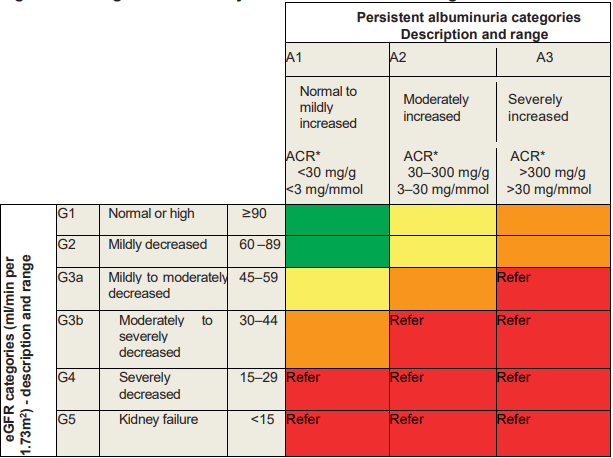
Adverse outcomes of CKD can often be prevented or delayed through early detection and treatment of risk factors for CKD. In patients with CKD, the stage of disease should be assigned based on the level of kidney function according to the classification below, irrespective of diagnosis.
Adults with early CKD i.e. stages 0–3 can be managed at primary care level once the cause and plan for care has been established. All stage 4 and 5 patients require referral/consultation with a specialist. If the patient is a candidate for long-term dialysis, referral to nephrology is advised.
Figure 1: Prognosis of CKD by GFR and albuminuria categories: KDIGO 2024
Click on image to enlarge.
ACR: albumin to creatinine ratio in urine specimen.
Green: low risk (if no other markers of kidney disease, no CKD); yellow: moderately increased risk; orange: high risk; red: very high risk; A1, A2, A3 = categories of albuminuria; G1, G2, G3a, G3b, G4, G5 = categories of eGFR
LoE:IVbiii
GENERAL MEASURES
- Address cardiovascular disease risk factors. See Ischaemic heart disease and atherosclerosis, prevention .
- Limit total daily salt intake (including salt in food). Consult with dietician as required.
LoE:IVbiv
- Avoid nephrotoxic drugs/agents like NSAIDs, aminoglycoside antibiotics and radiocontrast media.
- Regular exercise and target BMI (BMI <25 kg/m2 ) according to South African reference ranges.
- Screen for proteinuria.
- If urine dipstick 1+ or greater, repeat on a properly collected midstream urine specimen on another occasion.
- If proteinuria persists, quantify protein with a spot urine protein creatinine ratio. Significant proteinuria = spot urine PCR of >0.15 g/mmol.
- If urine dipstick < 1+, measure urine ACR.
- Patients differ in their ability to excrete a salt and water load and therefore fluid balance should be individualised.
- Refer patients to rehabilitation for multidisciplinary care and optimisation of function outcomes e.g., improved muscle strength and cardiovascular fitness, reduced blood pressure, weight management.
LoE:IIIbv
MEDICINE TREATMENT
The following interventions may delay progression of kidney disease.
Proteinuria reduction
Ideal targets: UPCR <0.03 g/mmol or UACR <3 mg/mmol.
Most benefit is achieved by reducing UPCR to <0.1 g/mmol or UACR <100 mg/mmol.
- Start treatment with a low dose of ACE-inhibitor and titrate up to the maximum tolerated dose, e.g.
- Enalapril, oral.
- Start with 5 mg 12 hourly and titrate to 20 mg 12 hourly, if tolerated.
LoE:IVbvi - Monitor creatinine and potassium after 2 weeks if eGFR <60 mL/min/1.73 m2 and after 4 weeks if GFR >60 mL/min/1.73 m2.
- Start with 5 mg 12 hourly and titrate to 20 mg 12 hourly, if tolerated.
- If creatinine increases by >20% from the baseline, stop ACE-inhibitor and consult a specialist.
LoE:IIIbvii
ACE-inhibitor not tolerated due to intractable cough:
- Consider an angiotensin II receptor blocker (ARB), e.g.: (specialist initiated)
LoE:IIIbviii
- Losartan, oral,
- Start with 50 mg daily and titrate to 100 mg daily, if tolerated.
- Replacing ACE-inhibitor with ARB does not preclude the risk of angioedema.
LoE:IIaix
|
CAUTION ACE-inhibitors and ARBs can cause or exacerbate hyperkalaemia in CKD. Check the serum potassium before starting these medicines, and monitor serum potassium on therapy. |
Hypertension
Optimise BP control with additional antihypertensive agents. BP control results in a lowering of proteinuria and slower decline in eGFR.
Target BP for patients with hypertension: <140/90 mmHg.
Target BP for patients with hypertension and confirmed CKD and/or diabetes: <130/80 mmHg.
See Hypertension.
Hyperlipidaemia
If hyperlipidaemia is a co-existent cardiovascular risk factor, manage according to Ischaemic heart disease and atherosclerosis, prevention.
Diabetes mellitus
- In diabetics, optimise control according to Diabetes mellitus.
- In diabetics with kidney disease there is an increased risk of hypoglycaemia.
- Insulin is the safer option to control blood glucose in patients with eGFR < 60 mL/minutes.
Note:
- Insulin requirements will decrease as renal disease progresses.
- Stop glibenclamide when eGFR <60 mL/min/1.73 m2 because of an increased risk of hypoglycaemia.
- Reduce metformin dose when eGFR <60 mL/min/1.73 m2 (maximum dose 500 mg 12 hourly).
- Discontinue metformin when eGFR <60 mL/min/1.73 m2 because of the risk of lactic acidosis.
LoE:IIIbx
Fluid overload and oedema
- Furosemide, oral or IV, 20 to 80mg daily, as a single or divided doses, initiating at the lowest effective dose and titrating upwards. Dose may be increased to 160 mg daily (IV or oral) in divided doses.
- First establish an effective dose and ascertain if urination occurs within 1-2 hours of intake. If urination does not occur within 1-2 hours, the dose should be increased further until urination ensues.
- Diuretic action starts within 60 minutes of dose, hence divided doses should be given in the morning and afternoon, e.g. 8 AM and 2 PM.
LoE:IVbxi
When fluid overloaded and eGFR <60 mL/min/1.73 m2, start:
- Furosemide, oral or IV, 40 mg in divided doses (e.g., 8 AM and 2 PM).
- Titrate to a maximum of 500 mg in divided doses (e.g., 8 AM and 2 PM).
- Furosemide is ineffective when patients are on dialysis and anuric.
Hypocalcaemia and hyperphosphataemia
The aim is to lower phosphate levels and maintain normal calcium levels to ensure calcium-phosphate product (i.e. Ca x PO4) <4.4 mmol2/L2 , to prevent calcium deposition in vessels and tissue which aggravates vascular disease.
Restrict dietary phosphate intake. (Dietitian consultation) https://unckidneycenter.org/kidneyhealthlibrary/nutrition-and-kidney-disease/
Patients with CKD stage 3–5, not on dialysis:
Hyperphosphataemia and/or hypocalcaemia:
- Calcium (elemental), oral (calcium carbonate), 500 mg 8 hourly with meals if calcium-phosphate product <4.4 mmol2/L2.
- Increase to approximately 1g 8 hourly with meals if hyperphosphatemia persists.
Aluminium hydroxide 300mg/5ml, oral, 10 mL 8 hourly with meals if calcium-phosphate product >4.4 mmol2/L2 , for two weeks only, then switch to calcium carbonate.
LoE:IVbxii
Hypocalcaemia and low or normal serum phosphate:
- Calcium (elemental), oral (Calcium carbonate), 500 mg 8 hourly two hours after meals, increase to approximately 1 g 8 hourly between meals.
In patients with CKD stage 5 who are not candidates for kidney replacement therapy, the benefits of phosphate binding are unclear, and regular PTH (parathyroid hormone) monitoring is not necessary.
Patients considered suitable candidates for renal replacement therapy:
Monitor Ca++, PO4 and PTH levels, as per figure 1.
For hyperphosphataemia uncontrolled on calcium carbonate:
- Aluminium hydroxide BP (300 mg/5 mL), oral, 10 mL 8 hourly. Specialist initiated.
- To prevent dementia-associated aluminium toxicity, do not use for longer than 3 months.
For hyperparathyroidism, initiate when PTH levels > 2 times upper limit of normal range: (Specialist initiated)
(N25.8)
- Calciferol, oral, 50 000 IU once weekly.
LoE:IIIbxiii
OR
- Calcitriol, oral, 0.25–4 mcg daily.
Anaemia associated with CKD in patients on dialysis programmes
N18.1-5† /N18.9† + (D63.8*/Z49.1-2)
Patients on chronic haemodialysis or peritoneal dialysis are often anaemic due to iron deficiency and deficiency of erythropoietin (EPO).
Simultaneous administration of iron and EPO is recommended, as EPO should be administered in a patient with normal iron stores. Adequate iron stores are required to assist with red blood cell production immediately after EPO administration (see Anaemia, iron deficiency).
LoE:IIaxiv
- Iron, elemental, oral. See Anaemia, iron deficiency, if no response, consider parenteral iron.
AND
Erythropoietin Stimulating Agents (ESAs), e.g.:
- Erythropoietin alpha or beta, 40–50 IU/kg/dose, IV/SC 2–3 times weekly and assessed at 4 weekly intervals.
- Administer IV dose over 1–5 minutes.
- If necessary, dose may be increased by 25 IU/kg.
Note:
There is an increased risk of cardiovascular events with haemoglobin levels >12 g/dL.
LoE:IIaxv
Definitive treatment, e.g. transplantation, usually improves anaemia. It is important to identify factors likely to aggravate anaemia, e.g. iron deficiency, infection, and vitamin B12 and folate deficiency.
Acidosis and hyperkalaemia
Specialist consultation for possible renal replacement therapy.
Check all medicines for possible dose adjustments. https://globalrph.com/renal/
CONSULT WITH A SPECIALIST AT THE LOCAL REFERRAL CENTRE
- Unknown cause of kidney failure.
- Rapid deterioration in renal function.
- Resistant hypertension despite appropriate medication and adherence.
- All patients with persistent proteinuria: on urine dipstick ≥ 1+ or proteinuria >1 g/24 hours (UPCR >0.1 g/mmol).
- Patients with nephrotic-range proteinuria (UPCR >0.35 g/mmol) or nephrotic syndrome should be referred for possible kidney biopsy.
REFERRAL
- All ESRD patients who may qualify for long term dialysis programs. See Renal replacement therapy.
- CKD stage 3 and above (see figure 1: Prognosis of CKD by GFR and albuminuria categories).
Standard Treatment Guidelines and Essential Medicines List for South Africa, Adult Hospital Level, 2020-2024_Version 1.0_17 October 2024
Chapter 7 Nephrology/Urological Disorders_7.1 Nephrology Disorders_7.1.1 Chronic Kidney Disease (CKD)
Drugs mentioned
ICD-10 codes
- D63.8Anaemia in other chronic diseases classified elsewhere
- N18.1Chronic kidney disease, stage 1
- N18.2Chronic kidney disease, stage 2
- N18.3Chronic kidney disease, stage 3
- N18.4Chronic kidney disease, stage 4
- N18.5Chronic kidney disease, stage 5
- N18.9Chronic kidney disease, unspecified
- N25.8Other disorders resulting from impaired renal tubular function
- Z49.1Extracorporeal dialysis
- Z49.2Other dialysis