CIRCULAR H 159 of 2020: Standard Operating Procedure for Management of People with Diabetes and COVID-19
15 July 2020
This circular has been published by the Western Cape Department of Health. EMGuidance confirms that it is not the owner of the information provided, nor does it intend to present it as such.
CIRCULAR H159 OF 2020: STANDARD OPERATING PROCEDURE FOR MANAGEMENT OF PEOPLE WITH DIABETES AND COVID-19
1. PURPOSE
The purpose of this guideline is to explain the procedures to be followed for early testing and management of people with diabetes during the COVID-19 pandemic. They are at significantly increased risk of mortality and more active support and management is therefore proposed. Our current data suggests that these patients are presenting or are being admitted too late and have adverse outcomes. This SOP will be in effect from the 15th July 2020.
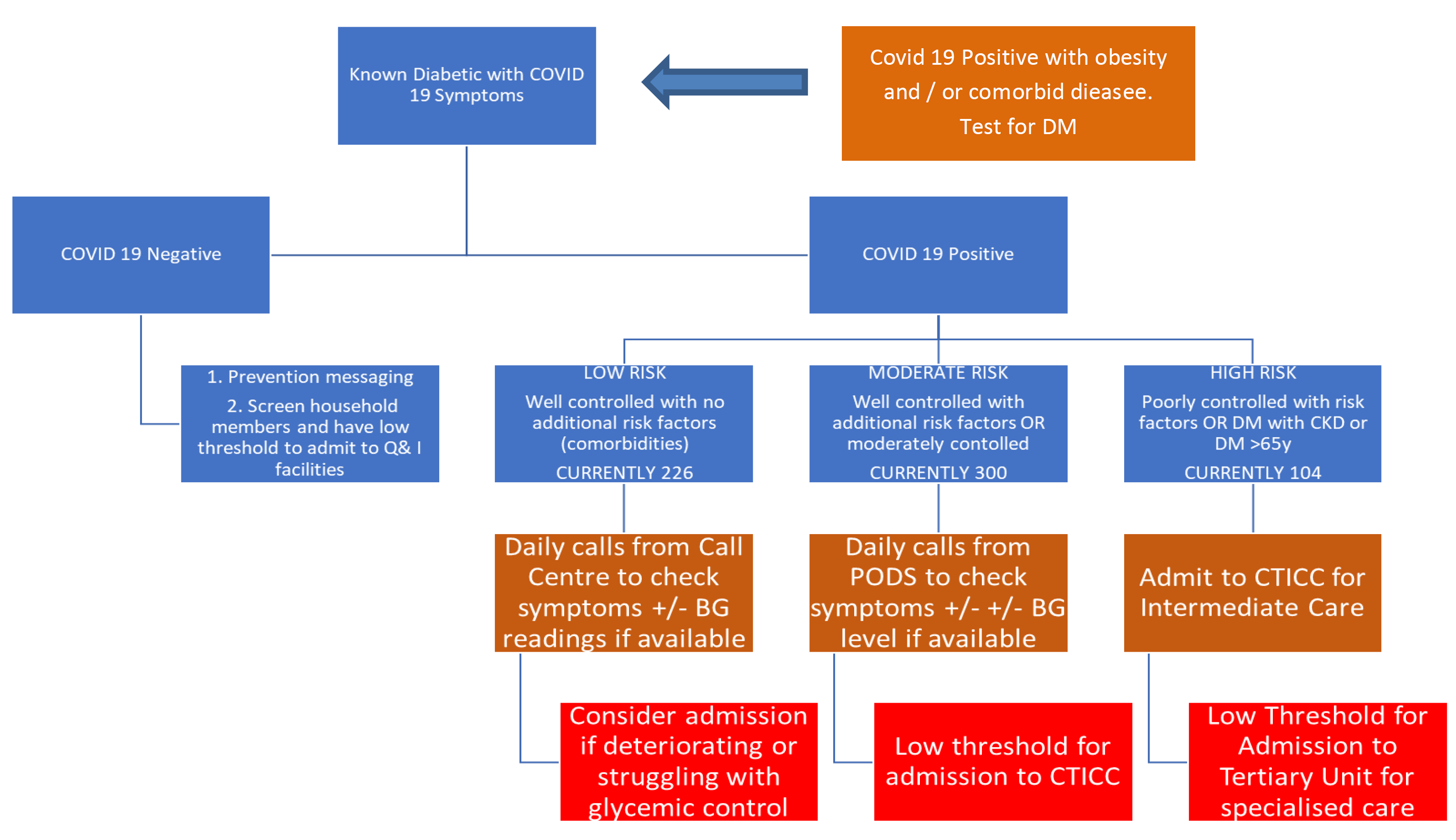
2. DECISION TREE FOR MANAGEMENT OF DIABETIC PATIENTS:
The following schematic describes the workflow for diabetic patients with COVID-19, stratified according to their risk profile
2.1. Lower threshold for screening for Diabetes in certain COVID-19 patients
a) Many patients are hyperglycaemic during their COVID 19 episode, either due to newly diagnosed or unmasked diabetes, or due to a stress response.
b) For patients who are not known diabetics, but have the following risk factors, we propose screening for diabetes:
I. Obesity
II. Hypertension
III. Family History of Diabetes
IV. Symptoms suggestive of diabetes
V. Gestational diabetes
A random BG of >11.1mmol/L should be followed up with an HbA1C confirmatory test or formal fasting blood glucose testing. However, for the purposes of this SOP, an individual with a random BG > 11.1 mmol/l and one of the above risk factors and/or comorbidities should be treated according to the above risk profile.
2.2. Known Diabetics diagnosed with COVID-19
The Single Patient Viewer (SPV) will be used to facilitate the categorisation of patients from their past medical diagnosis and comorbidities that are captured by the Provincial Health Data Centre (PDHC). A new report will automatically link patient results from their COVID tests to their diabetic status and other comorbidities and categorise them for management into low, moderate or high risk. These reports will be generated automatically based on the patient’s history including comorbidities. Where patients are ill and require admission at presentation, they should be admitted to an acute facility.
The actions taken should be dependent on the patient’s known diabetic control, comorbidities, age and presence of obesity. Where previous diabetic control is not known, management should be to treat the patient as though the level of control is suboptimal.
The additional measures described in this SOP will apply to diabetic patients diagnosed with COVID-19 within a 10-day window.
These COVID-19 Diabetic Patients will be risk stratified into 3 strata/groups:
a) Low Risk
b) Moderate Risk
c) High Risk
a. Low risk
These are well controlled diabetics (recent HbA1C <8% if available, or assessed as well-controlled by the treating clinician) who have no other risk factors for severe COVID-19 (such as obesity, hypertension and ischeamic heart disease) and are <65 years old.
i. Have a low threshold to consider admission to intermediate/acute care. However, if the patient is completely stable and has ready access to transport (in the event that he/she deteriorates), the patient can be managed at home.
ii. Ensure the patient’s most recent contact details (and secondary contacts) are captured correctly on to SPV.
iii. The call centre shall call the patient daily according to the script in Appendix A checking for any signs of deterioration and daily monitoring of BG levels (if available).
iv. The call centre agents will have a low threshold to escalate to a clinician (via the telemedicine pod) to assess the patient’s condition and request admission if necessary.
v. If the patient is stable he /she shall be referred via the Red Dot service 021-9284102 (explain for diabetic requiring Q/I and transport) and referred to an acute facility or the CTICC.
vi. If the patient is acutely ill, EMS shall be required for transfer to an acute facility.
vii. The clinician referring the patient shall inform the receiving facility of this pending admission using the Vula app.
b. Moderate Risk
These are well-controlled diabetics who have other risk factors such as obesity, hypertension and ischaemic heart disease OR their control is not optimal (recent HbA1C 8 to 10%).
i. Have a low threshold to consider admission to an intermediate care facility e.g. CTICC. However, if the patient is completely stable and has access to transport if he/she deteriorates, the patient can be managed at home.
ii. Ensure the patient’s most recent contact details (and secondary contacts) are captured correctly on to SPV.
iii. The pods shall call the patient daily according to the script in Appendix A checking for any deterioration and monitoring BG (if available).
iv. The pods will have a low threshold to request admission to an intermediate care facility (e.g. CTICC).
v. If a patient starts to deteriorate, EMS shall be immediately contacted to collect the patient for admission to the CTICC.
vi. The caller from the SS pod shall inform the CTICC of this pending admission.
vii. If the patient has multiple risk factors, comorbidities or complications, consider applying the high-risk strategy described below.
c. High Risk
These include poorly controlled diabetics (recent HbA1C > 10% or assessed as poorly controlled by the treating clinician) who have other risk factors such as obesity, are > 65 years and/or have comorbidities including Chronic Kidney Disease (CKD). These patients have a high mortality rate so this proactive approach is to reduce their risk of mortality.
i. Prepare these patients for admission (Appendix B).
ii. Admission will be recommended by the contacting clinician from the telemedicine pod, but will be on a voluntary basis.
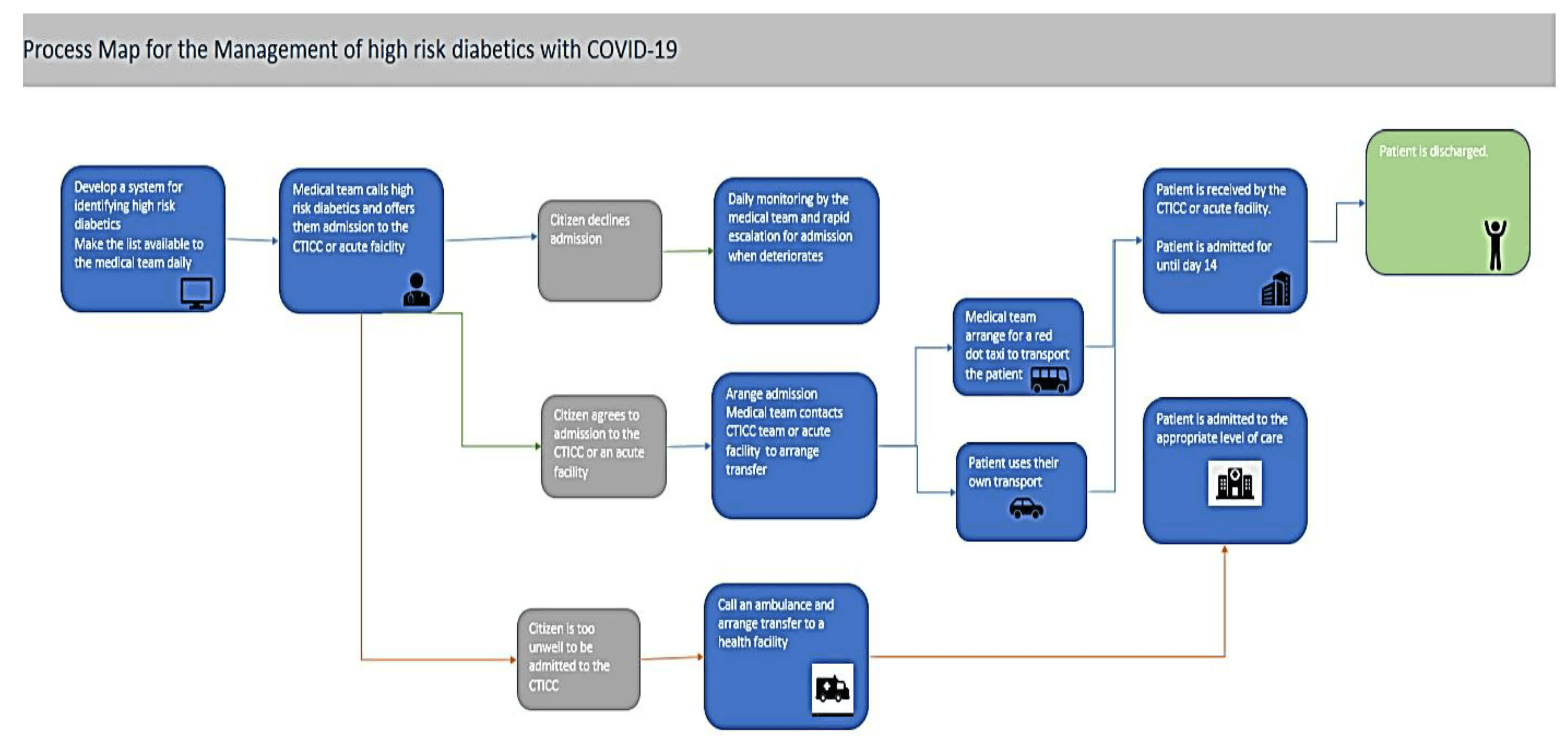
iii. If the patients are clinically stable, use the Red Dot service (021-9284102) to refer them to CTICC or acute facility. For admissions, the referring clinician should us the Vula app.
iv. Patients who are deteriorating or acutely ill should be referred to an acute facility using EMS.
v. If the patient has multiple risk factors, comorbidities or complications, consider direct referral to an acute hospital, even if the patient is clinically stable.
vi. These patients are may require specialist support. Many of these patients succumb within 4 days. If they are admitted to the CTICC, consideration should be given to providing the appropriate level of specialist care when required.
vii. The patients should receive close monitoring for glycaemic control and oxygen saturation.
3. IMPLEMENTATION
The CTICC and Tertiary Hospitals shall ensure that all patients are reported on the dedicated patient administration (Clinicom) for reporting on the numbers of known diabetics admitted into its care (including outcomes).
4. REPORTING
This should be implemented across the province commencing the 15th July 2020. Oversight for its implementation shall be from Dr Perez for Metro Health Services (MHS) and Dr Crous for Rural Health Services (RHS).
An Operational Line Listing of Active COVID-19 Diabetic Patients will be made available by the Health Impact Assessment (HIA) team to all stakeholders stratified by risk:
• Call Centre Agents will receive access to a daily line list of low risk COVID-19 Diabetic patients diagnosed in the last 10 days for daily follow-up.
• Substructure pods will receive access to a daily line list of moderate risk COVID-19 Diabetic patients diagnosed in the last 10 days for daily follow-up and can escalate calls to the telemedicine pod when required.
• The telemedicine pod will also receive access to a daily line list of high risk COVID-19 Diabetic patients diagnosed in the last 10 days for urgent follow-up and preparation for admission to the CTICC/acute hospital care.
The operational line list will continuously be updated as new patients are identified for immediate action, according to their risk stratification. Patients that complete their 10-14 days of follow-up without deterioration in their health state will be discharged from telephonic care. This will ensure a sustained manageable number of COVID-19 diabetic patients being followed up at all time for all teams.
Communication between call centre, substructure pods, EMS, CTICC and Acute Hospital Care needs to be coordinated and allow for smooth, barrier-free escalation of care as and when required.
Pre-intervention indicators will be monitored and compared against post-intervention indicators to continuously assess for impact of early escalation of care.
Appendix A- Script for Call Centre for low and moderate risk patients
Appendix B- script for PODs monitoring moderate risk patients