Clinical Guidelines: Patient Blood Management
General PBM statements and measures PBM measures for patients expected to bleed significantly during surgery General PBM statements and measures 1.1 All patients should have their Hb concentration measured before listing for major elective surgery. 1.2 Patients who are anaemic (Hb <13g/dL) should be investigated before elective surgery and treated appropriately, and elective non-urgent surgery
General PBM statements and measures
PBM measures for patients expected to bleed significantly during surgery
General PBM statements and measures
| 1.1 | All patients should have their Hb concentration measured before listing for major elective surgery. |
| 1.2 | Patients who are anaemic (Hb <13g/dL) should be investigated before elective surgery and treated appropriately, and elective non-urgent surgery other than Caesarean section should be delayed when possible. |
| 1.3 | Where blood transfusion is anticipated, this and alternatives to transfusion should be discussed with the patient and documented. |
| 1.4 | Red cell concentrate (RCC, previously called RBCs) should be transfused one unit at a time, and the patient’s Hb should be checked before each unit transfused, unless there is ongoing bleeding or a large deficit that needs correcting. |
| 1.5 | The use of intraoperative cell salvage and TXA administration should be considered in all trauma, major obstetric and non-obstetric patients where blood loss >500ml is expected. |
| 1.6 | Blood components should be prescribed for small children by volume rather than number of units. |
| 1.7 | Every institution should have a massive transfusion protocol that is regularly audited and reviewed every 2 years. |
| 1.8 | Group O RCC should be readily available in the clinical area, in case of life-threatening haemorrhage. |
| 1.9 | During major haemorrhage due to trauma and obstetrics, consideration should be given to transfusing red cells and FFP/FDP in preference to other IV fluid. |
| 1.10 | Patients who continue to actively bleed should be monitored by POC and/or regular laboratory tests for coagulation, fibrinogen and platelet counts or function. |
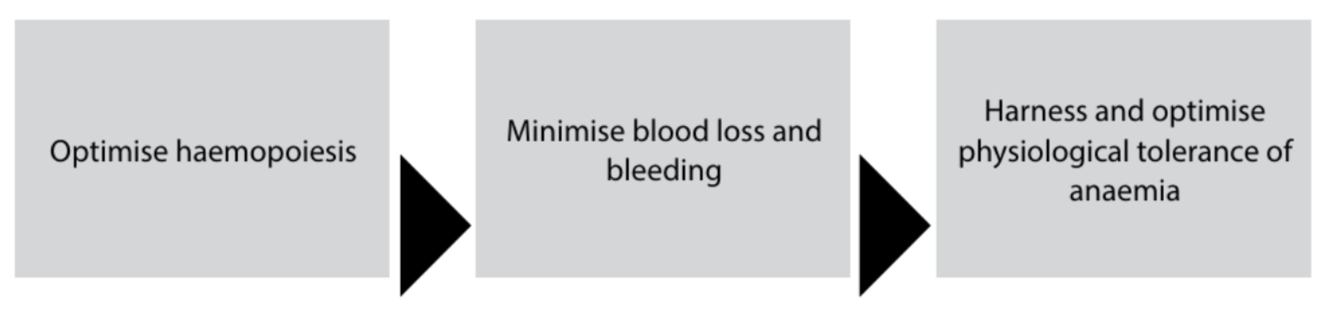
The three pillars of PBM should be observed throughout a patient’s journey of care.9
Click on the image to enlarge.
In resource-limited environments where blood products are scarce, attention should be given to alternative techniques for blood collection, in particular cell salvage. We also recommend the establishment of active Patient Blood Management Committees within every hospital. These committees should meet monthly and ensure the appropriate use of blood products and PBM principles within their institutions.
Clinicians and PBM committees should be cognisant of the difficulties some areas face in accessing blood products, and these should be considered when ordering and using blood products.
PBM Measures for Patients Expected to Bleed Significantly During Surgery
| Preoperative | Consensus | Grade | |
| 2.1 | Preoperative Hb should be measured, recorded and optimised as required. | Yes | A |
| 2.2 | Elective surgery should be postponed in patients with untreated anaemia. | Yes | A |
| 2.3 | Review and consider stopping antiplatelet and anticoagulant medication the recommended number of days before surgery. | Yes | B |
| 2.4 | Consider minimally invasive or laparoscopic surgical technique. | Yes | B |
| 2.5 | POC testing should be available with appropriate training. | Yes | C |
| Intraoperative | Consensus | Grade | |
| 2.6 | Position patient carefully to optimise venous drainage. | Yes | B |
| 2.7 | Use patient warming to maintain temperature >36°C. | Yes | A |
| 2.8 | Consider cell salvage if blood loss >500ml anticipated. | Yes | B |
| 2.9 | Consider giving TXA if blood loss >500ml anticipated. | Yes | C |
| 2.10 | The dose of TXA should be 15mg/kg. | Yes | C |
| 2.11 | Apply restrictive transfusion threshold (Hb 7–8g/dL) depending on patient characteristics and haemodynamics. | Yes | B |
| 2.12 | Consider use of topical haemostatic agents. | Yes | C |
| Postoperative | Consensus | Grade | |
| 2.13 | Maintain oxygen delivery, targeting oxygen saturation levels >92%. | Yes | A |
| 2.14 | Single unit blood transfusion policy, with subsequent re-assessment of Hb concentration and clinical need between RCC units. | Yes | A |
| 2.15 | Consider postoperative drains for cell salvage. | Yes | A |
Patient blood management is a patient-based approach aimed at reducing the unnecessary utilisation of blood products and improving patients’ clinical outcomes and safety, and focuses on the optimisation of three perioperative factors: patient, surgical and anaesthetic.10 It has been recommended as a standard of care in South Africa.9 PBM focuses on three ‘pillars’ of care in surgical patients: detection and treatment of perioperative anaemia; reduction of perioperative blood loss; and harnessing and optimising the patient-specific physiological reserve of anaemia.11 In recent years, transfusion medicine has been a focus of research, however, as much emphasis should be placed on the other pillars of PBM, in particular the early management of anaemia.
We recommend a national drive for early screening and management for anaemia for all patients who are to undergo surgery. Where possible, anaemia should be treated preoperatively with appropriate investigations and management with pharmacological agents, to avoid operating on anaemic patients and unnecessary administration of blood products.
South African Society of Anaesthesiologists (SASA) Guidelines for Patient Blood Management 2020. Confirmed as current version on the SASA website as of November 2024.