Clinical management and considerations for treatment of influenza
Clinical management and considerations for treatment of influenza Influenza is detectable in approximately 7% of children aged < 5y years hospitalised with pneumonia and 9% of individuals aged ≥5 years hospitalized with pneumonia in South Africa. [33, 34] . During the influenza season this increases to approximately 20-40% of all people hospitalised for pneumonia. For this reason, influenza mu
Clinical management and considerations for treatment of influenza
Influenza is detectable in approximately 7% of children aged < 5y years hospitalised with pneumonia and 9% of individuals aged ≥5 years hospitalized with pneumonia in South Africa.[33, 34]. During the influenza season this increases to approximately 20-40% of all people hospitalised for pneumonia. For this reason, influenza must be considered as an important potential cause of community acquired pneumonia (CAP) in all patients during the influenza season and consideration must be given to including oseltamivir as part of empiric treatment where indicated (see section 5.1) and available. Note that because influenza vaccination is not 100% effective, a history of influenza vaccination does not exclude the possibility of influenza infection in patients with compatible clinical features.
1. Antiviral therapy
Antiviral medications with activity against influenza are an adjunct to influenza vaccine in the control of influenza. Few patients with influenza require treatment and initiation of treatment should be based on clinical judgment taking into consideration the patient’s disease severity and progression, age, underlying medical conditions, likelihood of progressing to severe influenza, and time since onset of symptoms. When indicated, antiviral treatment should be started as early as possible, ideally within 48 hours of symptom onset, and should not be delayed while awaiting laboratory confirmation. However, antiviral treatment might still be beneficial in patients with severe, complicated or progressive illness, and in hospitalized patients when started more than 48 hours after illness onset. Antiviral therapy is recommended as early as possible for any patient with confirmed or suspected influenza who
- has complicated or severe illness (including all hospitalised patients), or
- has higher risk for influenza complications (see section 5.2.1).
Antiviral treatment is not indicated for treatment of influenza in persons who do not fall in the risk groups for severe influenza-associated disease and who present with uncomplicated influenza.
Prospective, randomised, controlled clinical trials (RCTs) show that treatment with oseltamivir for uncomplicated influenza illness can reduce the duration of symptoms by approximately 1 day when given within 48 hours of onset of illness [35-38] . Because of the large sample sizes required, there have not been RCTs conducted specifically to evaluate the effect of oseltamivir against severe outcomes such as hospitalisation or death. Observational data suggest a benefit of oseltamivir treatment against severe outcomes, although these may be subject to several limitations. A meta-analysis of individual patient data reported lower risk of mortality in patients treated with neuraminidase inhibitors compared to those not treated.[39] A meta-analysis showed a risk reduction in lower respiratory tract complications and in-hospital stay in the group that received oseltamivir[40]. For this reason the South African guidelines continue to recommend the use of neuraminidase inhibitors for the treatment of hospitalised patients with confirmed or suspected influenza who have complicated or severe influenza or are at higher risk for influenza complications (see section 5.2.1).
1.1 Antiviral medication recommended for treatment
Oral oseltamivir (Tamiflu®) and inhaled zanamivir (Relenza®) (limited availability in South Africa) are chemically related antiviral medications that act as neuraminidase inhibitors and have activity against both influenza A and B. These two medications are recommended for use during the 2021 influenza season. Adamantanes (amantadine and rimantadine) are not recommended for use due to high levels of resistance. The standard adult dose and duration of oseltamivir treatment is 75mg twice daily orally for 5 days. Doses for treatment are summarised in Table 2[41].
1.2 Antiviral treatment of influenza when influenza viruses and SARS-CoV-2 are co circulating
Treatment for influenza is the same for all patients regardless of SARS-CoV-2 co-infection. For hospitalised patients with suspected influenza illness, empiric treatment for influenza with oseltamivir should be started as soon as possible without waiting for influenza testing results. Oseltamivir has no activity against SARS-CoV-2.
Table 2: Recommended Dosage and Duration of Influenza Antiviral Medications for Treatment
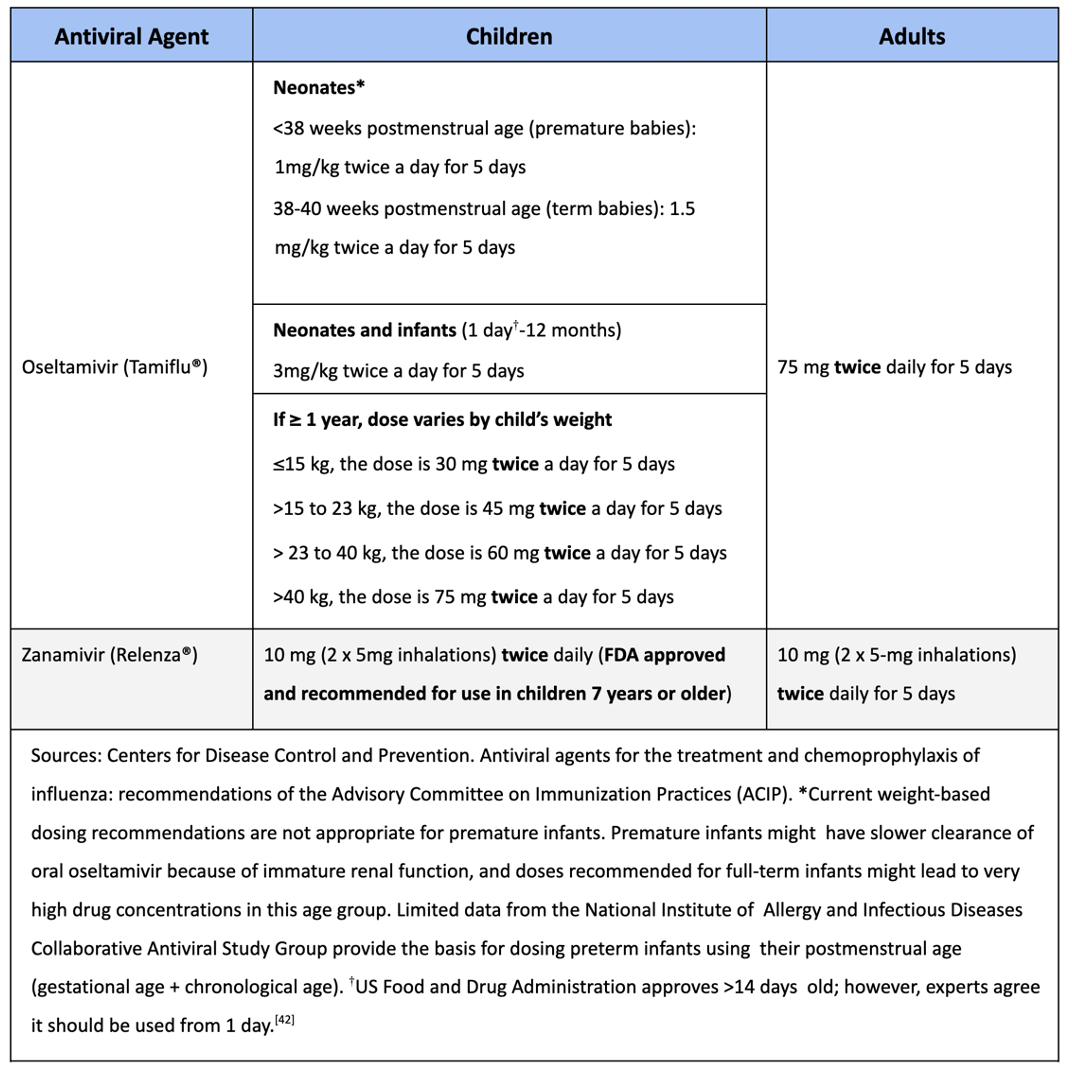 Click on the table to enlarge
Considerations for treatment with inhaled zanamivir
- Treatment with inhaled zanamivir is indicated in patients where oseltamivir-resistant influenza is demonstrated or strongly suspected.
- Zanamivir is only recommended for use in persons aged ≥7 years.
- Zanamivir contains lactose (powder for inhalation) and must NOT be administered by a nebuliser. It may also interfere with ventilator functioning in ventilated patients.
Other issues regarding critical care management of patients with influenza are beyond the scope of this document. A comprehensive review appears in the journal Critical Care Medicine 2010 Vol. 38, No. 4(Suppl.) pp e1-e142: H1N1 Novel Influenza: Pandemic Issues for Critical Care Practitioners. Free access is available online at: http://journals.lww.com/ccmjournal/toc/2010/04001
2. Other interventions for management
Antibiotic treatment: Antibiotics do not have a specific effect against the influenza virus but in cases of pneumonia, early empiric treatment for community acquired pneumonia is advised because of the high risk of secondary bacterial infection. Since there is increased risk of secondary infection with S. pneumoniae, Staphylococcus aureus and Streptococcus pyogenes co-amoxiclav is a suitable empiric antibiotic.
Oxygen therapy: Monitor oxygen saturation and maintain SaO2 >90% (92-95% for pregnant women) with nasal cannulae or face mask. High flow oxygen treatment may be required in severe cases of influenza.
Influenza: NICD recommendations for the diagnosis, management, prevention and public health response, National institute of communicable diseases, 2021