Community Acquired Pneumonia in Adults
Community acquired pneumonia in adults
Introduction
Identification
Severity assessment
Management based on severity
Relevant history/examination
Investigations
Referral criteria
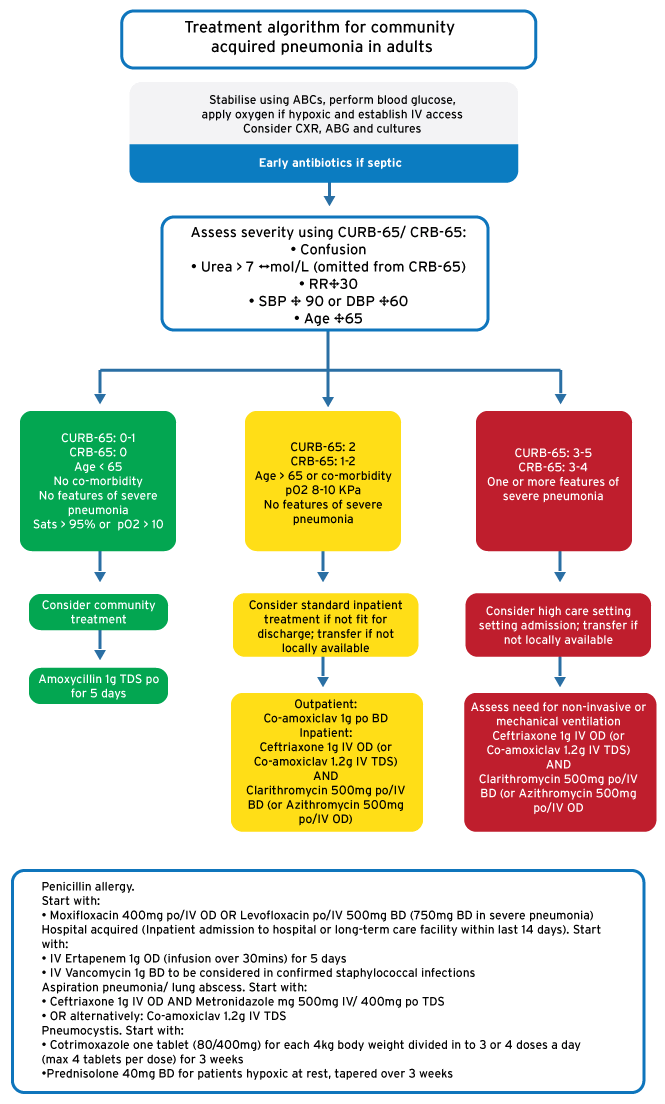
Treatment Algorithm
Introduction/ Description
Community-acquired pneumonia is defined as pneumonia in a patient who has not been hospitalised or has not resided in a long-term care facility (such as a nursing home) within the past 14 days.
Identification/ recognition/ diagnosis of problem
Pneumonia is identified as an infection of the lower respiratory tract associated with pulmonary signs or symptoms of acute infection, at least one systemic presentation or temperature >38°C, and new CXR infiltrate.
Differential diagnosis
- Pulmonary oedema
- Pulmonary embolism
- Bronchospasm/ asthma
- COPD
Severity assessment (triage)
| CRB-65 (no immediate access to lab) | CURB-65 (onsite access to lab) | ||||
Confusion RR≥30 SBP ≤ 90 or DBP ≤60 Age ≥65 | Confusion Urea > 7 µmol/L RR≥30 SBP ≤ 90 or DBP ≤60 Age ≥65 | ||||
| 0 | 1-2 | 3-4 | 0-1 | 2 | 3-5 |
| Consider community treatment | Consider standard inpatient treatment if not fit for discharge; transfer if not locally available | Consider high care setting admission, transfer if not locally available | Consider community treatment | Consider standard inpatient treatment if not fit for discharge; transfer if not locally available | Consider high care setting admission, transfer if not locally available |
Always consider admission or escalation of outpatient regiment if:
- Elderly
- Comorbidity
- Cyanosis
- Multilobar consolidation
- Complications
- Poor socio-economic status
Management based on severity
Immediate action
Non-drug treatment
Stabilise ABCs, commence high flow oxygen to maintain saturation 94-98% and obtain IV access. If sepsis is identified consider early use of fluids titrated to effect. Consider obtaining a CXR and an ABG early on in acutely unwell patients
Drug treatment
Give first dose of antibiotics early. If cultures are considered (e.g. acutely ill) obtain these early and then start antibiotics directly afterwards. Consider assisted ventilation (CPAP/ SIMV). See critical care section for ventilation guidance
Added tables/ dose charts
Outpatient
Amoxycillin 1g po TDS for 5 days
- Elderly/ co-morbid: Co-amoxiclav 1g po BD
- Allergy: Moxifloxacin 400mg po OD OR Levofloxacin 500mg po BD
Inpatient
- Ceftriaxone 1g IV OD (or Co-amoxiclav 1.2g IV TDS)
AND
- Clarithromycin 500mg po/IV (or azithromycin 500mg po/IV OD)
- Swap to oral as per outpatient regiment within three days, or as clinically guided
- Allergy: Moxifloxacin 400mg po/IV OD OR Levofloxacin po/IV 500mg BD (750mg BD in severe pneumonia)
Hospital acquired*
- IV Ertapenem 1g OD (infusion over 30mins) for 5 days
- IV Vancomycin 1g BD to be considered in confirmed staphylococcal infections
Aspiration pneumonia/ lung abscess
Ceftriaxone 1g IV OD ANDMetronidazole mg 500mg IV/ 400mg po TDS
OR alternatively:Co-amoxiclav 1.2g IV TDS only
- For either regiments swap to co-amoxiclav 1g po BD within three days, or as clinically guided
Pneumocystis
Cotrimoxazole one tablet (80/400mg) for each 4kg body weight divided in to 3 or 4 doses a day (max 4 tablets per dose) for 3 weeks
Prednisolone 40mg BD for patients hypoxic at rest, tapered over 3 weeks
*Inpatient admission to hospital or long-term care facility within last 14 days
Relevant history/ examination
Risk factors include
- Age over 65 years
- HIV/ immunocompromised
- Recent respiratory infection
- Exposure to respiratory infection
- Recent travel
- High-risk occupation
- Recent antibiotic exposure
- Smoking
- Comorbid medical conditions
Key diagnostic factors: presence of risk factors, cough, dyspnoea, rapid breathing/ tachycardia, crackles/ rales on auscultation
Other diagnostic factors: chills then fever, chest pain, lung percussion dullness, bronchial breath sounds, abdominal pain
Investigations
- CXR all admitted patients, or when diagnosis in doubt
- Ward Hb
- ABG if hypoxic on room air (Sats <94%)
- WCC, K, urea, creat
- Blood culture if admitted
- If not already known, pretest counsel and perform HIV if Pneumocystis suspected
- Sputum for AFB x 2 and for TB culture x1
Referral criteria
Depending on the initial presentation setting a referral may be required to accommodate investigations and admission to either standard or high care environments
Treatment algorithm for community acquired pneumonia in adults
References
Lim WS ed. Pneumonia Guidelines Committee of the BTS Standards of Care Committee: Guidelines for the Management of Community Acquired Pneumonia in Adults Update 2009. (http://thorax.bmj.com)
Lim WS, van der Eerden MM, Laing R, et al. Defining community acquired pneumonia severity on presentation to hospital: an international derivation and validation study. Thorax 2003;58(5):377-82.
Feldman C ed. Working Group of the South African Thoracic Society, Management of Community-Acquired Pneumonia in Adults.S Afr Med J 2007; 97: 1295-1306.