Community Acquired Pneumonia in Children
Guideline on Community Acquired Pneumonia in Children
Authors: Dr Liezl Smit & Dr Baljit Cheema
These guidelines were created in June 2015.
Summary of algorithm
Introduction
Clinical Presentation
Examination
Investigations
Management
Criteria for hospital admission
Indications for admission to intensive care (PICU)
Discharge criteria
Discharge advice
Follow up CXRs
Predominant causes of CAP by age group
Summary of algorithm
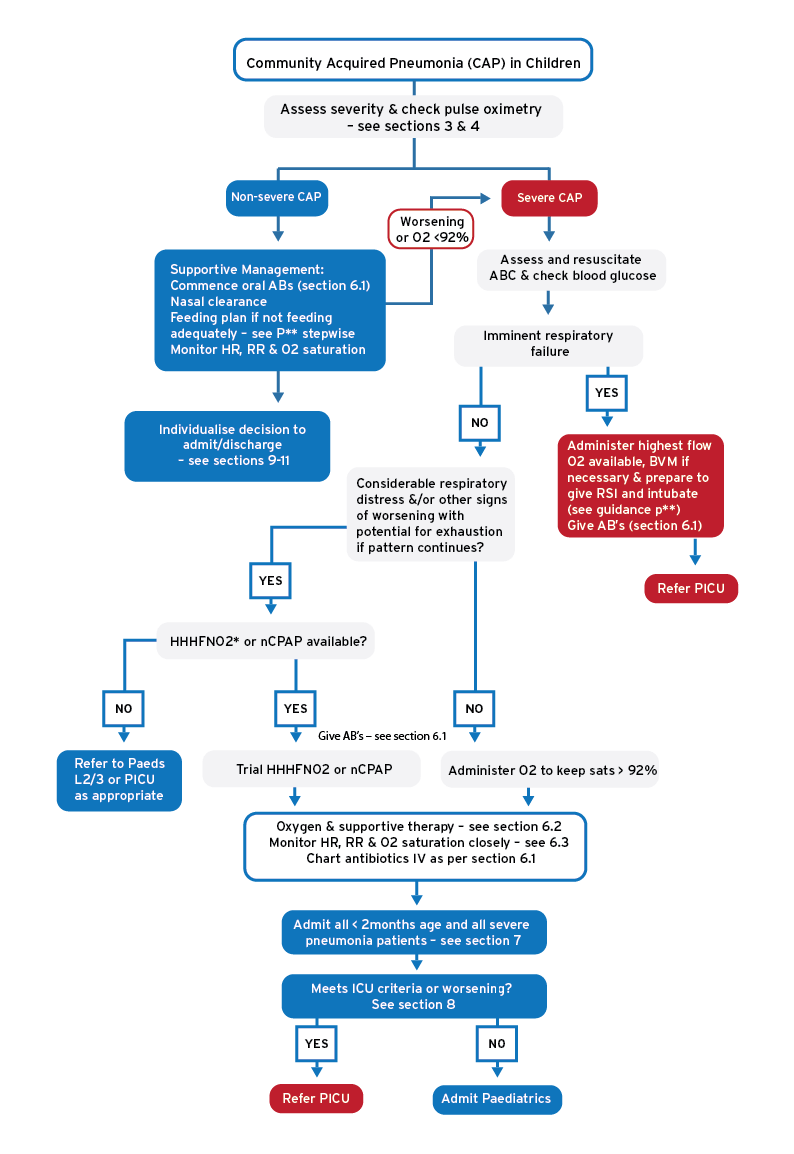
Click on image to enlarge
Introduction
CAP is a common manifestation of acute (<14 days) lower respiratory tract infection (LRTI) in previously well children. It must be promptly recognized and treated to prevent morbidity and mortality.
Streptococcus pneumonia is the most important bacterial pathogen in CAP at all ages. Viral LRTIs are most common in young children, but mixed viral-bacterial infections are also common, particularly in HIV infected children. Despite successful vaccines, antibiotics are recommended for all children with CAP until more data becomes available
Clinical presentation
WHO definition | Cough or difficulty breathing with Tachypnea NOTE: Tachypnea is the most sensitive and specific sign of radiologically confirmed pneumonia in children | RR > 60 bpm in < 2 months RR > 50 bpm in 2 – 12 months RR > 40 bpm in 1 – 5 years RR > 20 bpm in > 5 years |
| Beware | Children at Higher Risk of Severity & Complications (= low threshold for admission) | |
| Infants < 3 months Immunosuppression / HIV Malnutrition Not immunised | Chronic lung disease (CF, prematurity, HIV) Neuromuscular disorders Previous/recurrent episodes Prior antibiotic therapy | |
| Consider | Differential Diagnosis | |
| Upper airway obstruction/infection Lower airway obstruction Aspiration | Cardiac cause Metabolic acidosis Acute chest syndrome (Sickle cell anaemia) | |
Examination
NON-SEVERE PNEUMONIA | SEVERE PNEUMONIA | |
| LOOK FOR CLINICAL SIGNS of Respiratory Distress | Tachypnea NO Lower chest wall indrawing and NO oxygen requirement | Tachypnea WITH Lower chest wall indrawing OR WITH oxygen requirement |
| Other signs of severe respiratory distress include: grunting, nasal flare, use of auxiliary muscles, head nodding, central cyanosis, inability to feed, poor capillary refill time, impaired consciousness (20to hypoxia) | ||
DO PULSE OXIMETRY in ALL | Start O2 if saturation < 92% in room air If the child needs oxygen therapy, manage as severe pneumonia Assess need for ventilatory support Hypoxaemia is the clinical sign that most directly relates to severity of CAP Wheeze is an indication of airway disease and not usually a feature of bacterial pneumonia | |
Investigations
NON-SEVERE PNEUMONIA | SEVERE PNEUMONIA | |
| Blood investigations | None indicated routinely. FBC, CRP, Blood culture not indicated unless suspected risk factors or complications | IV access; FBC + Differential count, Blood culture, CRP, Glucose and Electrolytes Consider arterial blood gas. Give 1st dose of IV/IM Antibiotic (based on age and most likely pathogen- see below) |
| Imaging (CXR) | CXR does not need to be done routinely. Order CXR if: Clinical pneumonia does not respond to outpatient management PTB or foreign body aspiration are suspected Patient needing hospitalisation | Do CXR to assess severity of disease and detect complications |
- No combination of clinical signs, radiological findings, or host-responsive markers can reliably differentiate bacterial from viral pneumonia
- Fever is a common manifestation of pneumonia but is non-specific and variable
- Tachypnea is the most sensitive and specific sign of radiographically confirmed pneumonia in children
- Bacteria are generally only found on blood culture in < 5% of cases; with a higher yield of 13-26% in children with severe pneumonia
- Acute phase reactants like WCC and CRP do not reliably distinguish between viral and bacterial pneumonia
- Routine CXRs are not essential to confirm suspected CAP in children who are well enough to be treated as outpatients, but is strongly recommended for children with severe respiratory distress
- CXRs do not discriminate between bacterial and viral pneumonia; however consolidation is reliable and reasonably specific for bacterial pneumonia.
- CXRs should be considered in children presenting with high fever and no obvious focus of infection.
Differentiating Bacterial From Viral Pneumonia
It is almost impossible to reliably differentiate bacterial from viral LRTI – neither lab nor radiology investigations can accurately distinguish.
Therefore clinical judgement & a pragmatic approach is needed.
Below is some further information and helpful tips:
- Blood cultures
- Bacteria are generally only found on blood culture in < 5% of cases; with a higher yield of 13-26% in children with severe pneumonia.
- Blood cultures should not be routinely obtained in non-toxic, fully immunized children with CAP; but should be obtained in children with severe disease and those who fail to demonstrate clinical improvement or who deteriorate after initiation of AB.
- Acute phase reactants
- WCC, CRP, ESR and pro-calcitonin do not reliably distinguish between viral & bacterial pneumonia & can’t be used as sole determinants to distinguish between viral & bacterial causes
- These tests should not be done routinely except in patients with more serious disease and those with pneumonia-associated complications
- Radiology
- Routine CXRs are not essential to confirm suspected CAP in children who are well enough to be treated as outpatients, but is strongly recommended for children with severe respiratory distress
- CXRs do not discriminate between bacterial and viral pneumonia; however consolidation is reliable and reasonably specific for bacterial pneumonia.
- CXRs should be considered in children presenting with high fever and no obvious focus of infection.
Management
- Treatment is started empirically on best guess aetiology.
- Many cases of pneumonia can be treated with oral antibiotics from the start or can be changed from IV to oral as soon as there is definite improvement.
- Theoretically, antibiotics should only be given to children with bacterial CAP. However, differentiating viral from bacterial cases, especially in younger patients, is very difficult.
| ANTIBIOTICS | NON-SEVERE PNEUMONIA | SEVERE PNEUMONIA |
0-2 months | Recommended hospitalisation for all children < 2 months of age | Recommended: IV ampicillin 50mg/kg/dose 6hly + gentamycin 7.5 mg/kg/loading dose, then 5 mg/kg/dose once daily or ceftriaxone 50mg/kg/day or cefotaxime 50 mg/kg/dose 8hly |
>2 months to 5 years | Amoxicillin 30 mg/kg/dose 8hly PO for 5-7 days (High dose) | Recommended: IV ampicillin 50 mg/kg/dose 6hly for 5 -7 days [Consider admitting on high dose PO amoxicillin if not severely ill] Alternatives: IV cefuroxime (50 mg/kg/dose 8hly) or amoxicillin-clavulanic acid or cefotaxime/ceftriaxone *add cloxacillin 25-50 mg/kg/dose 6hly if suspected Staph. aureus *add macrolide if suspected mycoplasma or chlamydia |
>5 years | Amoxicillin 30 mg/kg/dose 8hly PO for 5 days OR macrolide PO if suspected Mycoplasma pneumoniae (erythromycin 10mg/kg/dose 6hly for 10-14 days) or clarithromycin/azithromycin | |
Additional notes on antibiotic treatment | *Add Gentamycin to all hospitalised children known with HIV infection, or suspected HIV, or severe malnutrition. Change to 2nd or 3rd line Cephalosporin if no response after 72 hrs. *Add Cotrimoxazole (10mg/kg IV load then 5mg/kg/dose IV qid) if PCP is suspected in an HIV exposed child < 1 year or known HIV infection not on PCP prophylaxis and ART. Consider oral treatment (double IV dose) if not severely ill. *Add a Macrolide (Erythromycin 10mg/kg/dose qid) in children aged 1-3 months if suspected Bordetella Pertussis. | |
- Treatment is started empirically on best guess etiology.
- Many cases of pneumonia can be treated with oral antibiotics from the start or can be changed from IV to oral as soon as definite improvement.
- Theoretically, antibiotics should only be given to children with bacterial CAP. However, differentiating viral from bacterial cases, especially in younger patients, is very difficult.
SUPPORTIVE TREATMENT
Oxygen Therapy
- Nasal prongs are recommended at a flow rate of 2L/min (1L/min in infants) which would provide approx. 28%-35% inspired oxygen (FiO2).
- Simple facemask (FM) oxygen can deliver 30-50% at flow rate 6-10L/min only IF FM IS TIGHT FITTING
- Venturi mask system typically delivers 28-40-% FiO2 depending on the flow rate and FM fitting
- Non-rebreather(NRB) FM (reservoir + one-way flow valve) can deliver FiO2 of upto 90% WITH TIGHT FM
- O2 should be discontinued when the child is improving clinically & saturations remain > 92% in room air.
Feeding & IV fluid therapy – see Stepwise assisted feeding for children with respiratory distress
- Encourage children to eat and drink normally.
- Enteral feeds through a nasogastric tube should be started if the child is too distressed to feed.
- Intravenous fluids are only required in children who are severely ill; use cautiously.
- Electrolytes should be measured as the syndrome of inappropriate antidiuretic hormone secretion (SIADH) is common. Restrict IV fluids to 40-60% of normal requirements after correction of hypovolaemia. If hyponatraemia is a problem, fluids containing half normal saline should be used.
Antipyretics & Analgesia
Paracetamol (15mg/kg/dose) or Ibuprofen (0.5mg/kg/dose) for fever or pleuritic chest pain.
MONITORING
- The frequency of monitoring will depend on the child’s condition.
- Children on oxygen therapy should have observations done 4 hourly including temperature, pulse, respiratory rate and patterns, and oxygen saturation.
Failure to improve after 48 hrs of treatment should prompt a review of therapy & a search for complications.
It is important to consider whether the child:
- is receiving the prescribed antibiotics
- is tolerating the treatment e.g. vomiting
- has dual pathology or pathogens
- has a resistant organism has developed a complication of the disease (para-pneumonic effusion, empyema, lung abscess, necrotising pneumonia or distal disease secondary to bacteraemia)
Criteria or hospital admission
All infants < 2 months
Children older than 2 months with:
- Signs of severe pneumonia
- Inability to feed or drink
- Cyanosis or hypoxia requiring O2 to maintain saturations > 92%
- Impaired level of consciousness
- Severe malnutrition
- Failure to respond to outpatient care or clinical deterioration on treatment
Indications for admission to intensive care (PICU)
- Failure to maintain saturations of >92% on FiO2 of ≥70% i.e. partial or full non-rebreather facemask (NRB FM) – if no NRB FM’s then administer highest FiO2 possible – see oxygen administration above
- Apnoea (not history alone – ongoing likelihood of apnoea and/or marked distress)
- Hypercarbia with resulting acidaemia (pH <7.25)
- Exhaustion (clinical judgment)
NOTE:
Heated humidified high flow nasal cannula oxygen (HHHFNO2) therapy or nCPAP may improve ventilation without need for full intubation.
If available trial these first (unless apnoea, gasping or imminent respiratory failure).
Discharge criteria
- Child drinking well
- Saturations > 92% in room air and has not required O2 for the last 6 hours
- Tolerating oral medication
Discharge advice
- Hand washing is an important measure to prevent pneumonia in children
- Immunisations should be kept up to date
- Continue breastfeeding
- Return to health facility if worsening of respiratory distress, unable to feed, or vomiting medicine
Follow up CXRs
Are of no value after an acute uncomplicated pneumonia if the patient is asymptomatic.
Should be done (4-6 weeks after discharge) if:
- Lobar collapse
- To document resolution of a round pneumonia (as this may mimic the appearance of a Ghon focus)
- Ongoing respiratory symptoms
Predominant causes of CAP by age group
< 2 months | >2 months to 5 years | >5 years |
| Bacteria Gram-negative bacteria Group B streptococcus Staphylococcus aureus Atypical bacteria Chlamydia trachomatis Viruses RSV, Influenza, Parainfluenza, Rhino, Adeno, Human metapneumovirus | Bacteria Streptococcus pneumonia Haemophilus influenza Staphylococcus aureus Mycobacterium tuberculosis Viruses RSV, Influenza, Parainfluenza, Rhino, Adeno, Human metapneumovirus | As for >2 months to 5 years age group Atypical bacteria Mycoplasma pneumoniae Chlamydia pneumoniae |
| Additional Pathogens in HIV INFECTED Children | ||
| Bacteria Klebsiella pneumoniae Escherichia coli Streptococcus milleri Non-typhoid salmonella Mycobacterium tuberculosis | Fungi Pneumocystis jiroveci (< 1 year) Candida species | Viruses Cytomegalovirus Varicella zoster |
References
- Zar HJ, Jeena P, Argent A, Gie R, Madhi SA and the members of the Working Groups of the Paediatric Assembly of the South African Thoracic Society. Diagnosis and Management of Community-Acquired Pneumonia in Childhood – South African Thoracic Society Guidelines. SAMJ 2005;95(12):977-990
- Harris M, Clark J, Coote N, et al. British Thoracic Society for the management of community acquired pneumonia in children: update 2011. Thorax 2011; 66:ii1-ii23. doi:10.1136/thoraxjnl-2011-200598
- Bradley JS, Byington CL, Shah SS, Alverson B, Carter ER, Harrison C, Kaplan SL, Mace SE, McCracken Jr GH, Moore MR, St Peter SD, Stockwell JA, Swanson JT. The management of Community-Acquired Pneumonia in Infants and Children Older than 3 months of age: Clinical Practice Guidelines by the Paediatric Infectious Diseases Society and the Infectious Diseases Society of America. Clinical Infectious Diseases 2011;53(7):e25-e76
- Esposito S, Cohen R, Domingo RC et al. Do we know when, what and for how long to treat? Antibiotic therapy for paediatric community-acquired pneumonia. Pediatr Infect Dis J 2012; 00:e78-85
- Zar HJ, Gray DM. Community-acquired pneumonia in HIV-infected children: a global perspective. Curr Opin Pulm Med 2010; 16:208-216
- Cohen A. Difficulty Breathing in Infants and Young Children: An Update. Pediatric Emergency Medicine Practice 2011;8(7):1-28
- Choi J. Common Paediatric Respiratory Emergencies. Emerg Med Clin N Am 2012;30:529-563
- Inpatient Oxygen Therapy. American Thoracic Society. http://www.thoracic.org/copd-guidelines/for-health-professionals/exacerbation/inpatient-oxygen-therapy/oxygen-delivery-methods.php