Croup
Treatment guideline for paediatric croup
Summary algorithm
Introduction
Clinical presentation
Clinical features and severity classification
Differential diagnosis
Investigations
Management
Admission/Referral criteria
Croup advice for caregivers
Summary algorithm
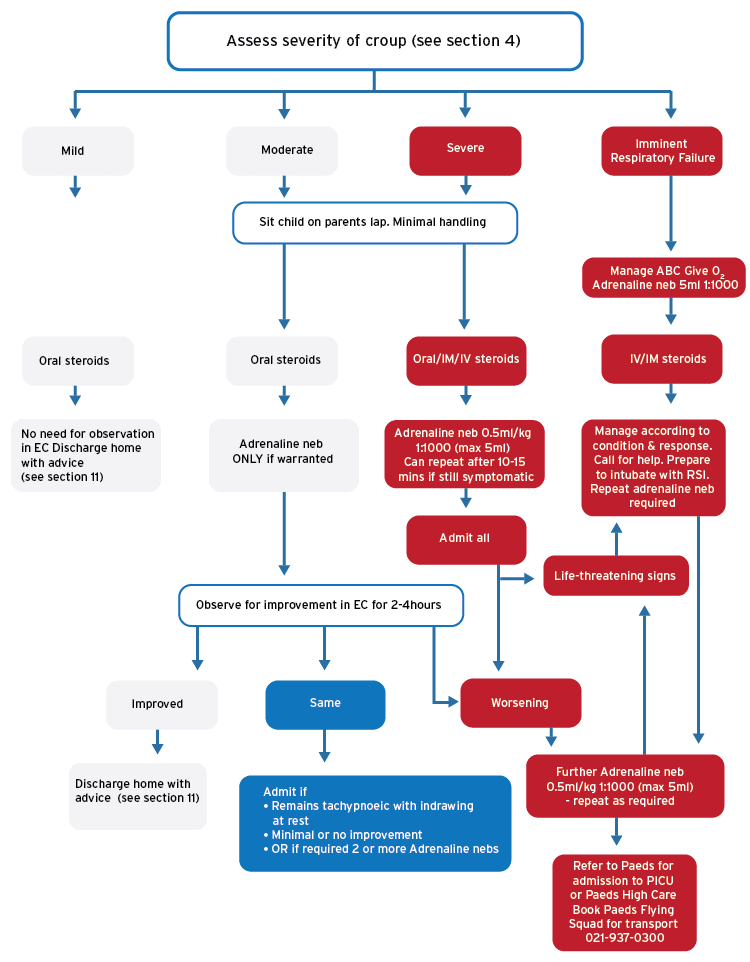
Click on image to enlarge
Follow severe or life-threatening guidance if worsening AT ANY TIME.
Introduction
Croup as is a viral infection primarily affecting the larynx, trachea and bronchi. Inflammation and oedema result in narrowing of the trachea and larynx. Young infants are most severely affected because they have smaller airways and any narrowing leads to a significantly greater increase in resistance to airflow. The noisy breathing associated with croup (stridor) is due to turbulent airflow through the narrowed airways. The commonest cause is Parainfluenza virus type 1. Symptoms usually resolves spontaneously in 48 hrs. Rarely severe obstruction leads to respiratory failure.
Clinical presentation
- Onset can be either sudden (often at night) or may occur after short period of coryza. The main features are: barky cough, hoarse voice, noisy breathing, there maybe associated é work of breathing (WOB). The stridor and é WOB are worse when the child is crying, upset or active.
NOTE: the severity of clinical signs may decrease as child fatigues due to poor respiratory effort.
Clinical features and severity classification
(From: Croup in children. Bjornson CL, Johnson DW. CMAJ, October 15,2013, 185(15), 1317-1323)
- Mild
- Barky cough: occasional
- Stridor: none to limited at rest
- Indrawing (suprasternal and/or intercostal): none to mild
- Moderate
- Barky cough: frequent
- Stridor: easily audible at rest
- Indrawing (suprasternal and/or intercostal): visible at rest
- Distress or agitation: none to limited
- Severe
- Barky cough: frequent
- Stridor: prominent inspiratory and occasionally expiratory
- Indrawing (suprasternal and/or intercostal): marked or severe
- Distress or agitation: substantial
- Lethargy may be present
- Impending respiratory failure
- Barky cough: often not prominent because of fatigue
- Stridor: audible at rest, but may be quiet or hard to hear
- Indrawing: may not be marked
- Lethargy or decreased level of consciousness
- Dusky or cyanotic without supplemental oxygen
Differential Diagnosis
- Acute foreign body (FB) aspiration – sudden onset of coughing or choking, usually a young infant or toddler, often occurs during play or eating (especially nuts or seeds).
- Acute anaphylaxis – may follow allergen ingestion (e.g. nuts, egg) or bite/sting.
- Bacterial upper airway infections (e.g. epiglottitis, bacterial tracheitis) – sudden onset, toxic appearance, high fever, drooling, tripod posture.
Investigations
- NONE Croup is a clinical diagnosis and no confirmatory investigations are required.
- If FB aspiration is suspected – CXR may help to identify radio-opaque FB’s and/or show associated features e.g. segmental hyperinflation or lobar collapse
Management – manage according to severity
Glucocorticoids are the mainstay of croup treatment as they reduce airway inflammation and oedema in a sustained manner. A single dose of dexamethasone is adequate. If the child has severe obstruction nebulised adrenaline can be used for a rapid reduction in airway oedema – however the effects wear off over a few hours and airway narrowing can recur. Excessive adrenaline nebulisation has the potential to cause marked tachycardia, hypertension and arrhythmias.
Initial Approach:
Whenever possible (severity permitting) adopt a minimally invasive HANDS OFF APPROACH – as this allows for the best initial assessment. Children with croup can have a very different appearance if allowed to settle for a few minutes.
- If possible allow child to remain on carers lap – DO NOT FORCE THE CHILD TO LIE DOWN
- Do not examine the throat – this can lead to complete airway obstruction
- If severe signs give facemask O2 – can be ‘blow-by’– do not force if doing so worsens obstruction.
If severe distress at rest or impending respiratory failure give
nebulised adrenaline 0.5ml/kg of 1:1000 IV solution (max. 5ml) and steroids
MILD CROUP:
- Oral dexamethasone 0.15mg/kg single dose
- If no dexamethasone – give oral Prednisolone 1-2mg/kg (repeat dose after 24hrs)
- No adrenaline nebulisation or observation in ED needed ® home with advice below
MODERATE CROUP:
- Oral dexamethasone 0.6mg/kg single dose
- If no oral dexamethasone use IV dexamethasone solution orally
- If no dexamethasone – give oral Prednisolone 1-2mg/kg (repeat dose after 24hrs)
- Adrenaline nebulisation is not usually needed – but can given as above if required
SEVERE CROUP:
Adrenaline:
- Nebulised adrenaline 0.5ml/kg of 1:1000 solution (max. 5ml)
- Can repeat every 10-15mins
- Caution with excessive adrenaline nebulisation – see *below
Steroids:
- Give a single dose of dexamethasone 0.6mg/kg – via Oral, IM or IV route
- If no oral Dexamethasone can use IV dexamethasone solution orally
- If no Dexamethasone– give oral prednisolone 1-2mg/kg (repeat dose after 24hrs)
IMPENDING RESPIRATORY FAILURE:
Assess ABC and manage according to resuscitation guidelines
Adrenaline:
- Nebulised adrenaline 0.5ml/kg of 1:1000 solution (max. 5ml)
- May be given continuously if the child is in extreme distress - monitor child closely
- *Need to balance airway benefit v CVS risk associated excessive adrenaline administration:
- Potential for arrhythmia, #BP & myocardial infarction with repeated/continuous nebulisation
- If the child develops extreme tachycardia - slow or pause adrenaline nebulisation
- Consider intubation – ideally by anaesthetist using gaseous induction
Steroids:
- Give a single dose of dexamethasone 0.6mg/kg – via IM or IV route
Admission/Referral criteria
IMPENDING RESPIRATORY FAILURE and SEVERE CROUP:
- If improving after adrenaline nebulisation, admit ALL to paediatric ward.
- If not improving after several adrenaline nebulisations or deteriorating:
- Transfer to PICU/high-care – discuss further management with referral centre/paediatrics
- Consider intubation ideally by anaesthetist /gaseous induction
MODERATE CROUP:
- If did not require adrenaline nebulisation stay for 2-3 hours of observation.
- If required adrenaline nebulisation stay for minimum 4 hours of observation after neb
- If improves & remains stable during observation period – can go home with advice (see section 11)
- If worsens and requires further adrenaline nebulisation - admit to paediatric ward or PICU/high care
MILD CROUP:
- Discharge home after dose of steroid with advice as in section 11.
Croup Advice for caregivers
- Advise to return if there is é WOB or noisy breathing – especially when child is at rest.
- Explain that some noisy breathing/mild increase work breathing are to be expected when the child is active, crying or upset. If signs not severe, they can try calm the child to see if the symptoms settle.
- If using prednisolone – provide a repeat dose to be taken at home 24hrs after 1st dose.
- Advise paracetamol 15mg/kg 6 hourly prn for fever or analgesia (as the cough can be painful).
References
- Croup in children. Bjornson CL, Johnson DW. CMAJ, October 15,2013, 185(15), 1317-1323.
- Croup. Johnson DW. BMJ Clinical Evidence 2014;09:321: 1-29.
- Pharmacologic and supportive interventions for croup. Woods CR. UpToDate Jan 30, 2014.