Crush Injury and/or Open fractures (Acute Traumatic Ischemias)
Crush Injury and/or Open fractures (Acute Traumatic Ischemias)
Objectives
Diagnosis
Criteria for HBO therapy
Work-up considerations
Treatment
Suggested treatment threshold
ICD 10 codes
Level of evidence
Objectives
Minimise tissue loss, improve functional recovery and reduce the need for repetitive surgery by mitigating the primary and secondary effects of injury via hyperoxygenation. Reducing oedema through HBO induced vasoconstriction. Stimulating fibroblast function, neutrophil oxidative killing, osteoclast and osteoblast activity. Antagonising ischemia-reperfusion injury.
Diagnosis
Injury to tissue which leads to a vicious circle of hypoxia, edema & ischemia and increasing pressure in a confined space impairing the blood flow and function of tissues. Usually seen with trauma but also after ischemic reperfusion injuries, burns and prolonged compression of a limb (i.e. toxic coma). Some surgical interventions like bone nailing may decrease vascularisation and increase formation of edema leading to compartment syndrome. Typically also increased risk of infection.
Criteria for HBO therapy
Crush injuries/acute traumatic ischemias with impending tissue loss, compartment syndrome development and loss of function. Current evidence supports in particular Gustilo 3B or 3C[1] injuries. Less severe injuries should be considered for treatment when host or injury related risk factors are present. Not indicated purely for prophylaxis or treatment of Crush Syndrome.
Work-up considerations
- Patient needs to be referred from or discussed with surgical or orthopaedic specialist.
- Medical history & physical examination.
- Lab work in order – bloods & cultures.
- ECG, where applicable
- X-ray’s – chest (where indicated) & affected soft tissue.
- Wound Photography (consented).
- Compartment pressures, if available.
- Transcutaneous oxygen measurements, where possible.
- Optimal stabilisation & maintenance of medical treatment i.e. IVI fluids, analgesia, appropriate IVI antibiotics, urinary catheter, NG tube, central lines, blood glucose control, etc.
- Timing of HBOT: As soon as reasonably possible after resuscitation and initial surgical management of any open wounds and fractures. The greatest benefit is probably associated with commencement within 24 hours of injury.
- Consider emergency myringotomies or placement of ventilation tubes with initial surgery, where applicable.
- Avoid petroleum based dressings or ointments.
- Signed informed consent for HBOT.
Treatment
- HBO at 2.0 - 2.4 ATA usually, (but up to 2.8 ATA acceptable) for 90 minutes. Consider 2.5 ATA if ischemia-reperfusion injury is present, with two 5 – 10 minute air breaks. If patient experiences any signs or symptoms due to central nervous system oxygen toxicity, consider treating patient at 2.0 ATA or give 10 min air breaks. Look for predisposing factors and try to limit or control as best possible.
- HBO Treatment schedule: First treatment ASAP, then ideally q8hrly for the 1st 48 hours, followed by q12hrly sessions for 72 hours.
- Transcutaneous oximetry measurements (TcPO2) monitoring under pressure is advised as this has predictive value in some situations.
Suggested treatment threshold
3 – 14 treatments, until adequate clinical response, till tissue injury is stabilised or to the point of tissue demarcation
ICD 10 codes
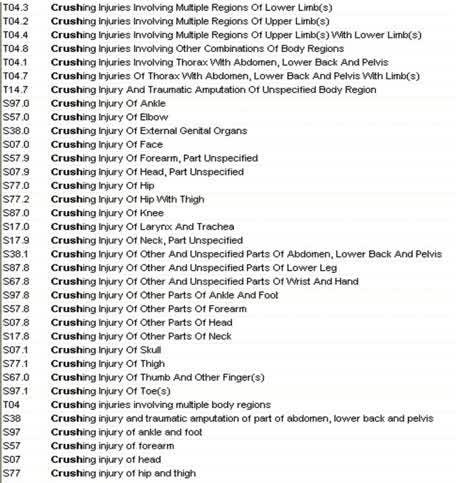
Level of evidence
Level B
Injury to tissue which leads to a vicious circle of hypoxia, edema & ischemia and increasing pressure in a confined space impairing the blood flow and function of tissues. Usually seen with trauma but also after ischemic reperfusion injuries, burns and prolonged compression of a limb (i.e. toxic coma). Some surgical interventions like bone nailing may decrease vascularisation and increase formation of edema leading to compartment syndrome. Typically also increased risk of infection.
Gustilo Classification:
Type | Mechanism | Outcome | Infection rate | Amputation rate |
| I | Small open wound < 1 cm | Usually no different from a closed fracture | Minimal | |
| II | Large laceration with minimal soft tissue damage | Usually no different from a closed fracture | 3% | |
| III | Crush Injuries: | Depends on subtype | ||
| A | Sufficient soft tissue to close wound (1°or 2°) | Complication rate < 10% | 4% | 0% |
| B | Flaps or grafts needed for coverage | > 50% incidence of complications | 52% | 16% |
| C | Major vascular injury | > 50% incidence of complications | 42% | 42% |